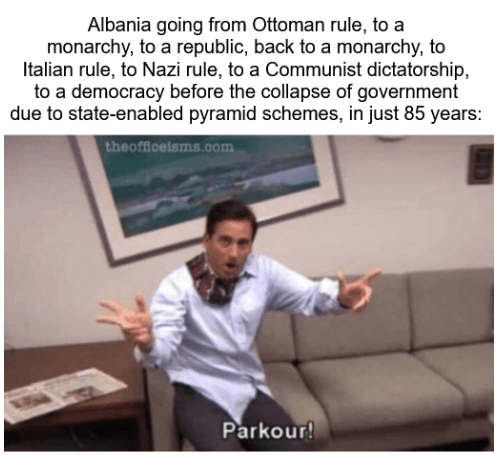
Context: Albania was a part of the Ottoman Empire from the late 15th century until a declaration of independence in 1912. Independence came with no real institutions and tribal/religious divisions, which the Great Powers of Europe sought to solve by installing a German, Prince Wilhelm of Wied, as monarch in 1914. This lasted about 6 months, with internal revolts and the outbreak of War One forcing the royal family to flee. With no monarch, the country quickly fell to Serbian, Greek, Italian and Austro-Hungarian occupation until a unified state was reestablished in 1920. For the first half of the 20s, this state was in perpetual chaos, until Ahmet Zogu was declared president of the republic in 1925. Three years later, Zogu declared himself King Zog I, establishing a new monarchy which ruled until the Italian invasion in 1939. Italy controlled Albania until the collapse of the Fascist regime in 1943, at which point the Nazis stepped in to administer a brutal occupation which spawned multiple resistance movements. There was now a combined resistance movement and civil war, with each faction aiming both to drive out the Nazis and seize power for themselves. By late 1944 the Nazis were forced to abandon Albania and the Communist faction emerged victorious in the civil war, crushing opposition before forming a single-party Communist state in 1946. This increasingly isolationist, brutally repressive and ideologically unyielding regime ruled Albania for 45 years, first falling out with Yugoslavia for not being Communist enough, then falling out with the USSR for denouncing Stalinism, then falling out with the Chinese after Dengist reforms. From 1978 onwards, Albania was alone, with no allies, run by an increasingly paranoid Enver Hoxha who kept the borders sealed, banned any outside culture, and poured a huge amount of money into constructing hundreds of thousands of concrete bunkers and pill-boxes for a war with Yugoslavia that was never coming. Hoxha died in 1985, and his successor Ramiz Alia tried to very cautiously liberalise, until the regime kind of gradually wound down and eventually elections were held in 1991. With that, democracy was back, but with little stability and rampant corruption. Albania was capitalist now, and 45 years of hardline Stalinist policy meant that there were essentially no checks and balances on financial institutions in place. In came the investment firms, which offered wild returns on investments to an economically illiterate populace desperate for income. What people didn’t realise is that these firms weren’t genuine businesses, but were simply Ponzi schemes paying old investors with the new investors’ money. By early 1997, some firms were no longer able to pay out, and the schemes quickly collapsed wiping out over half of Albania’s GDP in a matter of weeks. What began as protests against the government snowballed into an uprising, the government lost control of most of the country, and the army fractured with armed groups ruling most cities. Thousands died, tens of thousands left the country, and a UN mission had to be formed to enter Albania, restore order, and hold new elections.
DrHolmes52 on
Albania speed running government blackout bingo.
TheHistoryMaster2520 on
And within that communist dictatorship, Albania’s leader Enver Hoxha switched allegiance three times
Krashlia2 on
He’s a kid now.
He’s a squid now.
He’s a kid now.
He’s a squid now.
He’s a kid now.
He’s a squid now.
He’s a kid now.
He’s a squid now.
He’s a kid now.
He’s a squid now.
He’s a kid now.
He’s a squid now.
TiberiusGemellus on
My grandmother lived from 1929 to 2024 when she sadly passed. The things she saw in Albania during those decades. From Zog all the way down to Rama’s authoritarian leanings in the span of 95 years.

5 Comments
Context: Albania was a part of the Ottoman Empire from the late 15th century until a declaration of independence in 1912. Independence came with no real institutions and tribal/religious divisions, which the Great Powers of Europe sought to solve by installing a German, Prince Wilhelm of Wied, as monarch in 1914. This lasted about 6 months, with internal revolts and the outbreak of War One forcing the royal family to flee. With no monarch, the country quickly fell to Serbian, Greek, Italian and Austro-Hungarian occupation until a unified state was reestablished in 1920. For the first half of the 20s, this state was in perpetual chaos, until Ahmet Zogu was declared president of the republic in 1925. Three years later, Zogu declared himself King Zog I, establishing a new monarchy which ruled until the Italian invasion in 1939. Italy controlled Albania until the collapse of the Fascist regime in 1943, at which point the Nazis stepped in to administer a brutal occupation which spawned multiple resistance movements. There was now a combined resistance movement and civil war, with each faction aiming both to drive out the Nazis and seize power for themselves. By late 1944 the Nazis were forced to abandon Albania and the Communist faction emerged victorious in the civil war, crushing opposition before forming a single-party Communist state in 1946. This increasingly isolationist, brutally repressive and ideologically unyielding regime ruled Albania for 45 years, first falling out with Yugoslavia for not being Communist enough, then falling out with the USSR for denouncing Stalinism, then falling out with the Chinese after Dengist reforms. From 1978 onwards, Albania was alone, with no allies, run by an increasingly paranoid Enver Hoxha who kept the borders sealed, banned any outside culture, and poured a huge amount of money into constructing hundreds of thousands of concrete bunkers and pill-boxes for a war with Yugoslavia that was never coming. Hoxha died in 1985, and his successor Ramiz Alia tried to very cautiously liberalise, until the regime kind of gradually wound down and eventually elections were held in 1991. With that, democracy was back, but with little stability and rampant corruption. Albania was capitalist now, and 45 years of hardline Stalinist policy meant that there were essentially no checks and balances on financial institutions in place. In came the investment firms, which offered wild returns on investments to an economically illiterate populace desperate for income. What people didn’t realise is that these firms weren’t genuine businesses, but were simply Ponzi schemes paying old investors with the new investors’ money. By early 1997, some firms were no longer able to pay out, and the schemes quickly collapsed wiping out over half of Albania’s GDP in a matter of weeks. What began as protests against the government snowballed into an uprising, the government lost control of most of the country, and the army fractured with armed groups ruling most cities. Thousands died, tens of thousands left the country, and a UN mission had to be formed to enter Albania, restore order, and hold new elections.
Albania speed running government blackout bingo.
And within that communist dictatorship, Albania’s leader Enver Hoxha switched allegiance three times
He’s a kid now.
He’s a squid now.
He’s a kid now.
He’s a squid now.
He’s a kid now.
He’s a squid now.
He’s a kid now.
He’s a squid now.
He’s a kid now.
He’s a squid now.
He’s a kid now.
He’s a squid now.
My grandmother lived from 1929 to 2024 when she sadly passed. The things she saw in Albania during those decades. From Zog all the way down to Rama’s authoritarian leanings in the span of 95 years.