
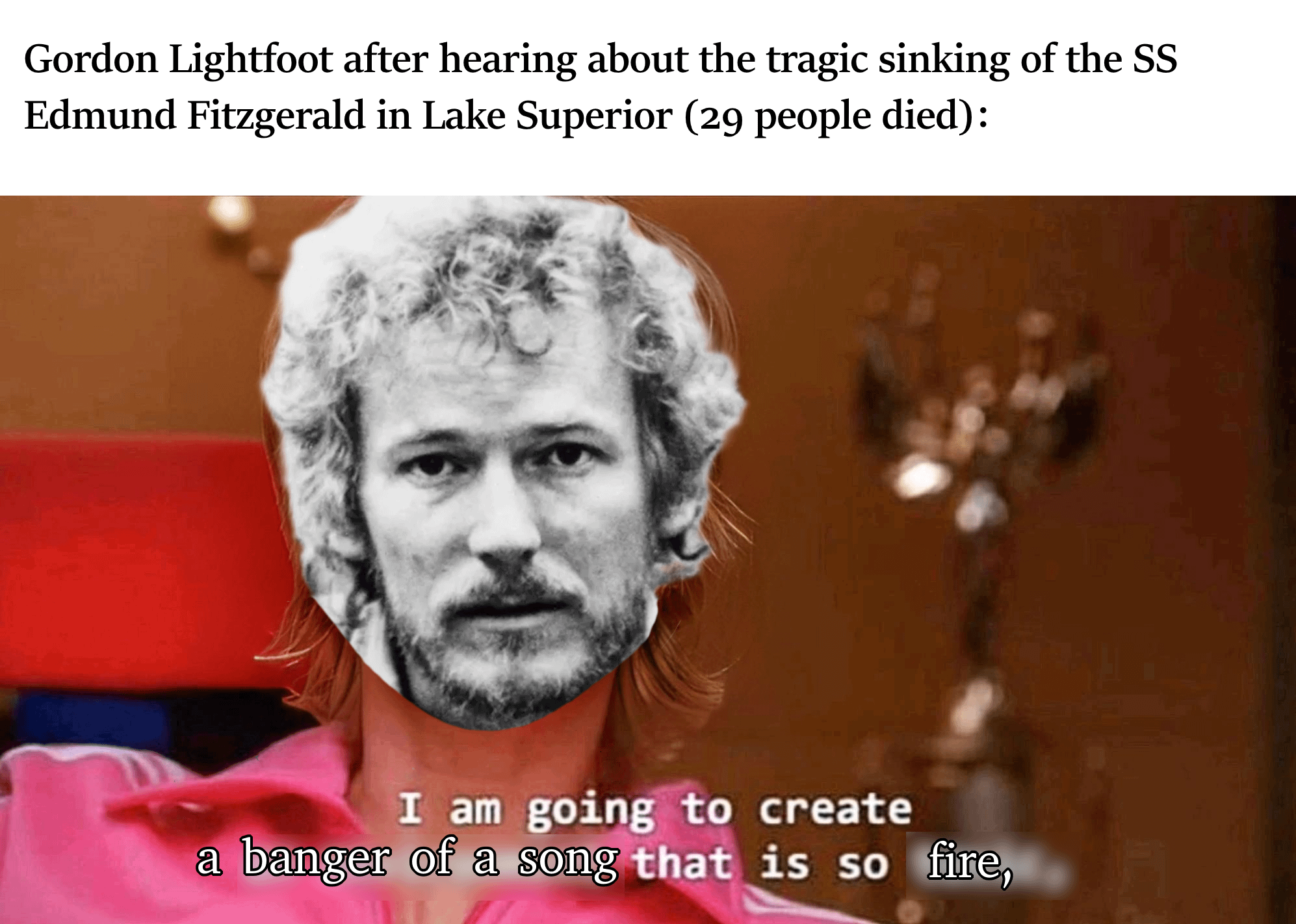
Context:
This was partially inspired by the news that the song recently hit no. 1 this year nearly 50 years after the sinking of the SS Edmund Fitzgerald.
But before we get to the song, a quick rundown on the Edmund Fitzgerald so you have a bit of an idea about the events that inspired the hit tune:
- Named after the chairman of the same name, the S.S. Edmund Fitzgerald dates back to the late 50s, the carrier’s first voyage being September 24th, 1958 where it would transport taconite ore to the various ports across the Great Lakes for over 17 years.
- Those lakes, for the record? Very dangerous. Lake Michigan often gets the title of “Most Dangerous Lake in North America™” but Lake Superior is pretty scary in its own right. It’s the largest lake in North America, it’s very deep – over 720 feet at its deepest point – the weather is fickle on the best of days and can change rather abruptly, not to mention the waves can get up to 30 feet though it’s more common to see waves of a slightly less terrifying 20 feet.
- Most important of all, it is incredibly cold; the average temperature for the lake is 4 degrees Celsius (39 Fahrenheit). To put it mildly, the lake has claimed both sailors and casual swimmers alike, and retrieval for person and vessel alike is notoriously difficult as a result of those low temps.
- Put another way, crossing Lake Superior can be dangerous for even the most seasoned crews and the Edmund Fitzgerald was certainly not the first ship to go down in Superior. The S.S. Kamloops, another ship that sank to the bottom of the lake, was considered a ghost ship due to its disappearance in 1926 until its wreckage was discovered 50 years after its final trip.
- As for the Edmund Fitzgerald, on November 10, 1975, the ship left a port in Wisconsin helmed by esteemed captain Ernest M. McSorley; the vessel was headed for Detroit with its usual tons of taconite to be processed.
- A storm was forecast to pass over the lake that day and the National Weather Service even issued gale warnings for Superior. The seas were notably rough that night and while there were other vessels that managed to weather the storm such as the SS Arthur M. Anderson, the carrier sank to the bottom of Superior with no distress signal ever received; the ship’s last ever communication was Captain McSorley saying “we are holding our own” at 7:10 P.M.
- The specific cause for the sinking remains speculative but what we do know is there were no survivors amongst the 29 crew members. None of their bodies were found, in part due to the aforementioned coldness of the lake. As the song goes, Superior never gives up her dead.
The sinking of the Edmund Fitzgerald really deserves a post in its own right to do it justice given what we do know about it but it’s one I feel needs to be done respectfully given the tragedy of the whole event. If there can be said any good came out of this, it's that it did lead to reform regarding regulations for vessels across the Great Lakes but it’s yet another example of our safety rails oft being written in blood.
As for the song, despite it being released a year after the sinking of the SS Edmund Fitzgerald, Gordon Lightfoot started recording it a month the sinking occurred, in December 1975 after he had read an article about its sinking in Newsweek called “Great Lakes: The Cruelest Month”. The article also has a section dedicated to the “legend of the Chippewa”, aka. the Ojibwe people, in case you’ve ever wondered where that word in the song comes from; according to the article the Ojibwe said the lake never gives up her dead.
The article in question piqued hiscuriosity but ultimately was, in his own words "too short, too brief" and Lightfoot "didn’t want it to be forgotten".
The story of the sinking of the Fitzgerald stayed with me in a funny kind of a way, all by itself. I wasn't forgetting about it. I knew everyone had forgotten about it, but I knew I hadn't forgotten it.
Unfortunately, the specifics of the wreck were not widely reported on and by Gordon’s own recollection of the song’s creation, he took more than a few creative liberties when it came to the lyrics because there wasn't a lot of details regarding what happened to the Edmund Fitzgerald at the time. He did try to include more details to match the events as we eventually learned more about the tragedy that unfolded, with the song seeing release in 1976.
Surprisingly, there wasn’t any controversy nor criticism about exploitation of a tragedy. For reference, a few decades later would see another boat-related tragedy via the sinking of the Titanic turned into the box office-destroying hit "Titanic". Its production & release drew a bit of controversy for reasons along similar lines [i.e. exploiting a tragedy], not helped by a historical aberration in how they portrayed Officer William Murdoch that caused the filmmakers to apologize for the depiction – but that's a story for another time.
But The Wreck of the Edmund Fitzgerald? If there was any controversy regarding its release, I couldn't find any interviews nor coverage that was overly critical of the song. In fact, the families of those lost in the lake – the ones who’ve made public statements in interviews I could track down anyway – were rather positive about the song.
The niece of wiper Gordon F. MacLellan, Sue Hills, said the following in an interview in 2001:
The song keeps the legend alive. It also tells the story. I have honestly hardly been able to listen to the song all the way through, though. Even 25 years later. Mr. Lightfoot really got to the heart of everything when he wrote that song.
Source: https://ssedmundfitzgerald.org/susan-hills-interview
Meanwhile, the daughter of the ship’s cook Robert Rafferty, Pam Johnson, actually met Gordon Lightfoot! She wasn’t thrilled that people were dancing to the song but didn’t seem to hold any animosity to the song itself or Gordon:
I was really sad and mad when I saw people dancing to it, and when I talked to Gordon Lightfoot, he and I discussed if my father would say those words, and I said, "Yes!"
…
Q: There have been several thousand shipwrecks on the Great Lakes, with a combined death toll of about 30,000 people. Why does the wreck of the Edmund Fitzgerald stand out the most?
A: The wreck stands out the most because of Gordon Lightfoot's song, in my opinion.
Q: The song says, "the legend lives on from the Chippewa on down." Will the legend ever die?
A: I do agree that the legend lives on and I hope it never dies.
Source: https://ssedmundfitzgerald.org/pam-johnson-interview
There’s a couple of historical inaccuracies in the 1976 version but they don’t really affect how well-written the song is or how it more or less immortalizes the victims of the Edmund Fitzgerald’s final voyage in a very respectful manner – and to Lightfoot’s credit he would change the lyrics during live performances as the years went on to better match the known events, even re-recording the song in 1988. The 1988 version, despite being more accurate, isn't as good as the original, mostly due to an overuse of reverb but that's just my opinion.
Gordon Lightfoot was renowned for his storytelling and being one of the all-time greats of singer-songwriters, and The Wreck of the Edmund Fitzgerald is perhaps his magnum opus in a career full of masterpieces. The composition for the 1976 version is outstanding, capturing the chaos that is the stormy waves of Lake Superior and the crew's final moments aboard the ship. It hit #2 on Billboard back in the day (Went to #1 in Canada; this was only a few years after the “MAPL System” was introduced), the album it was on went Platinum and it's one of the best songs to come out of one of the more underappreciated years in music.
When Lightfoot began recording the song, he set out to memorialize the tragedy & history has shown he thoroughly succeeded in that regard. In many ways, the legend of the Edmund Fitzgerald and Gordon Lightfoot became intertwined; Lightfoot attended several 25th anniversary memorials and remained in contact with several of the family members of the deceased. In his own words: "I’ve been carrying this song with me for 25 years. It’s not something you write and then walk away from. By all accounts, the families have praised Gordon for being a standout guy and even gave him a round of applause when they found out he was in attendance of the aforementioned service.
When Gordon Lightfoot passed away a few years ago, the Great Lakes Maritime Academy rang their bell 31 times on the 40th anniversary of the ship's sinking – 29 times for the sailors who died in the tragedy, once for all those who have passed away at sea…and once for Gordon Lightfoot who "wrote the ballad of the ship’s sinking".
Both forever legends that live on.
by CazOnReddit
1 Comment
If only they made whitefish bay