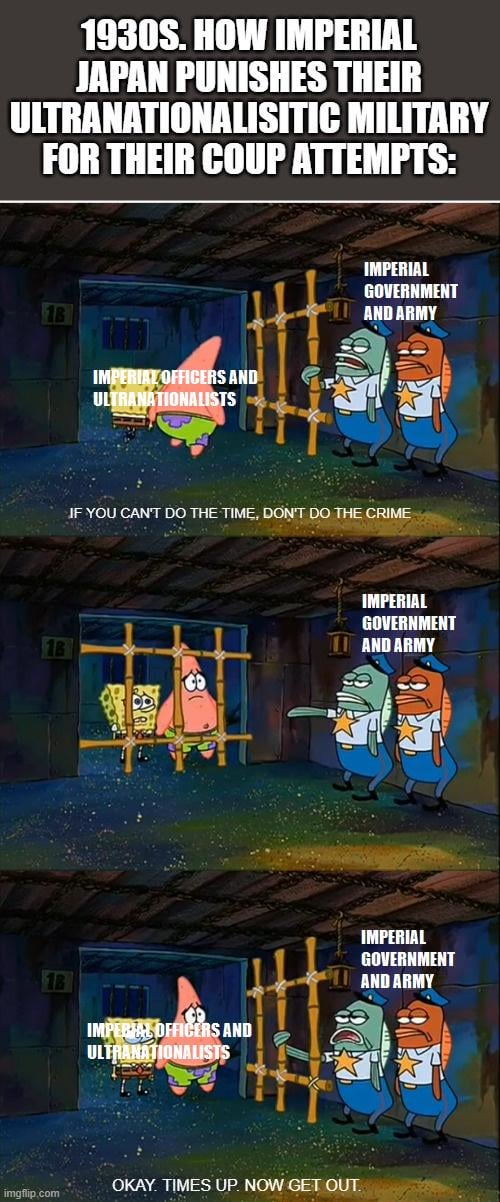
Context: Throughout the Showa Period, the Empire of Japan saw a wave of ultranationalism within society and its military. Besides assassinations of various prime ministers, there were also the various coup attempts by the Imperial Military.
The first one was around the 1930s was in 1931 in March in the aptly named “March Incident.” This was launched by the radical Sakurakai secret society within the Imperial Japanese Army, aided by civilian ultranationalist groups. However they failed to materialize any riot they hoped for, and the leaders were arrested, and the whole affair disintegrated. Ultranationalist Shūmei Ōkawawas sentenced to five years in prison, but served only two years due to intervention from a general. Meanwhile, Kingoro Hashimoto attempted another coup in October in the “Imperial Colors Incident.” All the conspirators were arrested and transferred to other posts.
Then there was the May 15 incident where reactionary members of the Imperial Navy and remnants of the Ultranationist League of Blood. The coup attempt failed after the plotters were turned in. But the punishments for this abortive coup were even milder than for the previously mentioned March Incident, as General Jiro Minami publicly excused the plot as simply an excess of patriotic zeal. Hashimoto was sentenced to 20 days house arrest, Captain Isamu Chō to 10 days and the other ringleaders were simply transferred.
In November of 1934, there was the Military Academy incident, which failed and saw some executions of its conspirators.
However, the biggest and infamous coup attempt during 1930s Japan, was the February 26 Incident. It was organized by a group of young Imperial Japanese Army officers with the goal of purging the government and military leadership of their factional rivals and ideological opponents. This saw assassinations of key political figures, and attempted takeover of the government. However, it wasn’t supported by the rest of the military or the Emperor, which led to the coup to dissolve quickly.
Unlike earlier coup examples, the coup attempt had severe consequences. After a series of closed trials, 19 of the uprising’s leaders were executed for mutiny and another 40 were imprisoned. The radical Kōdōha faction lost its influence within the army. But another consequence was that the military, now free from infighting, increased its control over the civilian government, which had been severely weakened by the assassination of key moderate and liberal-minded leaders.
FaultOutside2449 on
The more you learned about Imperial Japanese history from 1930 to 1945 the more your surprised by how this shitshow of a military was somehow able to fight both America and China at the same time for years. (Still got curb stomp to oblivion but still a little impressive)

2 Comments
Context: Throughout the Showa Period, the Empire of Japan saw a wave of ultranationalism within society and its military. Besides assassinations of various prime ministers, there were also the various coup attempts by the Imperial Military.
The first one was around the 1930s was in 1931 in March in the aptly named “March Incident.” This was launched by the radical Sakurakai secret society within the Imperial Japanese Army, aided by civilian ultranationalist groups. However they failed to materialize any riot they hoped for, and the leaders were arrested, and the whole affair disintegrated. Ultranationalist Shūmei Ōkawawas sentenced to five years in prison, but served only two years due to intervention from a general. Meanwhile, Kingoro Hashimoto attempted another coup in October in the “Imperial Colors Incident.” All the conspirators were arrested and transferred to other posts.
Then there was the May 15 incident where reactionary members of the Imperial Navy and remnants of the Ultranationist League of Blood. The coup attempt failed after the plotters were turned in. But the punishments for this abortive coup were even milder than for the previously mentioned March Incident, as General Jiro Minami publicly excused the plot as simply an excess of patriotic zeal. Hashimoto was sentenced to 20 days house arrest, Captain Isamu Chō to 10 days and the other ringleaders were simply transferred.
In November of 1934, there was the Military Academy incident, which failed and saw some executions of its conspirators.
However, the biggest and infamous coup attempt during 1930s Japan, was the February 26 Incident. It was organized by a group of young Imperial Japanese Army officers with the goal of purging the government and military leadership of their factional rivals and ideological opponents. This saw assassinations of key political figures, and attempted takeover of the government. However, it wasn’t supported by the rest of the military or the Emperor, which led to the coup to dissolve quickly.
Unlike earlier coup examples, the coup attempt had severe consequences. After a series of closed trials, 19 of the uprising’s leaders were executed for mutiny and another 40 were imprisoned. The radical Kōdōha faction lost its influence within the army. But another consequence was that the military, now free from infighting, increased its control over the civilian government, which had been severely weakened by the assassination of key moderate and liberal-minded leaders.
The more you learned about Imperial Japanese history from 1930 to 1945 the more your surprised by how this shitshow of a military was somehow able to fight both America and China at the same time for years. (Still got curb stomp to oblivion but still a little impressive)