
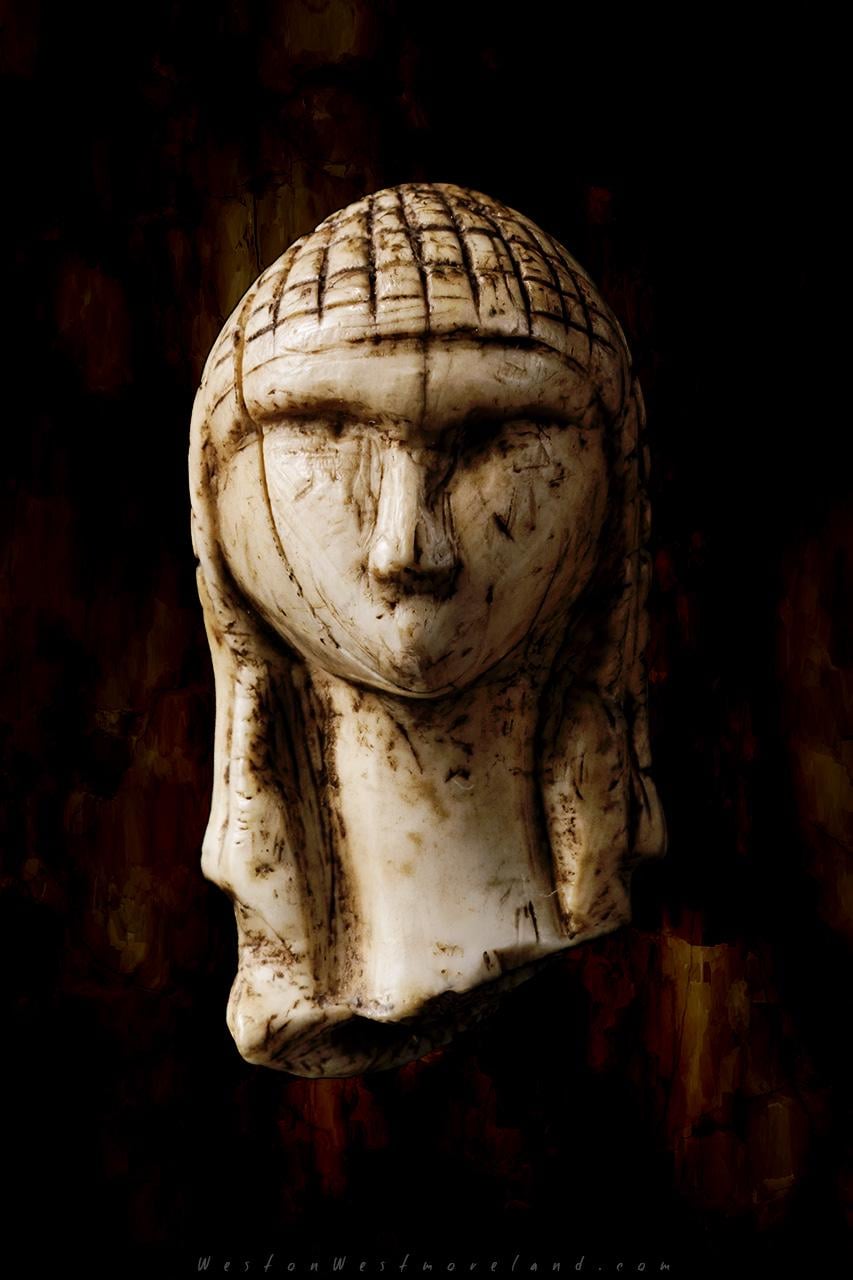
The Lady with the Hood or Venus of Brassempouy (25k YBP), France. This 1,44″ high fragmentary ivory figurine from the Upper Paleolithic was carved from a mammoth tusk. It is one of the oldest busts ever found and one of the earliest known realistic representations of a human face… [1280×853]
by WestonWestmoreland
1 Comment
…The Venus of Brassempouy was discovered in 1894, in a stratum recognized now as Gravettian, accompanied by at least eight other human figures. These may be an example of unfinished work, as if the artist or artists carved several figurines at the same time.
The head is “unsexed, although it is usually called a ‘Venus’ or a ‘lady'”. While the forehead, nose and brows are carved in relief, the mouth is absent. A vertical crack on the right side of the face is a consequence of the internal structure of the ivory. On the head is a checkerboard-like pattern formed by two series of shallow incisions at right angles to each other; it has been interpreted as a wig, a hood with geometric decoration, or simply a representation of hair styled in cornrows
Although the head was discovered so early that its context could not be studied thoroughly, scholars agree that the Venus of Brassempouy belonged to an Upper Paleolithic material culture, the Gravettian (29,000–22,000 BP). More precisely, they date the figurine to the Middle Gravettian period, with “Noailles” burins circa 26,000 to 24,000 BP. It is more or less contemporary with the other Paleolithic Venus figurines, such as those of Lespugue, Dolní Věstonice, Willendorf, etc. Nonetheless, it is distinguished among the group by the realistic character of the representation.
As usual, my apologies for inaccuracies and mistakes.