
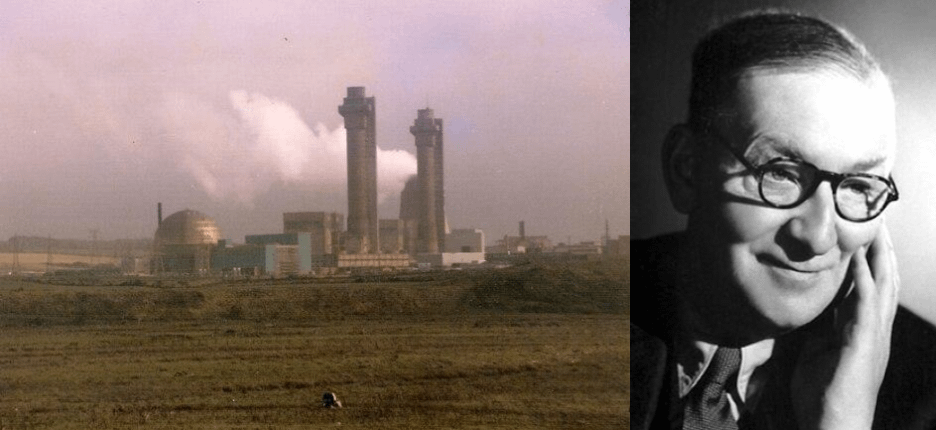
John Cockcroft insisted on installing filters on two Northern England nuclear reactors. They were mocked as a waste of money, until one of the reactors caught fire. The filters caught 95% of the radioactive dust blasted into the air, arguably saving much of England from becoming a nuclear wasteland.
by nuttybudd
13 Comments
Source: https://www.bbc.com/news/uk-england-cumbria-29803990
> They were labelled a waste of time and money, but in 1957 the bulging tips of two exhaust shafts rising above Sellafield arguably saved much of northern England from becoming a nuclear wasteland. The towers of Windscale Piles have been a landmark for decades but soon the last of these Cold War relics will be gone.
> Cumbria’s skyline will change with the removal of the towers – known as Cockcroft’s Follies – but had they not been in place 57 years ago, the entire landscape may have been drastically different.
> Until Chernobyl exploded in 1986, the blaze that ravaged the uranium-fuelled reactor at Windscale Pile One in October 1957 was Europe’s most terrible nuclear disaster. It is still the UK’s worst atomic incident.
> Without the filters – installed at the last minute by Nobel Prize-winning scientist Sir John Cockcroft – the effects of the radioactive dust blasted into the Cumbrian air would have been much more devastating.
> “Radioactive dust did escape, but the filters caught about 95 per cent of it,” says Christopher Cockcroft, Sir John Cockcroft’s son.
> “Had the filters not been there I would think a considerable part of the the Lake District and Cumbria would have been put out of bounds, at least for agricultural use and perhaps for people.”
> They were roundly criticised by the engineers building the nuclear facility.
> Engineers, who had been told by the government to make the UK a nuclear power by 1952, nicknamed the filters Cockcroft’s Follies, mocking them as an expensive piece of pointless delay.
> However, as one of Sir John’s physicists Terence Price said after the fire, “the word folly did not seem appropriate after the accident”.
This is anti-nuclear sensationalism. [https://en.wikipedia.org/wiki/Windscale_fire#Radioactive_release](https://en.wikipedia.org/wiki/Windscale_fire#Radioactive_release)
The filters obviously worked and contained the release, but even without the filters it wouldn’t have turned “much of England into a nuclear wasteland”

What a shit post title, that’s not at all what’s claimed.
This kind of sensationalist anti science garbage needs to be banned.
Nothing a nuclear reactor could ever possibly do would turn the UK into a nuclear wasteland. The worst that would actually happen is the people who refused to take iodine pills would have a higher chance of developing cancer in a few decades.
Fuck you, op.
They called them ‘Cockcroft’s follies’ ffs….
So silly. If they were mocked as a waste of money they wouldn’t have been built.
I’ve worked at Sellafield. The story goes that two old local women on a passing train saw the chimney spewing smoke and one said, “At last after all them years, they’re finally working.”
Cool, so we just get to be the normal wasteland instead.
If they estimate the material escaping to be 1000 times less than Chernobyl and the filters prevented 95% from escaping.
The amount without filters would have been 50 times less than Chernobyl. Given the denser population of the UK, it might have been catastrophic.
If we would have more people like John Cockcroft, there wouldn’t be as much sceptism towards nuclear power.
I recently did a guided tour of Heysham 2, the nuclear power plant near Lancaster and just South of where this one was. One of the guides, Brian, talked about this feature extensively. It was a really good day out. Would recommend
Practically every aspect of the nuclear industry has research and regulation aimed at making things safer, even air filtration. Just a few examples:
[International Society for Nuclear Air Treatment Technologies](https://www.isnatt.org/)
[American Society of Mechanical Engineers Committee on Nuclear Air and Gas Treatment](https://cstools.asme.org/csconnect/CommitteePages.cfm?Committee=O10200000)
[ASME Code on Nuclear Air and Gas Treatment](https://www.asme.org/codes-standards/find-codes-standards/code-on-nuclear-air-and-gas-treatment/2023/pdf)
Current standards generally require HEPA filtration- so at least 99.97% of contaminated dust would be captured.
Instead, much of England is now a standard wasteland.
Plot twist : he caused the fire to prove them wrong.