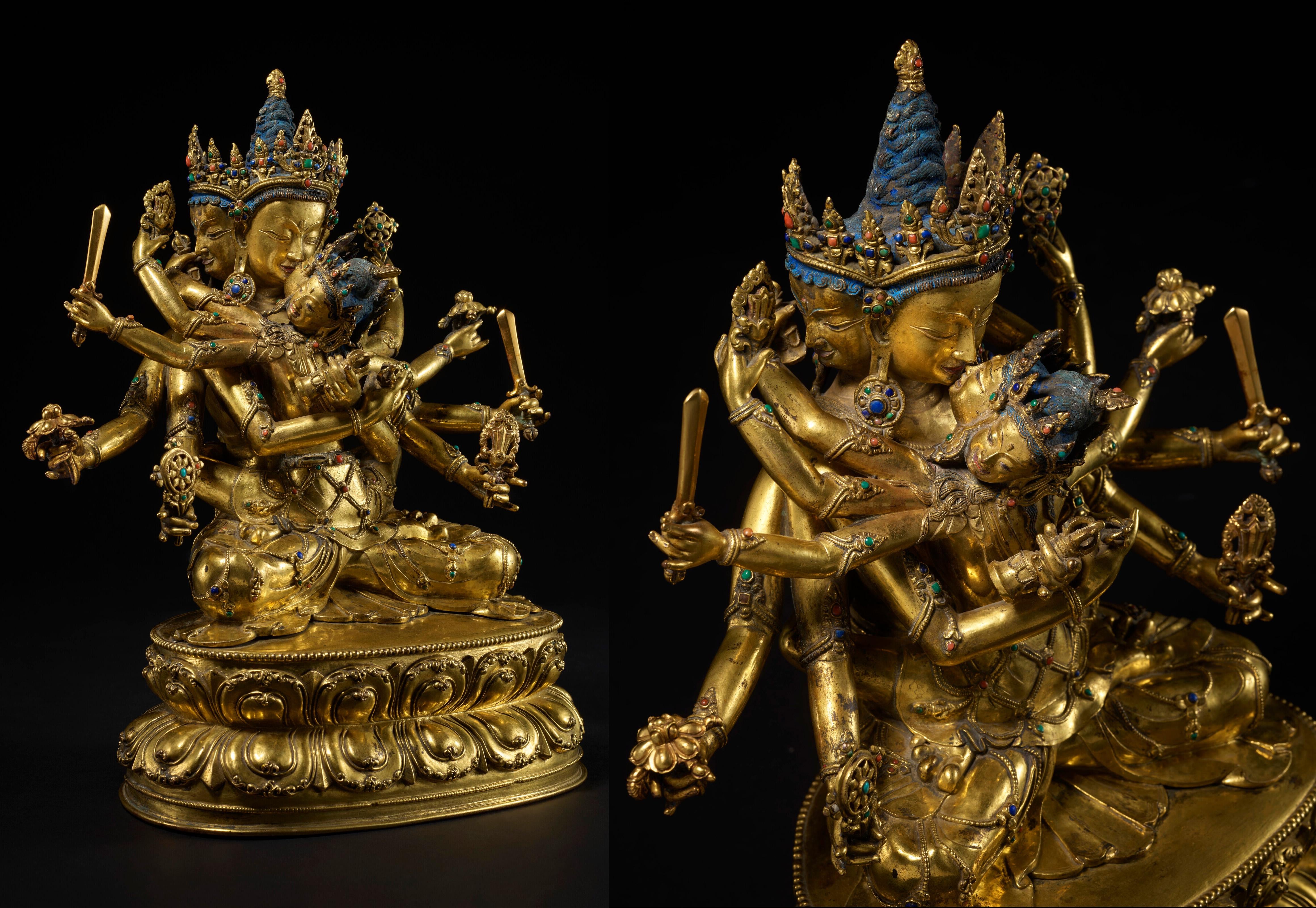
[Christie’s](https://www.christies.com/en/lot/lot-6551903). This exceptional gilt copper alloy sculpture represents one of the highest expressions of artistic and spiritual synthesis in 15th-century Tibetan art. It portrays Akshobhyavajra Guhyasamaja, the unified form of the male deity Akshobhya and his consort Adhiprajna, joined in yab-yum to embody the transcendental union of compassion and wisdom.
The complex iconography is rendered with remarkable precision: Akshobhyavajra has three faces and six arms. His original hands, crossed in vajrahumkara mudra, hold a vajra and ghanta, symbols of method and wisdom, while simultaneously embracing his consort. His remaining hands hold a chakra (wheel), mani (flaming jewel), padma (lotus), and prajna-khadga (sword of wisdom). Adhiprajna mirrors this divine symmetry with her own three faces and six arms, also holding the same attributes in complementary arrangement. The divine couple sits atop a luxurious double-lotus pedestal supporting a complex visual composition that integrates the iconographic principles of the Five Tathagathas.
The high quality and distinct iconographic vocabulary of this work allow it to be confidently attributed to the atelier of Sonam Gyaltsen, one of the foremost Tibetan sculptors active in the Shigatse region of Central Tibet during the second quarter of the 15th century. His workshop flourished under the patronage of the Sakya order and members of the Rinpungpa dynasty (1435–1565), during a period marked by intense religious and artistic production.

2 Comments
[Christie’s](https://www.christies.com/en/lot/lot-6551903). This exceptional gilt copper alloy sculpture represents one of the highest expressions of artistic and spiritual synthesis in 15th-century Tibetan art. It portrays Akshobhyavajra Guhyasamaja, the unified form of the male deity Akshobhya and his consort Adhiprajna, joined in yab-yum to embody the transcendental union of compassion and wisdom.
The complex iconography is rendered with remarkable precision: Akshobhyavajra has three faces and six arms. His original hands, crossed in vajrahumkara mudra, hold a vajra and ghanta, symbols of method and wisdom, while simultaneously embracing his consort. His remaining hands hold a chakra (wheel), mani (flaming jewel), padma (lotus), and prajna-khadga (sword of wisdom). Adhiprajna mirrors this divine symmetry with her own three faces and six arms, also holding the same attributes in complementary arrangement. The divine couple sits atop a luxurious double-lotus pedestal supporting a complex visual composition that integrates the iconographic principles of the Five Tathagathas.
The high quality and distinct iconographic vocabulary of this work allow it to be confidently attributed to the atelier of Sonam Gyaltsen, one of the foremost Tibetan sculptors active in the Shigatse region of Central Tibet during the second quarter of the 15th century. His workshop flourished under the patronage of the Sakya order and members of the Rinpungpa dynasty (1435–1565), during a period marked by intense religious and artistic production.
Cool Sekiro boss