
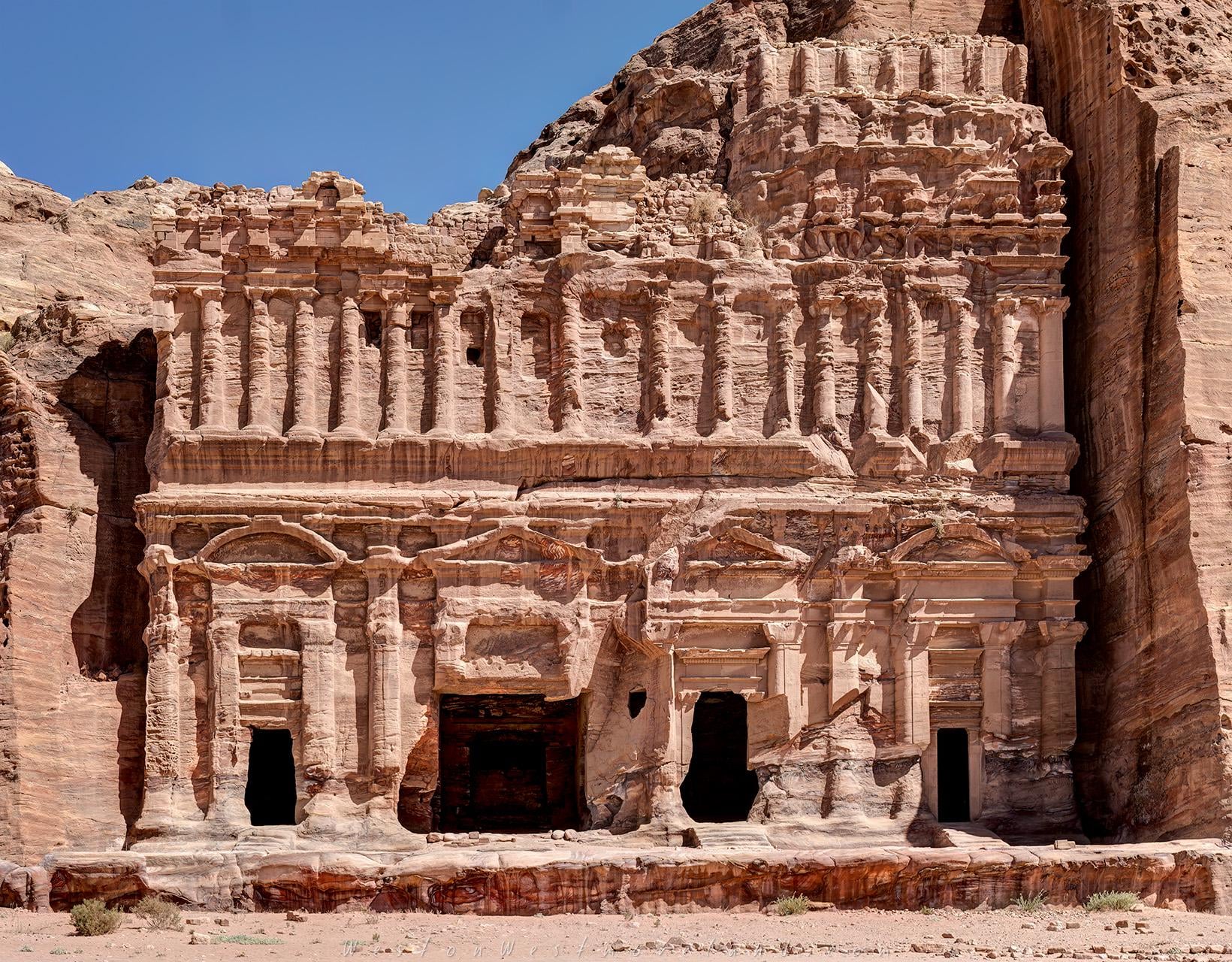
Palace Tomb, Petra, Jordan, 40-70 AD. One of the four “Royal Tombs”, monumental sepulchers carved into the pink sandstone cliff overlooking the city center. Its heavily weathered facade was supposedly designed following the Roman palace design popularized by Nero’s Golden House… [1640×1280] [OC]
by WestonWestmoreland
2 Comments
…which gave the tomb its name together with its wide and richly decorated structure.
Tomb 765 is one of the largest monuments in Petra and one of the few monuments in Petra which mixes carved and built structures. Its five-story façade (about 49 m wide and 46 m high) shows an overwhelming proliferation of architectural elements for purely ornamental purposes, with an intricate presence of pilasters, columns and entablature elements.
The lower order is structured by a total of twelve supports crowned by Nabataean capitals. These narrow pilasters have a quarter column alternatively engaged on one side. The four doorways, approached by steps, have a tall superstructure of entablatures, dwarf pilasters and moldings. This magnifies the decorative effect of the doorway frame, together with the pediments, which are triangular in the Centre, and curved on the sides. The doors lead to four interior chambers. The two central ones are connected by a narrow passage.
The second order consists of 18 half columns with pseudo-ionic capitals (simplified form of a classic Ionic capital). The center bays are wider than the others. Six flat niches in the bays towards the left probably served to contain memorial slabs. The seventh niche from the left has an opening at its base, leading to a vertical shaft behind the facade, which provides access to the cliff above the tomb, where there is a skillfully conceived water collecting system of channels and cisterns.
The eighteen dwarf pilasters of the third order are in alignment with those of the order below. The fourth order is very weathered, and from the topmost order, which is set further back, only seven half columns survive.
A part of the upper facade was built free-standing: On the left side, about a third of the pseudo-ionic entablature has been bricked up using sandstone blocks, supported by vaulting and timber beams. The left two-thirds of the dwarf order above are also masonry-built and similarly would have been the top two orders.
My apologies for inaccuracies and mistakes.
Looking great in the photo.
I do not remember I saw it when I was visiting. And I spent 3 days there.