
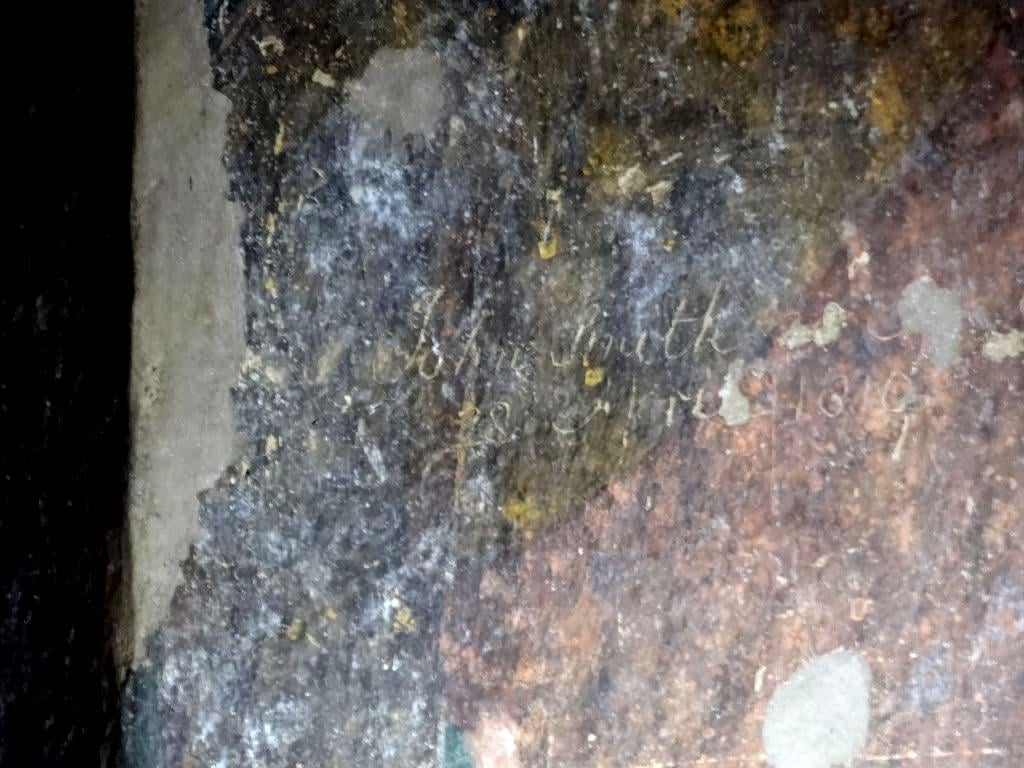
The signature of John Smith, a British cavalry officer who rediscovered the Buddhist Ajanta Caves in India, on one of the caves’ pillars, along with the date, 28 April 1819 [1024×768]
by Antique_Quail7912
The signature of John Smith, a British cavalry officer who rediscovered the Buddhist Ajanta Caves in India, on one of the caves’ pillars, along with the date, 28 April 1819 [1024×768]
by Antique_Quail7912
2 Comments
On 28 April, 1819, a British officer named John Smith, of the 28th Cavalry, while hunting tigers was shown the entrance to Cave No. 10 when a local shepherd boy guided him to the location and the door. The caves were well known by locals already.
Captain Smith went to a nearby village and asked the villagers to come to the site with axes, spears, torches, and drums, to cut down the tangled jungle growth that made entering the cave difficult.
He first saw ceilings with beautiful and artistically drawn faces on them, then he noticed monastic halls which helped him identify their Buddhist origin. He then deliberately damaged an image on the wall by scratching his name and the date over the painting of a bodhisattva. Since he stood on a five-foot high pile of rubble collected over the years, the inscription is well above the eye-level gaze of an adult today.
Too big and heavy to be carried to the British Museum, so he left his mark there.