The letters ανηρπ are relatively uncommon and appear in past forms of the verb “snatched away,” usually said of fate or a god like Hades, who has “snatched away” the deceased. E.g., ἀνήρπασε Μοῖρα, “fate snatched away” the deceased.
The letters ομν might be part of a name like “The**omn**estos” or a word like ὀμνύναι, “to swear.”
The letters παντ are probably part of the word for “all” or “every” (e.g. πάντα).
I think βροτοι[ς should be “(to/for) mortals,” another sign of an inscription talking about gods or death.
εξετε might be part of a word like ἐξετέλεσε indicating who “completed” his life or who “performed” a sacrifice or who “built” the monument.
You should take it to a museum or university with an archeology department and have an expert check it out!

1 Comment
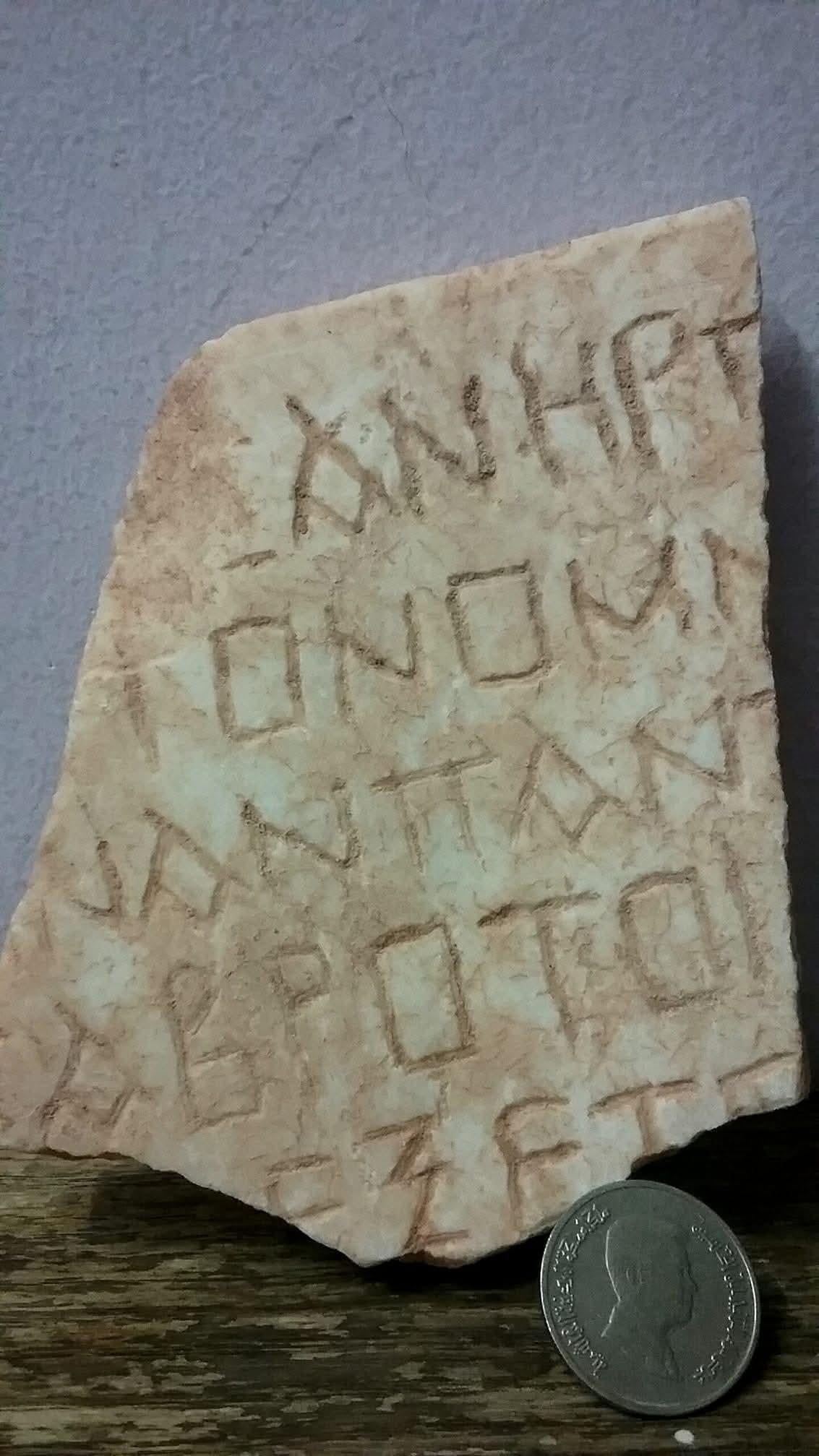
I suspect this is a funerary inscription. Here’s what I think I can read:
]ανηρπ[ασ…?
]τον ομν[
]ναν παντ[
]α βροτοι[ς
]εξετε[
The letters ανηρπ are relatively uncommon and appear in past forms of the verb “snatched away,” usually said of fate or a god like Hades, who has “snatched away” the deceased. E.g., ἀνήρπασε Μοῖρα, “fate snatched away” the deceased.
The letters ομν might be part of a name like “The**omn**estos” or a word like ὀμνύναι, “to swear.”
The letters παντ are probably part of the word for “all” or “every” (e.g. πάντα).
I think βροτοι[ς should be “(to/for) mortals,” another sign of an inscription talking about gods or death.
εξετε might be part of a word like ἐξετέλεσε indicating who “completed” his life or who “performed” a sacrifice or who “built” the monument.
You should take it to a museum or university with an archeology department and have an expert check it out!