
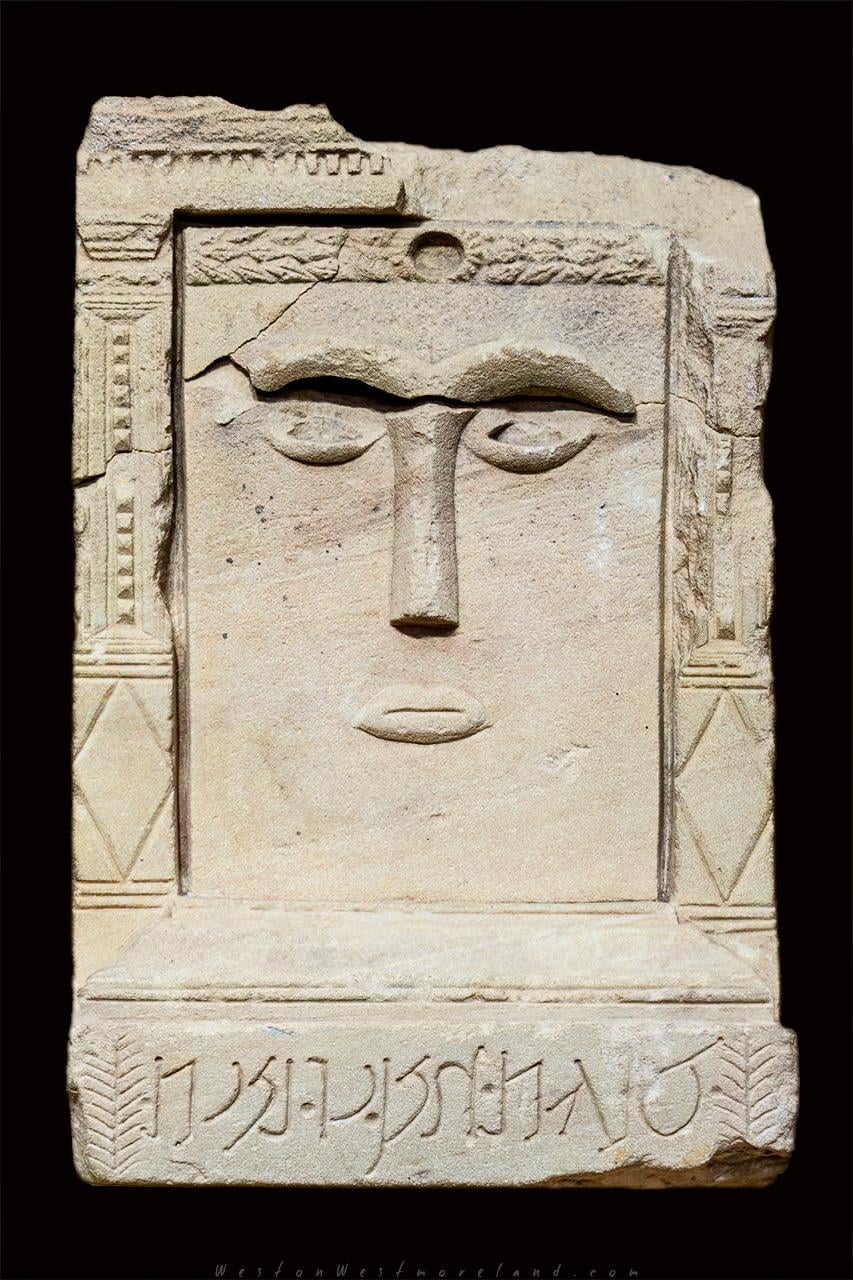
Goddess of Hayyan, Nabatean Kingdom, 1st-2nd century AD, Jordan. This limestone carving is the most human-like example of an eye betyl found in Petra so far. The betyl is not a representation of the God or an idol, but a medium of the presence of the God so it can be venerated… [1280×853] [OC]
by WestonWestmoreland
2 Comments
…Uncovered during excavations at the Temple of the Winged Lions in Petra in 1975, this 12.6 x 7.9 x 4.9 in limestone piece was incorporated into the north wall or to a niche of the temple.
The eyes are almond-shaped, rather than the more common rectangular form. Thick eyebrows, long nose, and mouth lips are all clearly outlined. The head is crowned by a wreath with a round recess in the center, perhaps for a precious stone. The face is framed by decorated columns and a frieze with dentils.
Below the frame there is the Nabataean inscription “Goddess of Hayyan, Son of Nayibat,” with palms or feathers on either side. According to this, it is a votive stele that was probably donated by a private person named Hayyan.
The finding of this stele supports the assumption that the Temple of the Winged Lions was dedicated to one of the main Nabataean female deities, known throughout the region as Allat (the goddess), and referred to in Petra as al-Uzza (the most powerful.) This native goddess was obviously equated with other cosmopolitan deities from the Hellenistic and Roman worlds, such as Isis and Aphrodite. Some scholars believe that the crescent shapes around it indicate that it is a stylized version of the Isis basileion (horn crown), and therefore in connection with the Isis cult. But others call this into question.
As usual, my apologies for inaccuracies and mistakes.
Is this Nabatean script underneath?