
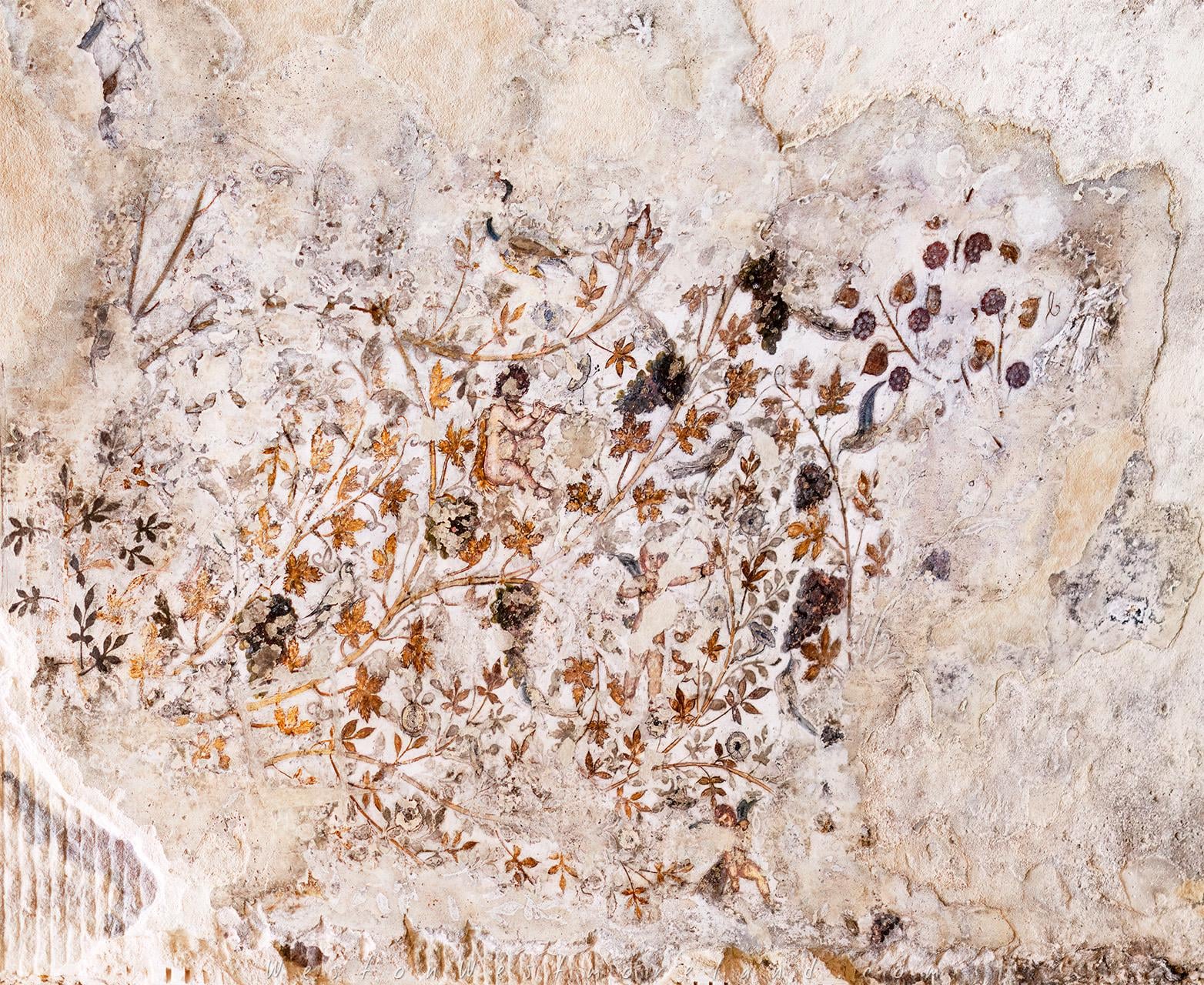
Nabatean frescoes, Little Petra, Jordan, 40 BC – 25 AD. The Hellenistic Alexandrian style painted remains in the arched recess of a chamber known as the “Painted Biclinium” are the most important and largest example of Nabataean mural painting that has survived in situ… [1564×1280] [OC]
by WestonWestmoreland
1 Comment
…The mural depicts a web of intertwined grape and ivy vines, small Cupids (including a flute player and an archer), birds, insects, flowers, fruits, etc., all of which suggest a cult of Dionysus, whom this place apparently was dedicated to.
Investigation during the 2006 – 2010 restoration revealed that lead white, Egyptian blue, copper green, colored minerals and organic dyes were applied to a gypsum-like substrate. Gilding could be proven on individual vine leaves.
Located in the fertile hinterlands 5 miles north of Petra , Little Petra (Siq al-Barid) is a wadi, a narrow river valley that contains water only when heavy rain occurs. It is a rich archaeological site, featuring rock cut tombs, stone-built architecture, and complex hydrological engineering. The landscape preserves evidence of large-scale viticulture and wine making, alongside the cultivation of grains, olives, and other produce.
The Painted Biclinium, a rock-cut dining room, is located on the south side of the Siq al-Barid, surrounded by a series of tombs and banqueting halls cut into the natural sandstone of the wadi, alongside the foundations of freestanding structures, cisterns, and water channels.
The wall paintings offer the most abundant variety of figural painting from the Nabataean period, and may offer clues into the vegetation under cultivation in the area. In addition, the paintings are proof of the importance of Dionysiac religious cult in Nabataea.
As usual, my apologies for inaccuracies and mistakes.