
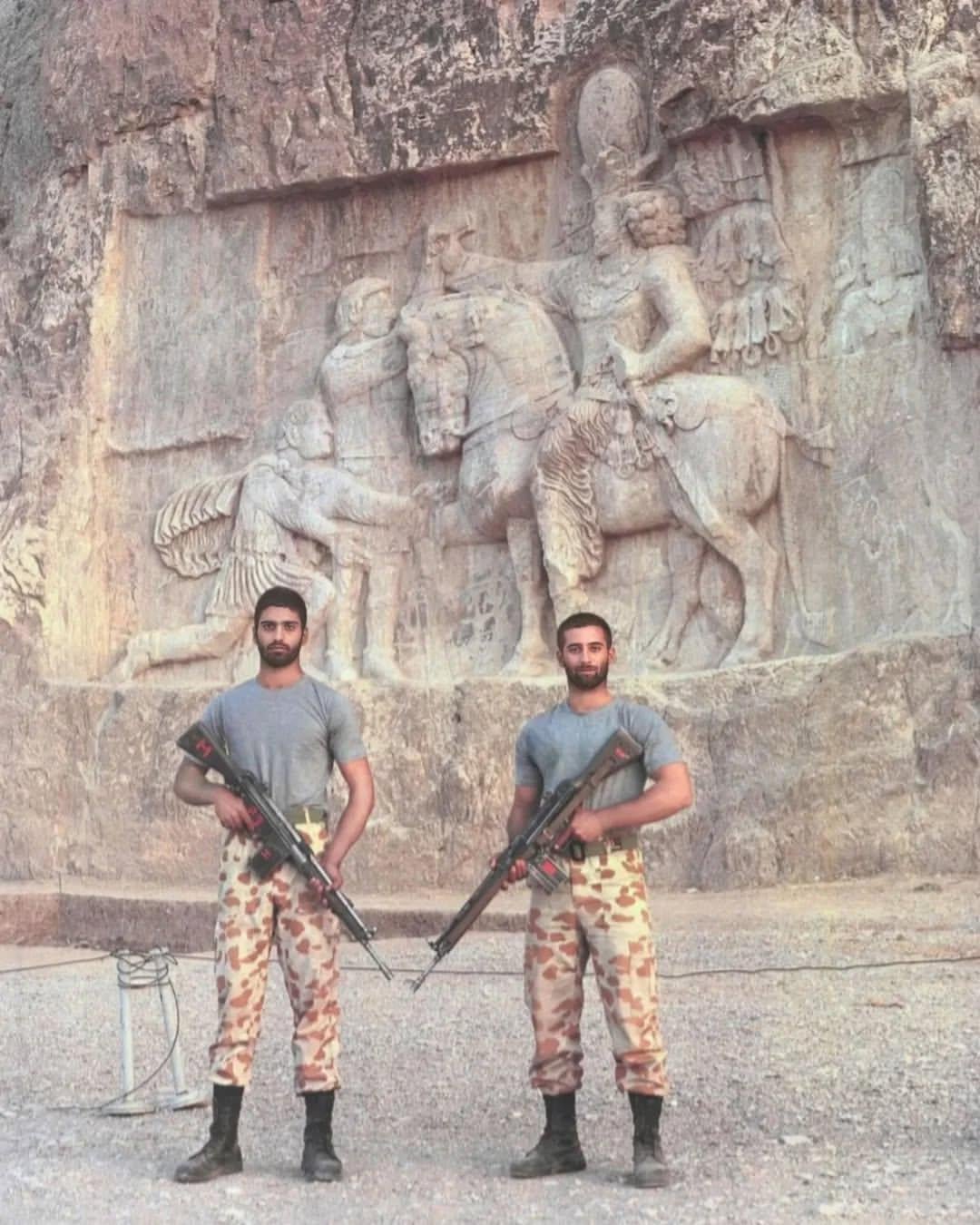
A famous photo of two Persian commandos posing in front of the Persian victory relief over Rome. Valerian kneels before the Persian king at the Battle of Edessa in 260 AD, while Philip I extends his hand, representing the peace treaty he negotiated. From the Army Archives of Iran, 1988. [1350×1080]
by Party_Judgment5780
5 Comments
The photo was taken shortly after the war between Iran and Iraq ended (1980-1988). The two commandos are armed with G3 battle rifles. Shapur I’s victory relief in Naqsh-e Rostam, Iran, is among the most famous and important Sasanian reliefs, commemorating his triumphs over the Roman Empire during the 3rd century AD. Shapur is depicted seated triumphantly on horseback, wearing his royal crown and elaborate Sasanian attire. Beneath him, one of the most striking scenes shows the Roman Emperor Valerian kneeling humbly, symbolizing his historic defeat and capture at the Battle of Edessa in 260 AD — the only time in history that a Roman emperor was taken captive in battle. Valerian’s kneeling posture, with his head lowered and body submissive, emphasizes both his humiliation and Shapur’s dominance.
In another part of the relief, Roman Emperor Philip the Arab is shown extending his hand to Shapur, representing the peace treaty he negotiated in 244 AD following the death of Gordian III, who is depicted as fallen beneath the horse, symbolizing his death in battle. By combining these separate events into one visual narrative, the relief communicates a continuous story of Persian superiority over multiple Roman emperors. The reliefs are highly detailed and well-preserved, showing the armor, clothing, and regalia of both the Persian and Roman figures. Naqsh-e Rostam also includes the tombs of Achaemenid kings Darius the Great, Xerxes I, Artaxerxes I and Darius II, among other works. Here’s the site today:
[https://www.simonnorfolk.com/archaeologies/site-09](https://www.simonnorfolk.com/archaeologies/site-09)
I trust that Valerian was treated as an honored guest on this occasion.
Pic goes hard
I have enough holes for both of them
This was probably *the* most glorious victory of the Sasanian Empire over the Roman Empire. Here’s a beautiful cameo that celebrates the same even ([Wikimedia](https://upload.wikimedia.org/wikipedia/commons/7/7f/Cameo_Shapur_Valerianus_Bab360_CdM_Paris.jpg)).
The Christian polemicist Lactantius describes Valerian’s fate in his *On the Deaths of the Persecutors* (chap. 5):
>2 Hic captus a Persis non modo imperium, quo fuerat insolenter usus, sed etiam libertatem, quam ceteris ademerat, perdidit vixitque in servitute turpissime. 3 Nam rex Persarum Sapor, is qui eum ceperat, si quando libuerat aut vehiculum ascensdere aut equum, inclinare sibi Romanum iubebat ac terga praebere et imposito pede super dorsum eius illud esse verum dicebat exprobrans ei cum risu, non quod in tabulis aut parietibus Romani pingerent. 4 Ita ille dignissime triumphatus aliquamdiu vixit, ut diu barbaris Romanum nomen ludibrio ac derisui esset. 5 Etiam hoc ei accessit ad poenam, quod cum filium haberet imperatorem, captivitatis suae tamen ac servitutis extremae non invenit ultorem nec omnino repetitus est. 6 Postea vero quam pudendam vitam in illo dedecore finivit, derepta est ei cutis et exuta visceribus pellis infecta rubro colore, ut in templo barbarorum deorum ad memoriam clarissimi triumphi poneretur legatisque nostris semper esset ostentui, ne nimium Romani viribus suis fiderent, cum exuvias capti principis apud deos suos cernerent.
I’ll translate since this passage is so entertaining:
>”Having been captured by the Persons, he lost not only the empire, which he had treated insolently, but also the freedom that he had taken away from everyone else, and lived in the basest servitude. Whenever Shapur, the king of the Persians who had captured him, wished to climb into his car or mount his horse, he ordered the Roman to bow down and present his back. And putting his foot onto his back, he would revile him and say with a laugh, “This is true: not what you Romans paint on boards or walls.” And so he lived for some time after his most righteous defeat, so that Roman power was long the object of mockery and derision among the barbarians. And this was added to his punishment: although he had a son who was emperor, he never found in him an avenger of his own captivity and utter slavery. In fact, no attempt was even made to retrieve him. After he had ended his shameful life in disgrace, his skin was torn off and his hide was removed from his innards and dyed red, so that it could be mounted in the temple of the barbarians’ gods to commemorate their most famous triumph and always be displayed to our ambassadors, so that the Romans should not trust too much in their own strength when they beheld the spoils of their captured emperor among their gods.”