
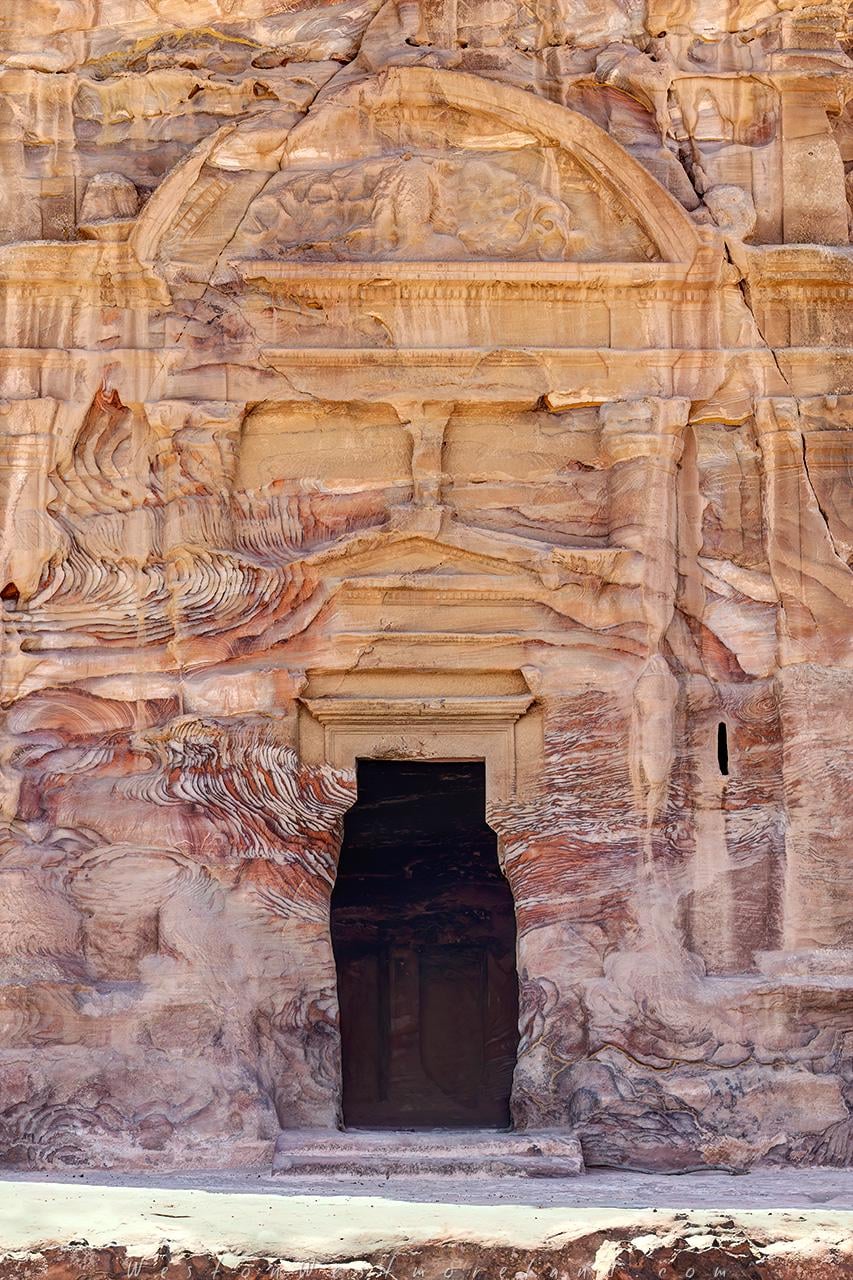
The sand blasted façade of the Nabatean style family tomb of Sextius Florentinus, c. 130 CE. Petra, Jordan. A Roman governor of Arabia Petrea, he likely ruled for just three years before his death. The semi-circular tympanum depicts a woman with vines. Inside are eight graves…[1280×853] [OC]
by WestonWestmoreland
1 Comment
…These tombs were dug out from the soft sandstone mountainsides or, as is the case with this tomb, from huge separate rocks. The structure and colors of the rock strata are simply surreal. No doubt the façades were left unpainted… The centuries of exposure and the softness of the sandstone have turned these façades into amazing abstract creations. It would have been amazing to see a freshly carved tomb, though. One can only wonder…
Petra flourished in the 1st century AD, when the Treasury, possibly the mausoleum of Nabataean king Aretas IV, was constructed, and its population peaked at an estimated 20,000 inhabitants.
Nabataea fell to the Romans in 106 AD, who annexed and renamed it Arabia Petraea. Petra’s importance declined as sea trade routes emerged, and after an earthquake in 363 destroyed many structures, mainly their water conduction system and flood protection structures. In the Byzantine era, several Christian churches were built, but the city continued to decline, and, by the early Islamic era, it was abandoned except for a handful of nomads. It remained unknown to the western world until 1812, when Swiss traveler Johann Ludwig Burckhardt rediscovered it.
As usual, my apologies for inaccuracies and mistakes.