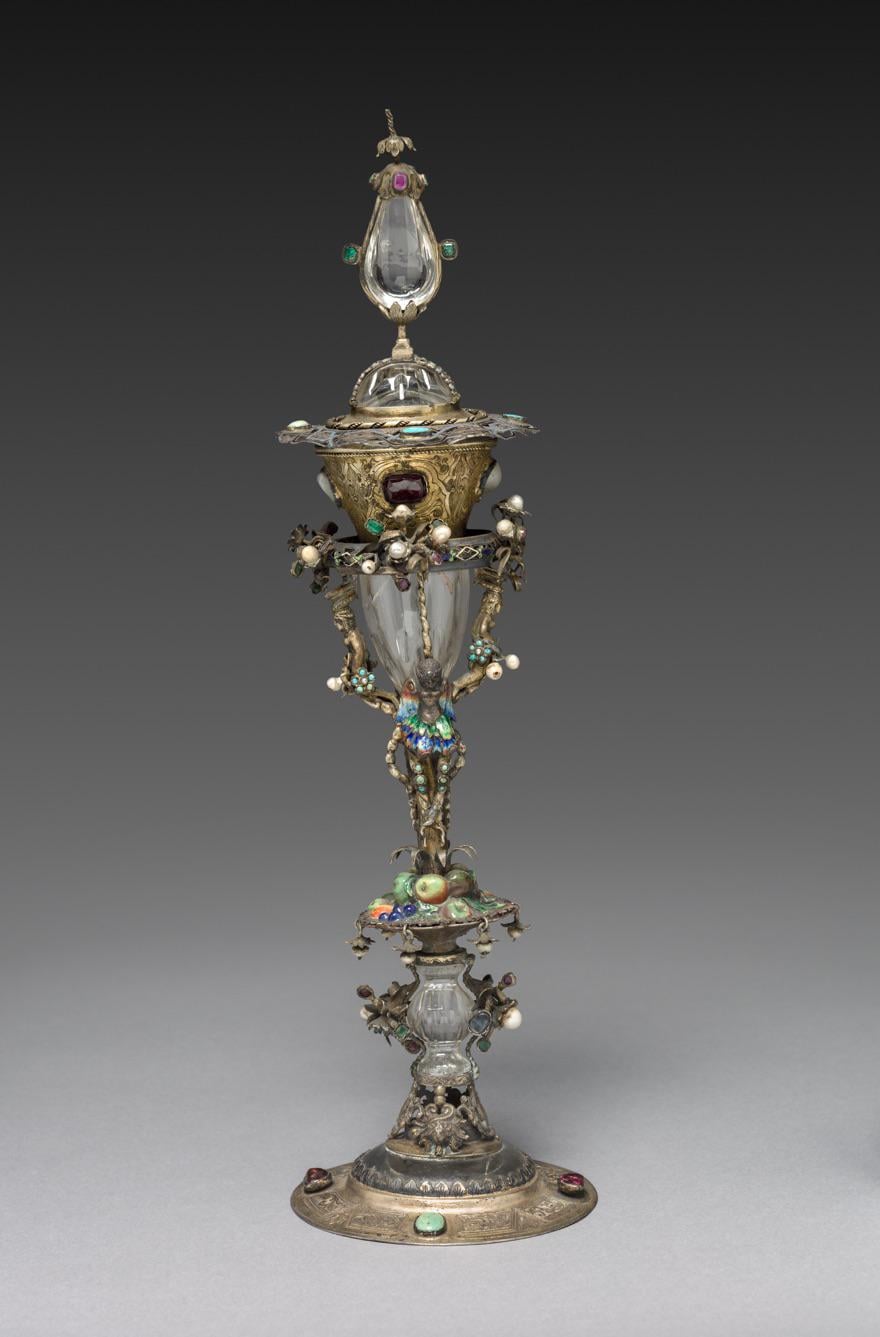
A gilt silver blood [reliquary](https://www.clevelandart.org/art/1950.365) and lid from 16th-century Italy is a vessel used to display a blood relic, and is a significant example of Renaissance-era metalwork and Catholic devotion. The reliquary, with its accompanying lid, is a rare artifact of religious metalwork from the Italian Renaissance.
In the Italian Renaissance, reliquaries were often highly decorative and meant to be viewed by the faithful. Artisans frequently used precious materials like gilt silver to emphasize the sacredness of the contents. Reliquaries were more than just containers; they were intended to present relics “in a vivid and exciting way”.
Some reliquaries took naturalistic forms, appearing to “bring the saint back to life”. While this Cleveland example is not in a figural shape, many others from the same period were.
Such vessels typically featured a glass panel or other means for the relic to be seen by worshippers. During the 16th century, touching or kissing reliquaries was a common practice of religious devotion.
While this specific relic housed in the Cleveland Museum is not explicitly identified, the most famous “blood relic” in Italy is that of St. Januarius (San Gennaro) in Naples. The relic consists of two sealed glass ampoules containing what is said to be the dried blood of St. Januarius. The mythology is that on certain feast days, the dried blood miraculously liquefies, a phenomenon said to be observed since 1389 and housed in a special reliquary in the Cathedral of Naples. This famous example illustrates the intense veneration and public spectacle surrounding blood relics during this period.

1 Comment
A gilt silver blood [reliquary](https://www.clevelandart.org/art/1950.365) and lid from 16th-century Italy is a vessel used to display a blood relic, and is a significant example of Renaissance-era metalwork and Catholic devotion. The reliquary, with its accompanying lid, is a rare artifact of religious metalwork from the Italian Renaissance.
In the Italian Renaissance, reliquaries were often highly decorative and meant to be viewed by the faithful. Artisans frequently used precious materials like gilt silver to emphasize the sacredness of the contents. Reliquaries were more than just containers; they were intended to present relics “in a vivid and exciting way”.
Some reliquaries took naturalistic forms, appearing to “bring the saint back to life”. While this Cleveland example is not in a figural shape, many others from the same period were.
Such vessels typically featured a glass panel or other means for the relic to be seen by worshippers. During the 16th century, touching or kissing reliquaries was a common practice of religious devotion.
While this specific relic housed in the Cleveland Museum is not explicitly identified, the most famous “blood relic” in Italy is that of St. Januarius (San Gennaro) in Naples. The relic consists of two sealed glass ampoules containing what is said to be the dried blood of St. Januarius. The mythology is that on certain feast days, the dried blood miraculously liquefies, a phenomenon said to be observed since 1389 and housed in a special reliquary in the Cathedral of Naples. This famous example illustrates the intense veneration and public spectacle surrounding blood relics during this period.