
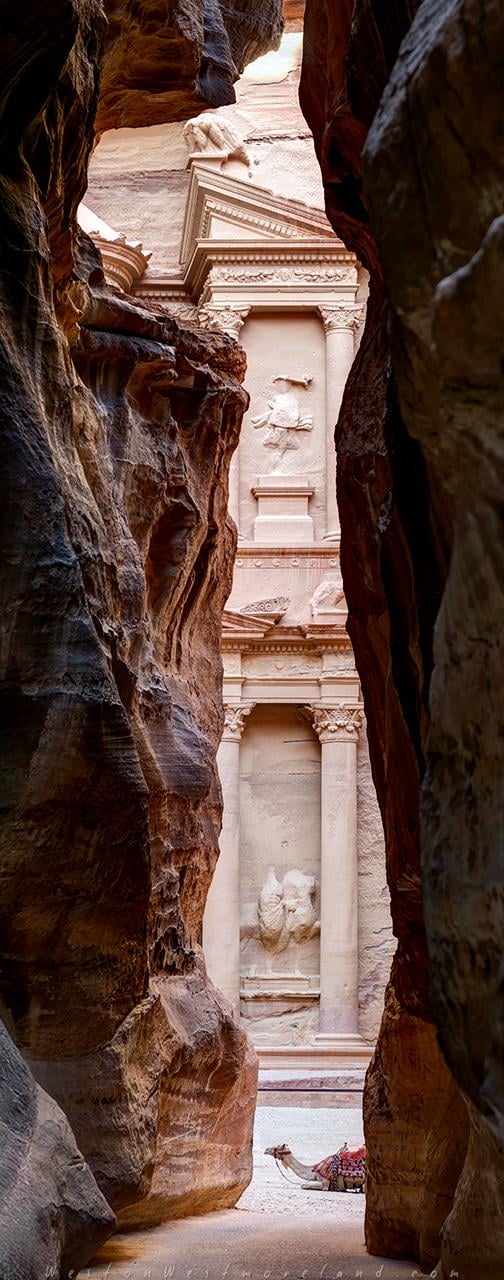
The Treasury seen from the Siq, Petra, 1st Century AD. One of the most elaborate rock-cut tombs in the capital of the Nabatean Kingdom, as most of the surviving buildings and tombs in the city, the facade was carved out of the cliff. This was the first glimpse of Petra on arrival…[1280×504] [OC]
by WestonWestmoreland
1 Comment
…when you entered the city through the long and narrow gorge that protected the entrance, known as the Siq.
The area around Petra has been inhabited from as early as 7000 BC, and was settled by the Nabataeans, a nomadic Arab people, in the 4th century BC. Petra became the capital city of the Nabataean Kingdom in the 2nd century BC. The Nabataeans invested in Petra’s proximity to the incense trade routes by establishing it as a major regional trading hub, which gained them considerable revenue. Unlike their enemies, the Nabataeans were accustomed to living in the barren deserts and thus were able to defend their kingdom. They were particularly skillful in agriculture, stone carving, and rainwater harvesting.
Petra flourished in the 1st century AD, when the Treasury, possibly the mausoleum of Nabataean king Aretas IV, was constructed, and its population peaked at an estimated 20,000 inhabitants. Nabataea fell to the Romans in 106 AD, who annexed and renamed it Arabia Petraea. Petra’s importance declined as sea trade routes emerged, and after an earthquake in 363 destroyed many structures, mainly their water conduction system and flood protection structures. In the Byzantine era, several Christian churches were built, but the city continued to decline, and, by the early Islamic era, it was abandoned except for a handful of nomads. It remained unknown to the western world until 1812, when Swiss traveler Johann Ludwig Burckhardt rediscovered it.
Forgot to say, Petra can be visited in Jordan, a spectacular country full of natural and archaeological wonders and inhabited by warm and welcoming people…
As usual, my apologies for inaccuracies and mistakes.