
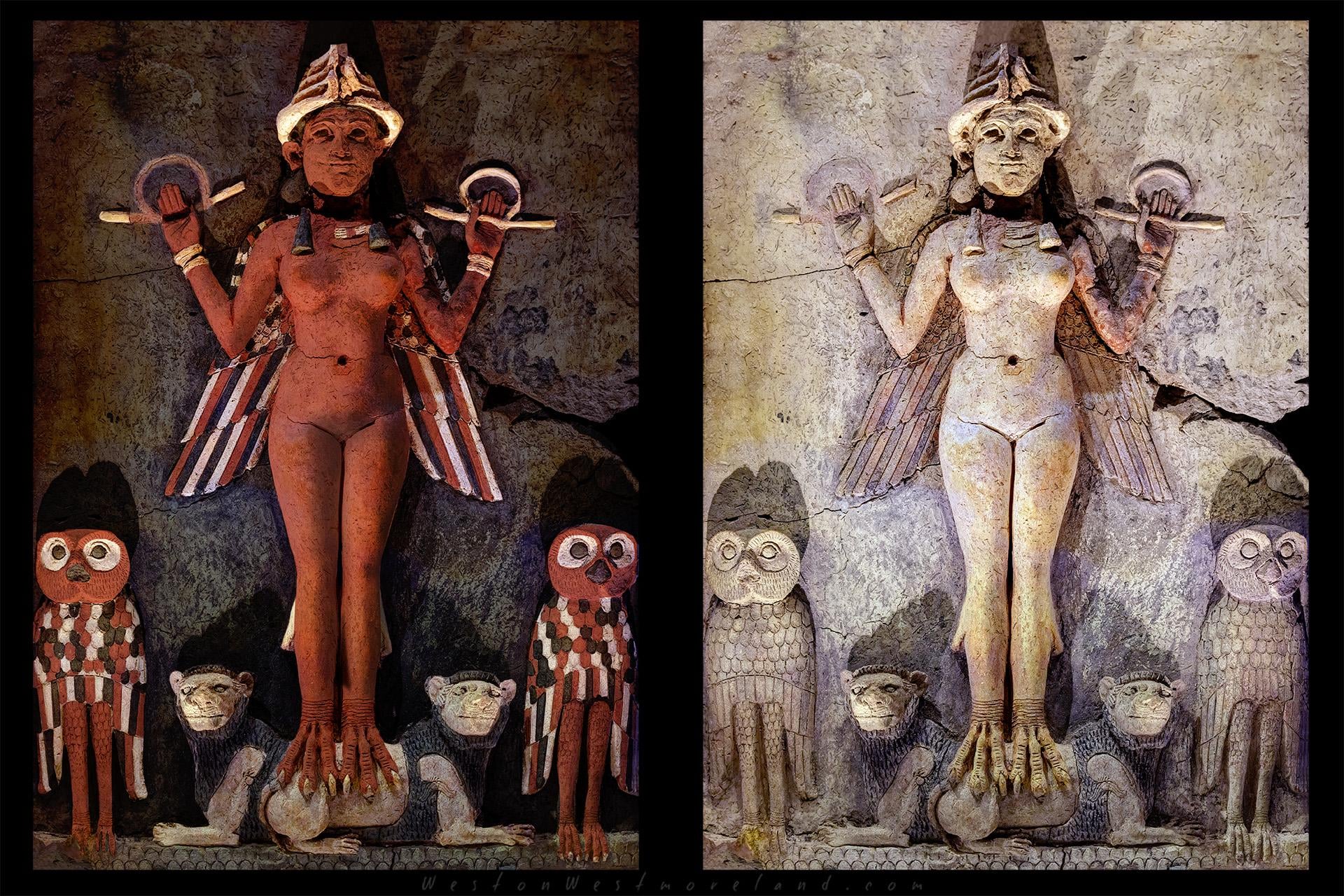
The Queen of the Night relief, terracotta, Old Babylonian Empire, c. 1775 BC. Current state vs. colors restored according to experts at the British Museum after analysis of pigment traces. The relief is dimly lit from below, as it probably was originally (personal interpretation)… [1920×1280] [OC]
by WestonWestmoreland
1 Comment
…also known as the Burney Relief, this high relief plaque depicts a goddess -nude, winged and with bird’s talons- who stands on two lions and is flanked by two owls. The composition as a whole is unique among works of art from Mesopotamia, even though many elements have interesting counterparts in other images from that time.
Pigment traces allow us to reconstruct its original coloration. The goddess was painted red overall. Her feathers and those of the owls were colored red, black and white. The background of the plaque was black, as her hair and eyebrows and the manes of the lions. The pubic triangle and the areola were accentuated in red pigment but not painted black. The bodies of the lions were white. It is assumed (inferred from other illustrations of the same period and place) the horns of the headdress and part of the necklace were originally colored yellow, as the bracelets and rod-and-ring symbols. However, there is no yellow pigment anywhere to be found.
This plaque, dated it between 1800 and 1750 BC, is also special in many other ways. High relief was not so usual, and the brittleness and size of the composition (20 in × 15 in) makes its survival through almost 4000 years of history nothing short of a miracle.
Experts have been unable to determine whether it represents Lilith, Ishtar, or Ereshkigal (the first has more or less been ruled out). Even its authenticity has been questioned since it was discovered in the 1930s, but general opinion tends to support its genuineness.
As usual, my apologies for inaccuracies and mistakes.