
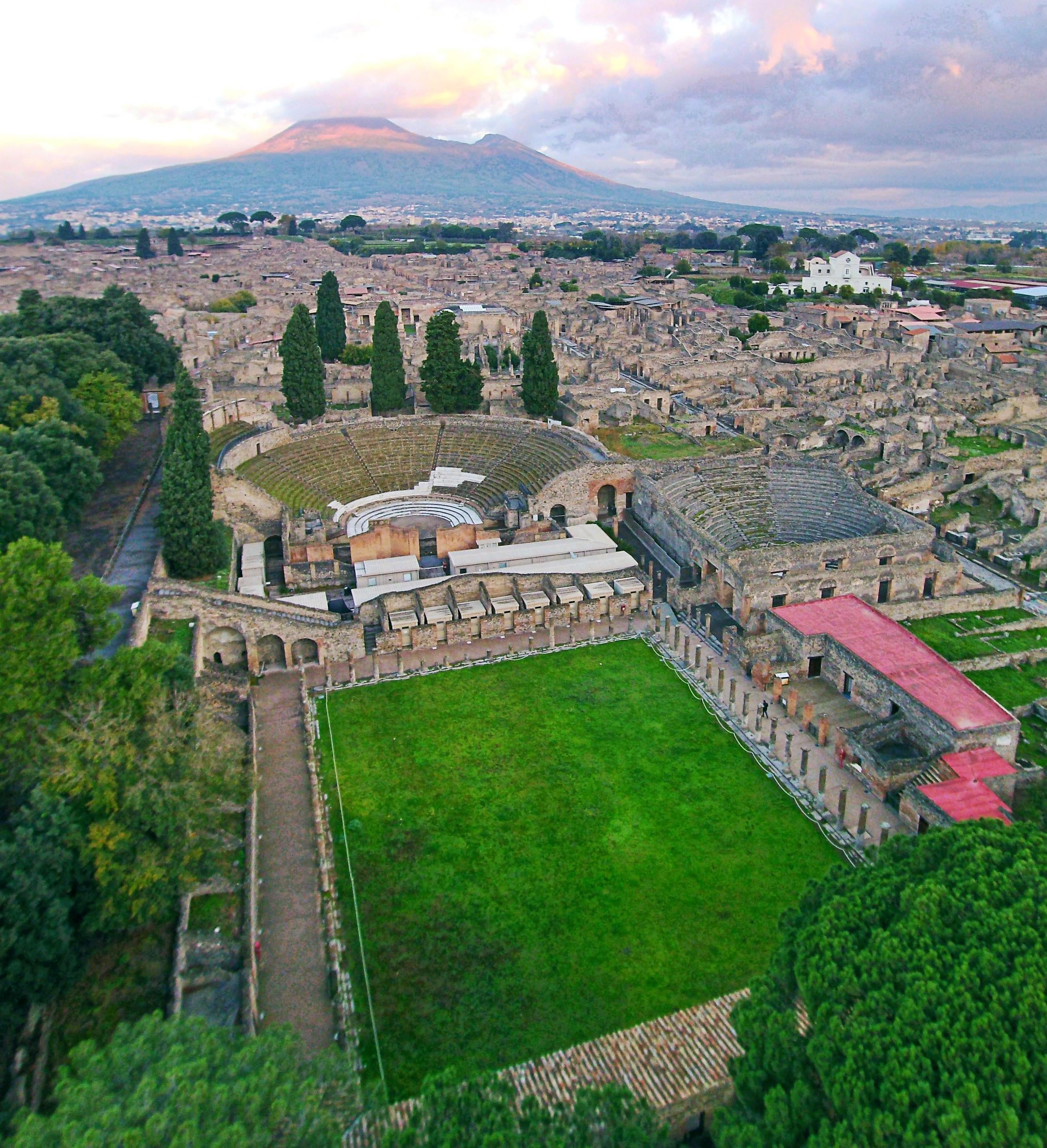
Archaeologists have discovered evidence confirming that Pompeii was reoccupied for centuries after Mount Vesuvius’ eruption in 79 AD. People resettled the upper floors of buildings jutting out over the ashes, with lower buried floors being repurposed to serve as cellars. [2619×2872]
by Party_Judgment5780
1 Comment
Stratigraphic excavation has uncovered extensive evidence of life after 79 AD—features that earlier excavations often removed in the rush to expose the city as it was at the moment of destruction. Prior to the eruption, Pompeii had a population of approximately 20,000. The number of deaths, though still the subject of some controversy, is estimated by archaeologists at 15–20% of the population, primarily due to thermal shock. Some of the survivors who could not start anew elsewhere returned to the destroyed city. They were later joined by newcomers—many of low social standing—lured by the opportunity to occupy abandoned villas or search for valuables buried under the ash.
Excavations suggest that people initially occupied the upper floors of buildings jutting out over the ash, with lower buried floors being repurposed to serve as cellars. The large vaulted spaces in the earlier horrea (warehouses) were subdivided into small rooms, ovens were built for bread baking, and staircases were constructed to access upper windows. Evidence of food production, including a millstone and another oven built inside a reused cistern in the House of the Geometric Mosaics, indicates a subsistence economy.
Archaeologists also recovered ceramics, coins from successive emperors, and even fifth-century oil lamps bearing the Chi-Rho monogram, indicating two main phases of resettlement: one from the late first to early third centuries AD, and another from the fourth to mid-fifth century. One poignant discovery was the burial of a newborn dated to between 100 and 200 AD. By the time of another eruption in 472 AD—just before the fall of the Western Roman Empire—Pompeii’s final residents abandoned the site.
[https://archaeologymag.com/2025/08/pompeii-after-vesuvius-reoccupation/](https://archaeologymag.com/2025/08/pompeii-after-vesuvius-reoccupation/)
[https://www.bbc.co.uk/news/articles/c62wx23y2v1o](https://www.bbc.co.uk/news/articles/c62wx23y2v1o)
[https://www.thetimes.com/world/europe/article/pompeii-eruption-survivors-ruins-fxzmmwvzz](https://www.thetimes.com/world/europe/article/pompeii-eruption-survivors-ruins-fxzmmwvzz)
[https://www.theguardian.com/science/2025/aug/06/people-reoccupied-pompeii-after-vesuvius-eruption-archaeologists-find](https://www.theguardian.com/science/2025/aug/06/people-reoccupied-pompeii-after-vesuvius-eruption-archaeologists-find)
[https://www.euronews.com/culture/2025/08/07/pompeiis-second-life-new-evidence-suggests-the-city-was-reoccupied-after-devastating-erupt](https://www.euronews.com/culture/2025/08/07/pompeiis-second-life-new-evidence-suggests-the-city-was-reoccupied-after-devastating-erupt)