
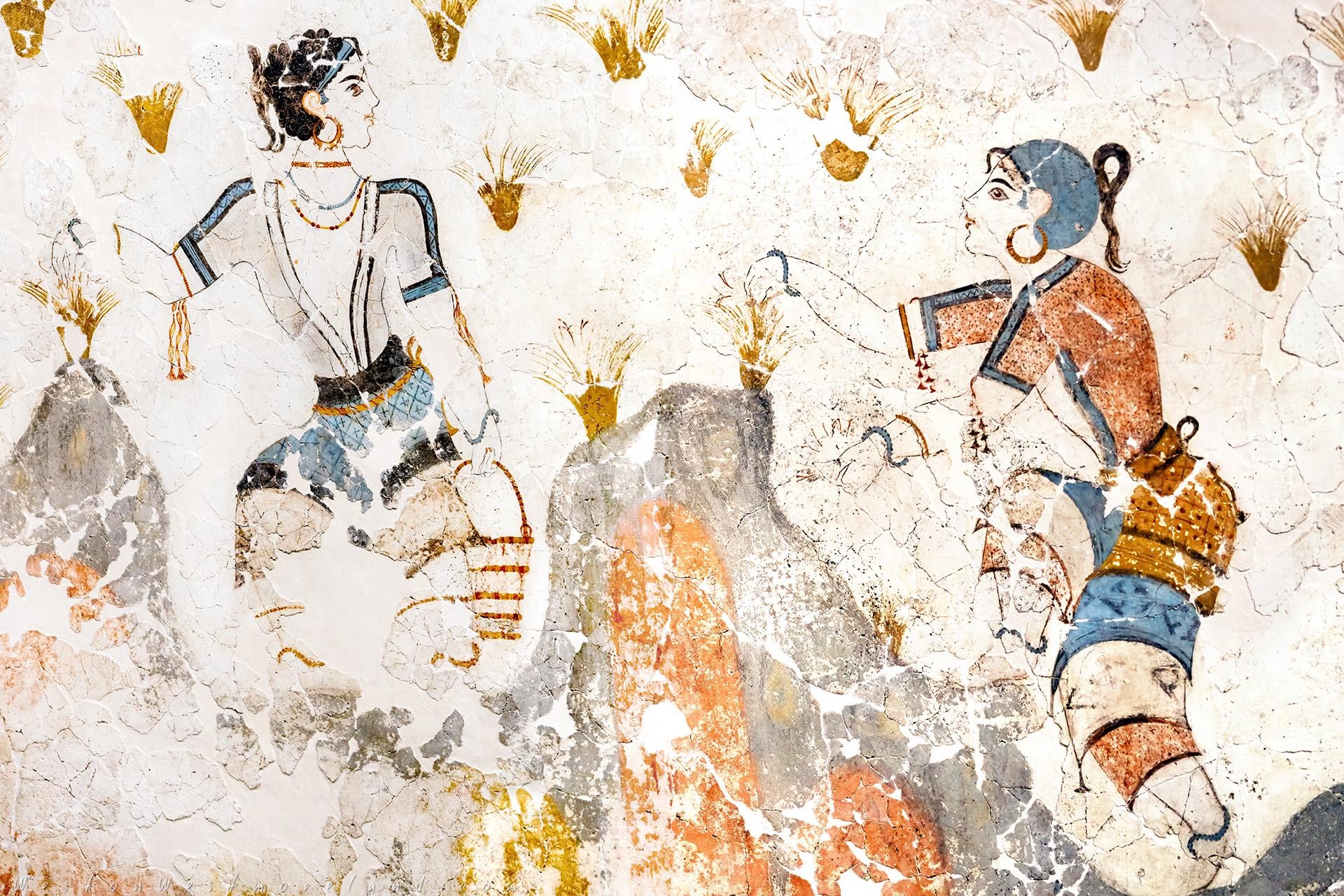
Two Theran young women collecting Saffron, part of the Goddess of Nature Fresco, Cycladian-Minoan civilization, 16th century BC. Akrotiri, island of Thera (Santorini), Greece. The short hair of the girl on the left and the shaved hairstyle of the other depict two young girls… [1920×1280] [OC]
by WestonWestmoreland
1 Comment
…the first older than the second, as shaved hair was a sign of youth.
This painting originally decorated the walls of a room on the first floor of “Xeste 3”, an impressive three story private house from ancient Akrotiri, probably owned by a wealthy and powerful person who hosted the religious ceremonies, and likely held an important position in the religious hierarchy. It is one of the four buildings that have been unearthed and studied in depth so far.
Several women with elaborate hairstyles, lavish garments and jewels, are depicted gathering crocus flowers. They are offering the stigmas of the plant through the intervention of a monkey to the Goddess of Nature as this plant was of great value due to its healing and coloring properties. It is possible that it portrays an important celebration honoring the Goddess, where females of successive age groups participated in the context of their initiation in ritual acts and their progression to the next age group.
The narration begins from the wall on the right side of the entrance portraying two females (depicted here) in a rocky landscape, and gathering the crocuses that are in full blossom. The older one seems to be overseeing the younger one with the shaved head.
The narration continues on the wall across the entrance with the [offering of the plant to the seated Goddess](https://www.reddit.com/r/ArtefactPorn/comments/1ak9li6/goddess_of_nature_fresco_akrotiri_island_of_thera/) in the epicenter of the depiction. Of the two women on the edges of the depiction, [the one on the right](https://www.reddit.com/r/ArtefactPorn/comments/1j76eq7/young_theran_woman_carrying_safron_in_a_basket_on/) is headed towards the Goddess with a full basket on her shoulder, whereas the one on the left (seen in the image with the goddess) is emptying her harvest in a large pannier. The majestic Goddess is accompanied by a winged griffin and accepts the dried stigmas offered to her by the hand of the monkey in front of her.
To create such vibrant frescoes, a smooth lime plaster was applied to the walls and then painted over.
Around 1600 BCE, a disastrous earthquake, followed by a volcanic eruption, covered the city of Akrotiri in the island of Thera in a thick layer of pumice and ash, which resulted in the remarkable conservation of frescoes -including this one- from multiple buildings throughout the town. These frescoes provide modern society with invaluable insight into the daily lives of the Cycladic people.
As usual, my apologies for inaccuracies and mistakes.