
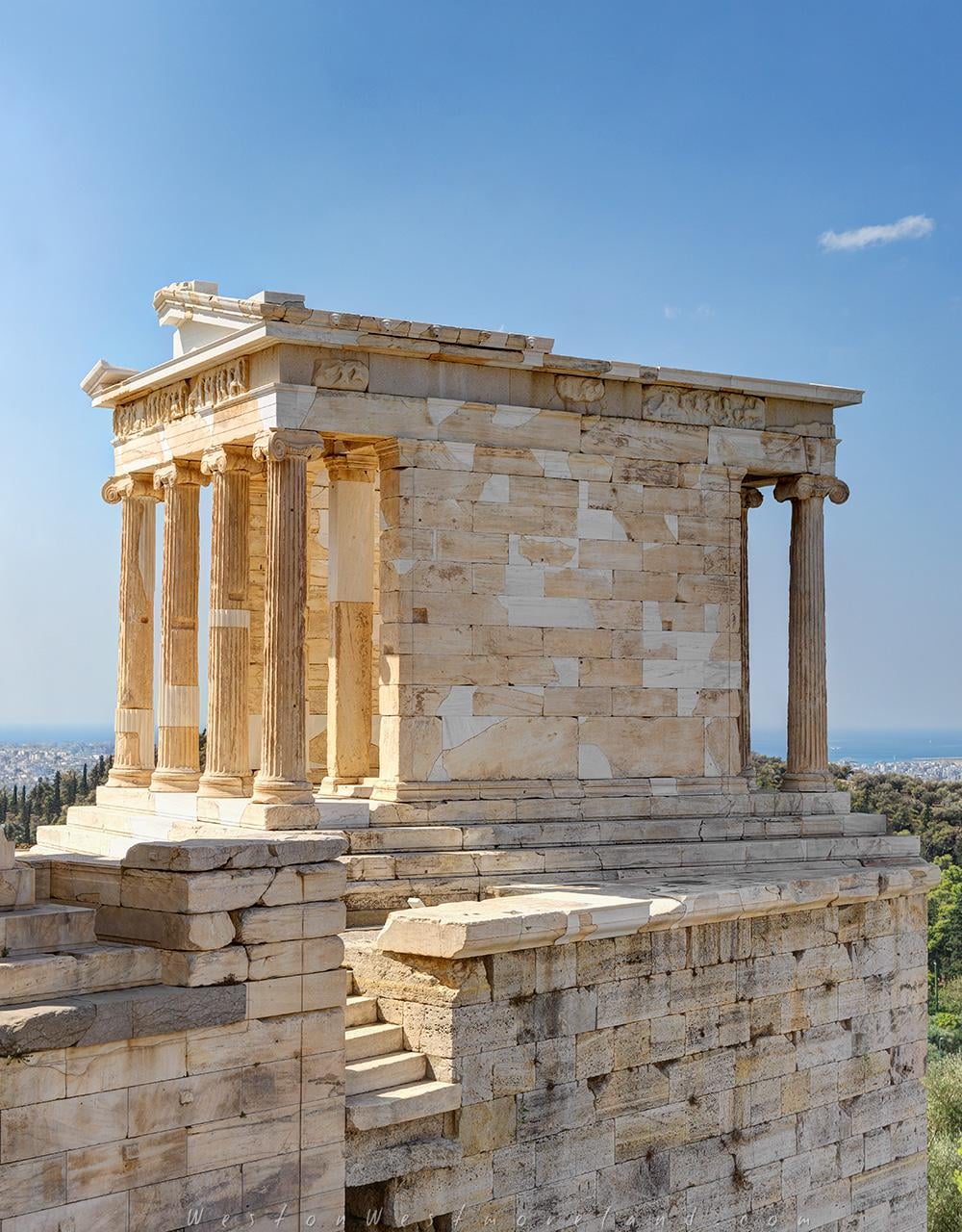
Temple of Athena Nike, Acropolis of Athens, c. 420 BC. Dedicated to the goddesses Athena and Nike, this tiny shrine is the first fully Ionic temple on the Acropolis. It occupies a prominent place on the south west bastion corner to the right of the entrance, the Propylaea… [1280×1000][OC]
by WestonWestmoreland
1 Comment
…and can be seen from outside the Acropolis.
In contrast to the Acropolis proper, a walled sanctuary entered through the Propylaea, the Victory Sanctuary was open, entered from the Propylaea’s southwest wing and from a narrow stair on the north. The sheer walls of its bastion were protected on the north, west, and south by the Nike Parapet, named for its frieze of Nikai celebrating victory and sacrificing to their patroness, Athena and Nike.
The temple, as all Greek temples, was considered a home of the deity, represented in its statue, and was not a place where regular people would enter. The believers would simply perform rituals in front of the temple, where a small altar was placed, and could take a glimpse of the sculpted figure of the goddess through the space between the columns. The privilege of entering the temple was reserved for the priestesses, who held a respected position in Greek society.
As the name suggests, the temple housed the statue of Athena Nike, a symbol of victory. It probably had a connection to the victory of the Greeks against the Persians around half a century earlier. Nike usually had wings, but in this case we know that the statue had no wings, hence it was called Athena Apteros (without wings). The ancient Greek writer Pausanias later explained that the statue of Athena had no wings, so that she could never leave Athens.
As usual, my apologies for inaccuracies and mistakes.