
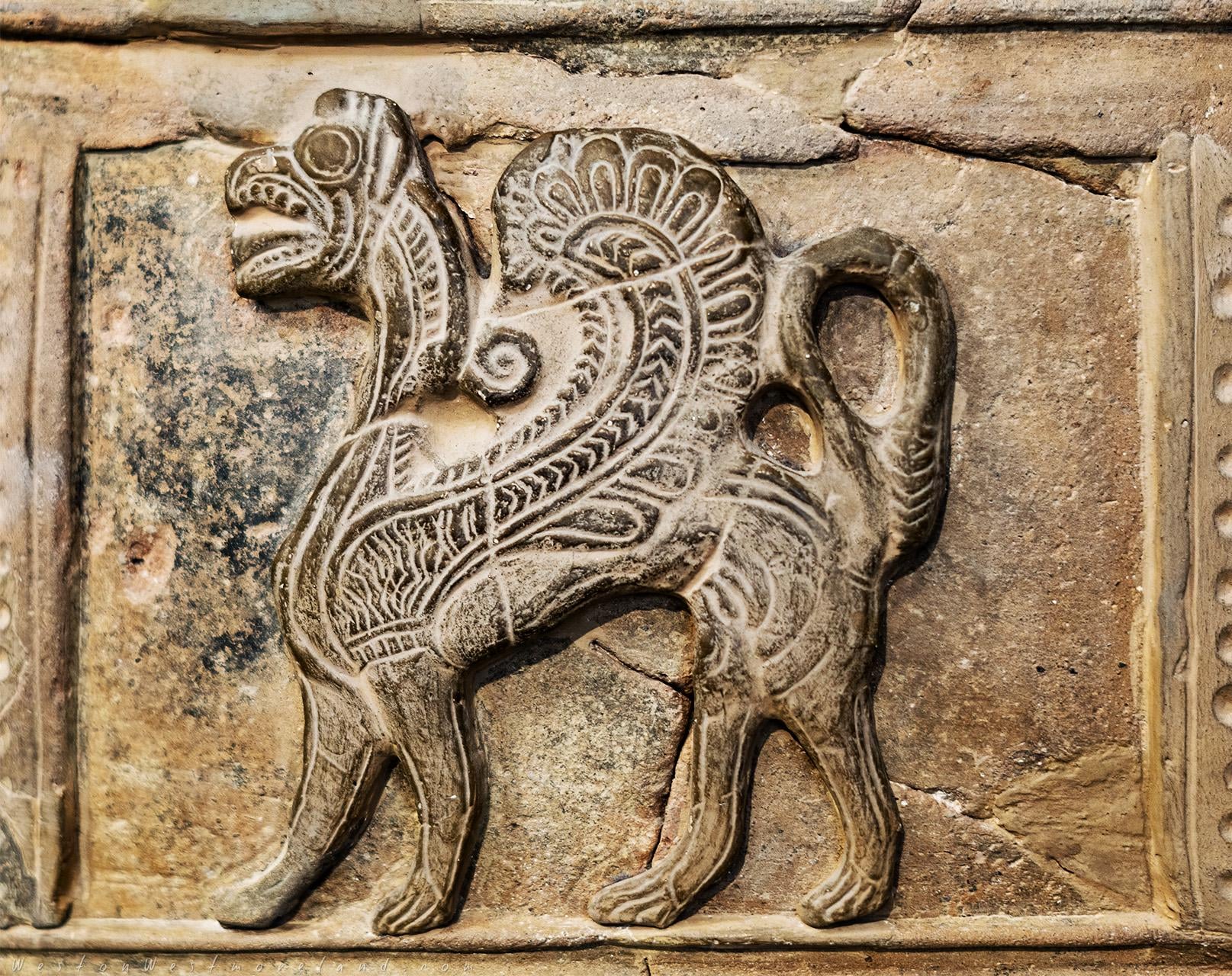
Detail of one of the relief griffins that decorated a pithos found at Xidas, Afrati-Arcades, Crete. Early Archaic period, 7th century BC. Relief pithoi of this period served a double purpose, to store goods, such as olive oil, and to display the social status of the owners… [1615×1280] [OC]
by WestonWestmoreland
1 Comment
…These pithoi were high-value objects and many such have been found in settlements of the Hellenistic period, highlighting their value as family heirlooms.
The griffin is an imaginary hybrid creature with the body of a lion and the head of a bird, with or without wings. The special symbolic importance of the mythical creature in the Creto-Mycenaean world is attested by its depiction in scenes associated with the appearance and cult of the goddess, and the authority of the ruler. Typical examples are found on gold signet rings and seals with epiphany and cult scenes, in the frescoes of Akrotiri Thera and in the Throne Rooms of the palaces of Knossos and Pylos.
The griffin as an iconographic theme is reintroduced to Greek art in the Archaic period from Egypt and the East, in the context of the adoption of elements of the Orientalizing Style, as one of several “chimeric” creatures, hybrids of two or more animals (such as the sphinx and the siren). Griffins are mainly found in vase-painting and in the shape of relief protomes (busts) attached to metal and clay cauldrons.
You can find the complete pithos [here](https://ca.heraklionmuseum.gr/ca/pawtucket/index.php/Detail/objects/892).
As usual, my apologies for inaccuracies and mistakes.