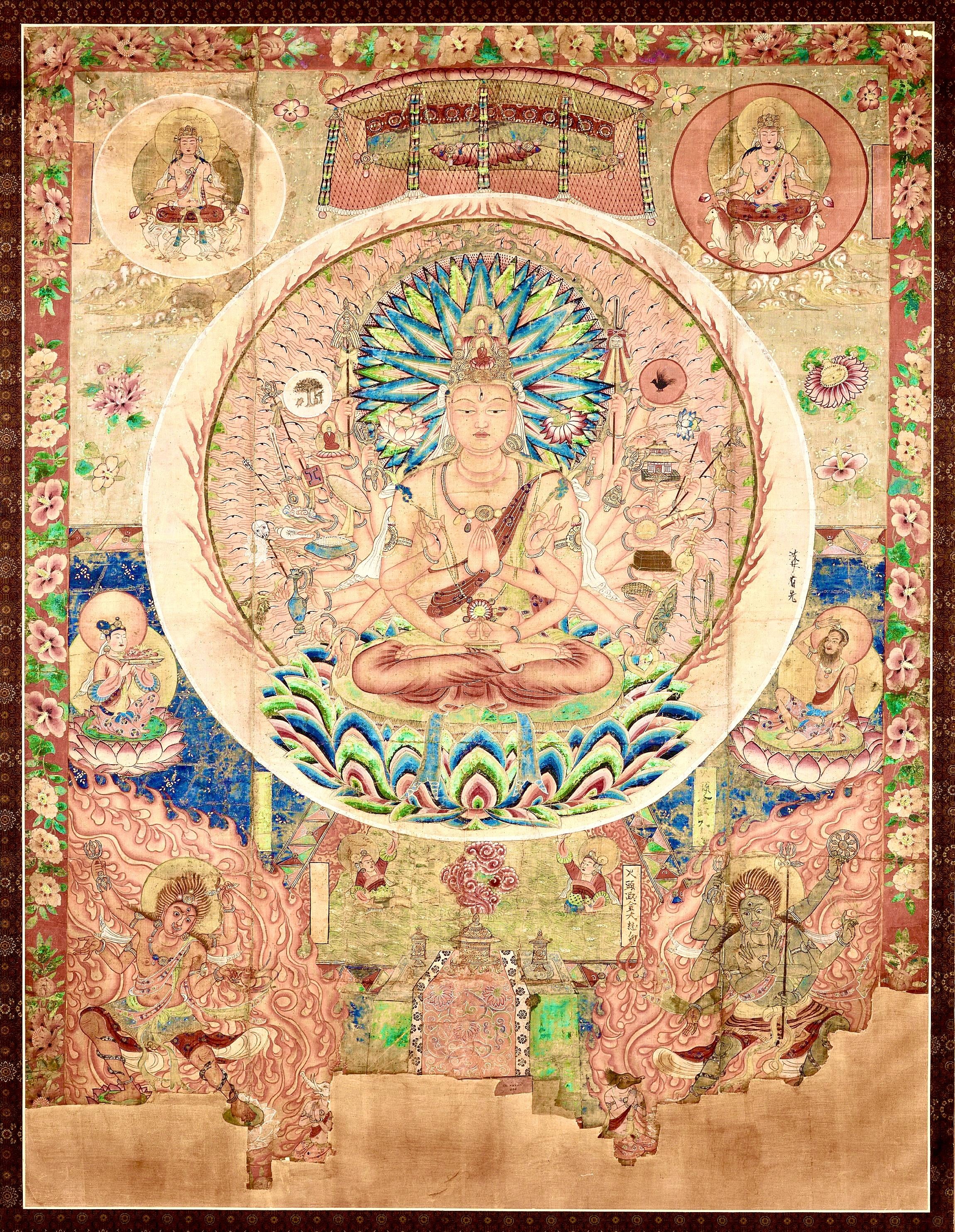
Thousand-Armed Avalokiteshvara (Mandala of Avalokiteshvara), 8th – 10th century CE [2300×2968]
by Ironyfree_annie

Thousand-Armed Avalokiteshvara (Mandala of Avalokiteshvara), 8th – 10th century CE [2300×2968]
by Ironyfree_annie
1 Comment
Mandala or circle, is a spiritual and ritual symbol in Hinduism and Buddhism, representing the universe. The circular designs symbolizes the idea that life is never ending and everything is connected. This large rectangular banner is showing the ‘Mandala of Avalokiteshvara’.
In the center of an illustrious circle, there is a flamboyant aureole with a flaming border and thousands of eyes. The Thousand Arms Avalokiteśvara is seated in Vajrasana on a multi-colored lotus seat in the middle. His forehead has a half-closed third eye and the front two arms are in Anjali Mudra (Namashkar) with different arms holding many other divine objects. On his tiara Amitabh is depicted.
In the left corner of the banner is decorated with the moon Bodhisattva. He is sitting in Vajrasana on the lotus with five gooses in the front. He is holding lotus buds in both of his hands. Behind his head a golden halo has been illustrated. On the right corner of the banner is decorated with the Sun Bodhisattva. He is sitting in Vajrasana on the lotus with five horses in the front. He is holding lotus buds in both of his hands. Behind his head a golden halo has been illustrated.
In the right middle corner of the banner, Rsi Vasu is depicted sitting on the lotus, with dark golden halo behind his head. In the left side middle corner of the banner, Sridevi is depicted sitting on the lotus, with dark golden halo behind her head. She is offering flowers to Thousand Arms Avalokiteshvara.
On the beautiful green Kaleen (Carpet) with red border, two small figures Sun and moon are supporting an illustrious circle ed with purple clouds in which Thousand arms Avalokiteshvara is shown. In bottom is the Blue-faced Vajra Kundalin and to the left is fiery-headed Ucchusma.
The two Naga Kings Nanda and Upananda uphold the stem of the lotus that s the seat of Avalokiteshvara. The painting depicts both Indian and Chinese elements concerning facial features, drapery and floral representations.
(Currently housed in the National Museum, New Delhi, India)