
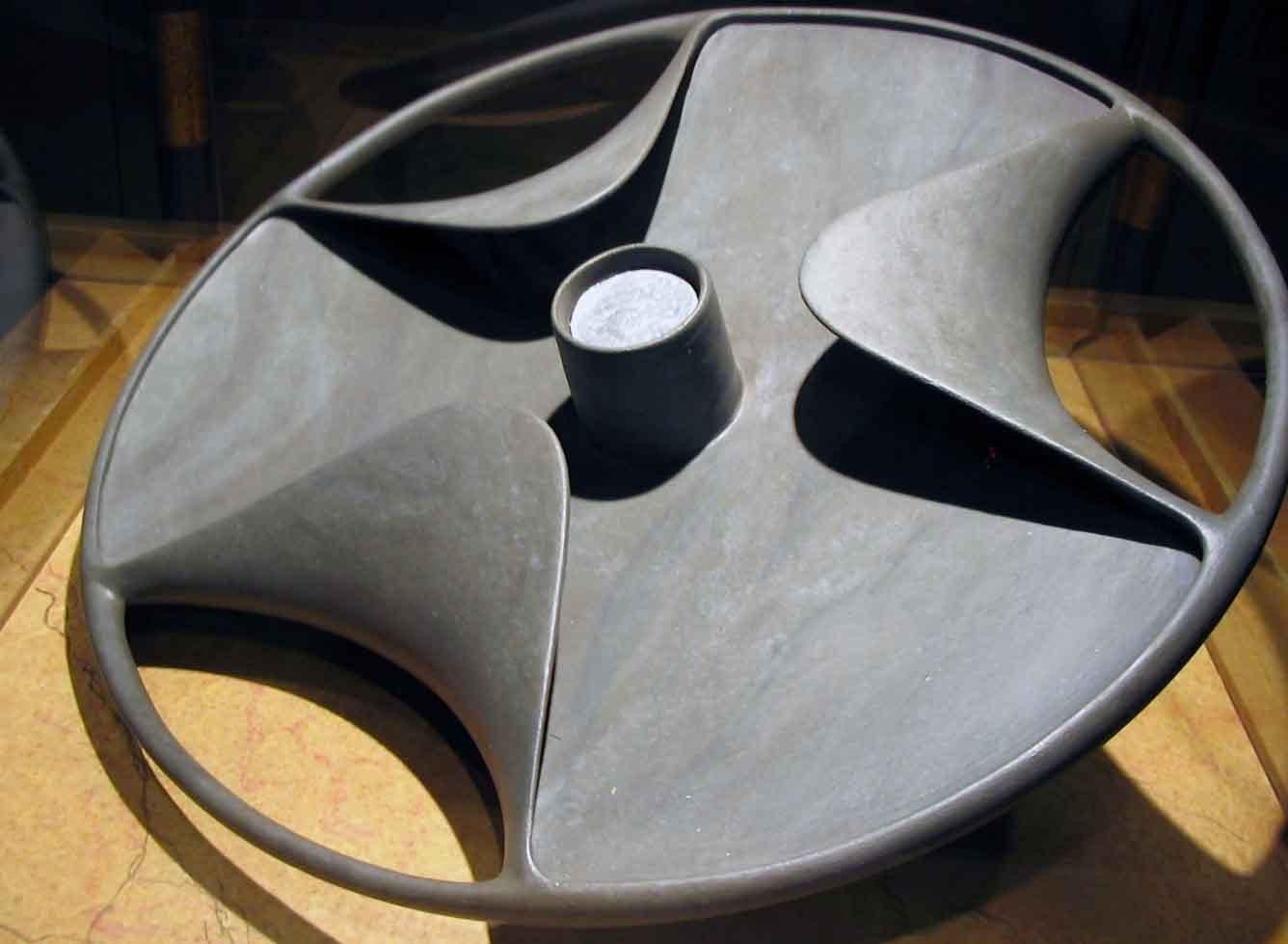
The Sabu Disk is an enigmatic artifact discovered in 1936 in the tomb of Prince Sabu, son of Pharaoh Anedjib, at the Saqqara necropolis in Egypt. Dating to around 3000 BCE (First Dynasty), the disk is made of a fragile, finely carved metamorphic stone called schist. It resembles a shallow, three-lobed bowl or wheel with a central hub, leading to various speculations about its purpose.
Despite its elegant design, the disk's original function remains unclear. Some Egyptologists suggest it may have been a ceremonial object, an incense burner, or a symbolic representation of a lotus or solar motif. Others, especially fringe theorists, propose it as evidence of advanced ancient technology, likening it to a flywheel or turbine. However, there is no evidence to support these more speculative claims.
To this day, the Sabu Disk is viewed as a remarkable example of early Egyptian craftsmanship, and a mystery that continues to puzzle archaeologists.
by DeScepter
5 Comments
It seem like there isn’t evidence to support and of the claims.
I wonder if a shaft can be put through the central hub, because the first thing that came to mind for me is some sort of winnowing device.
This is a photo of a replica, not the original.
Photos of the actual artifact can be found [here](https://egypt-museum.com/sabu-disk/), and in the Wikipedia article linked to by OP.
Me trying to figure out what purpose it could have served on a Goa’uld mothership:
* Table Centerpiece? Nah not gaudy enough
* Steering wheel? Nah, they had that orangish red ball thingy
* Hrmm, actually it looks more Lantean…
Personally, I find the most likely explanation is that this was a device useful for making rope. If you Google “rope making top” or “ancient rope making tools,” you’ll see a lot of circular devices with 3 notches or prongs for twisting fibers together.