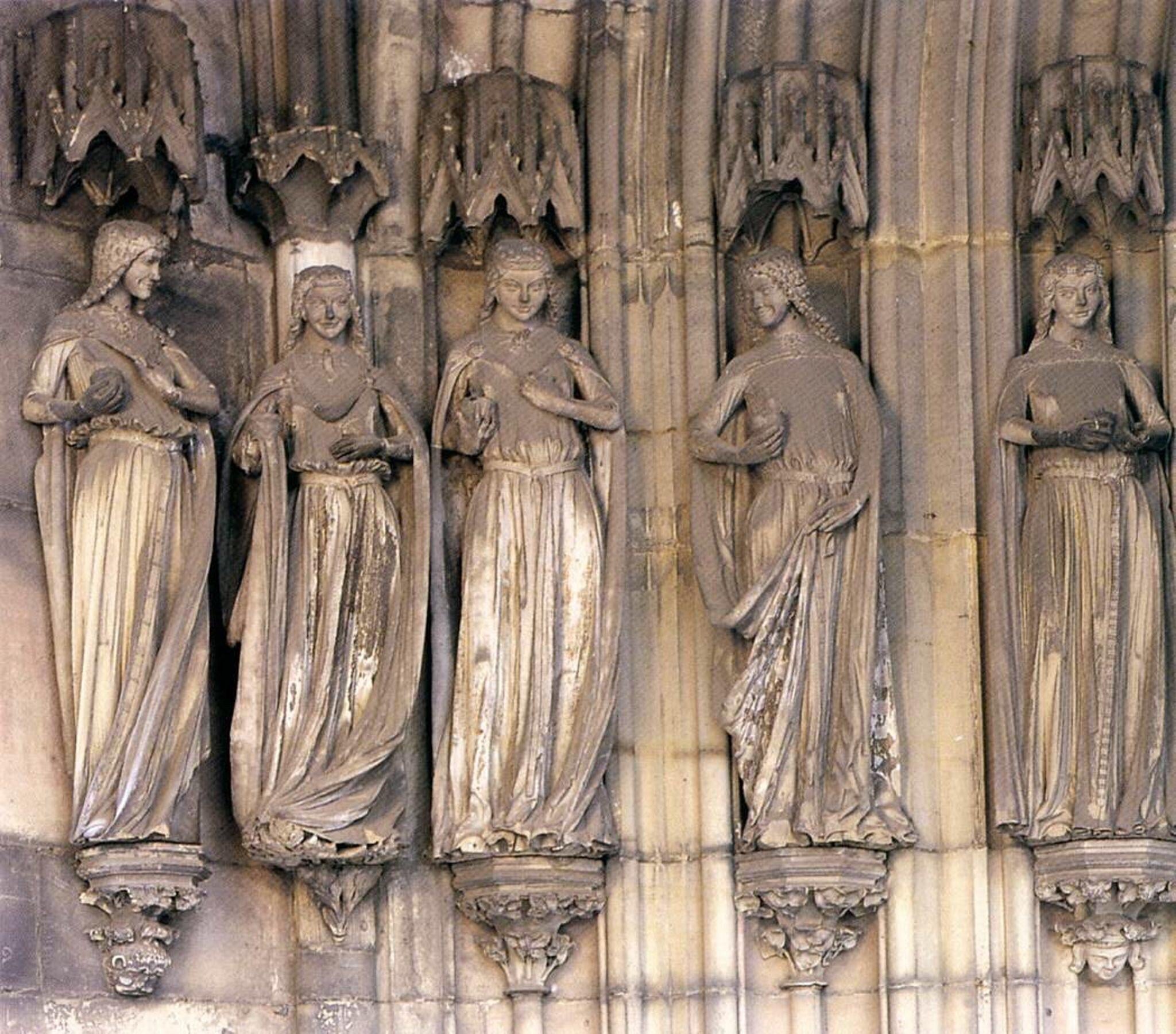
Wise and Foolish Virgins, Stone Sculptures, Magdeburg Cathedral, Germany, c. 1245-1250 [2048 x 1800]
by Persephone_wanders

Wise and Foolish Virgins, Stone Sculptures, Magdeburg Cathedral, Germany, c. 1245-1250 [2048 x 1800]
by Persephone_wanders
1 Comment
Monumental sculptures at Magdeburg in Germany, around four feet tall and constructed c. 1245-1250, allude to the parable of the wise and foolish virgins (Matthew 25:1-13). On the right-hand side of the portal stand the wise virgins, resolute and content as they acknowledge their shared fate with an exchange of gazes and lucid body language. On the other side stand the foolish. They too, with lively torsion, acknowledge each other’s shared fate. However, this is the fate of the damned. We notice their expressive, furrowed brows, their dimpled chins and downturned mouths. One foolish virgin seems aloof, as if still in slumber. This only intensifies the grief of her fellow foolish companions.
The parable goes that ten virgins went forth to meet Christ, the bridegroom. Whilst five were wise and took oil with them to keep their lamps alight, the other five were foolish and took no oil. Christ tarried, and all ten virgins slumbered. Then, at midnight, they heard a cry: ‘Behold, the bridegroom cometh, go ye out to meet him!’ (Matthew 25:6) The wise, with their lamps alight, saw the path to the bridegroom and went to meet him at the marriage feast. On the other hand, the foolish could not see, nor could they obtain any oil from the merchants. Finally, when they begged for Christ at the door, not only did he shut them out, but he did not know them (Matthew 25:12).
Magdeburg was the first Cathedral portal to depict a group of females exclusively, and to present the wise and foolish virgins in monumental form. I believe such innovative tendencies at Magdeburg drastically alter the viewing experience. In early Gothic renderings, the virgins are presented in relief form and as ancillaries to the overarching text: the Final Judgement. At Magdeburg, however, these women become agentic forms as they react to the moment of judgement with remarkable expressivity. Excerpt from essay by [Annabelle Stephenson](https://sussexcemms.wordpress.com/2020/09/23/encountering-monumental-stone-women-at-magdeburg-cathedral/) ‘Encountering Monumental Stone Women at Magdeburg Cathedral’
Magdeburg Cathedral officially called the Cathedral of Saints Maurice and Catherine, is a Lutheran cathedral in Germany and the oldest Gothic cathedral in the country. It is the proto-cathedral of the former Prince-Archbishopric of Magdeburg. Today it is the principal church of the Evangelical Church in Central Germany. The south steeple is one of the tallest cathedrals in eastern Germany. The cathedral is likewise the landmark of Magdeburg, the capital city of the Bundesland of Saxony-Anhalt, and is also home to the grave of Emperor Otto I the Great and his first wife Edith.
The first church built in 937 at the location of the current cathedral was an abbey called St. Maurice, dedicated to Saint Maurice. The current cathedral was constructed over the period of 300 years starting from 1209, and the completion of the steeples took place only in 1520. Despite being repeatedly looted, Magdeburg Cathedral is rich in art, ranging from antiques to modern art.