
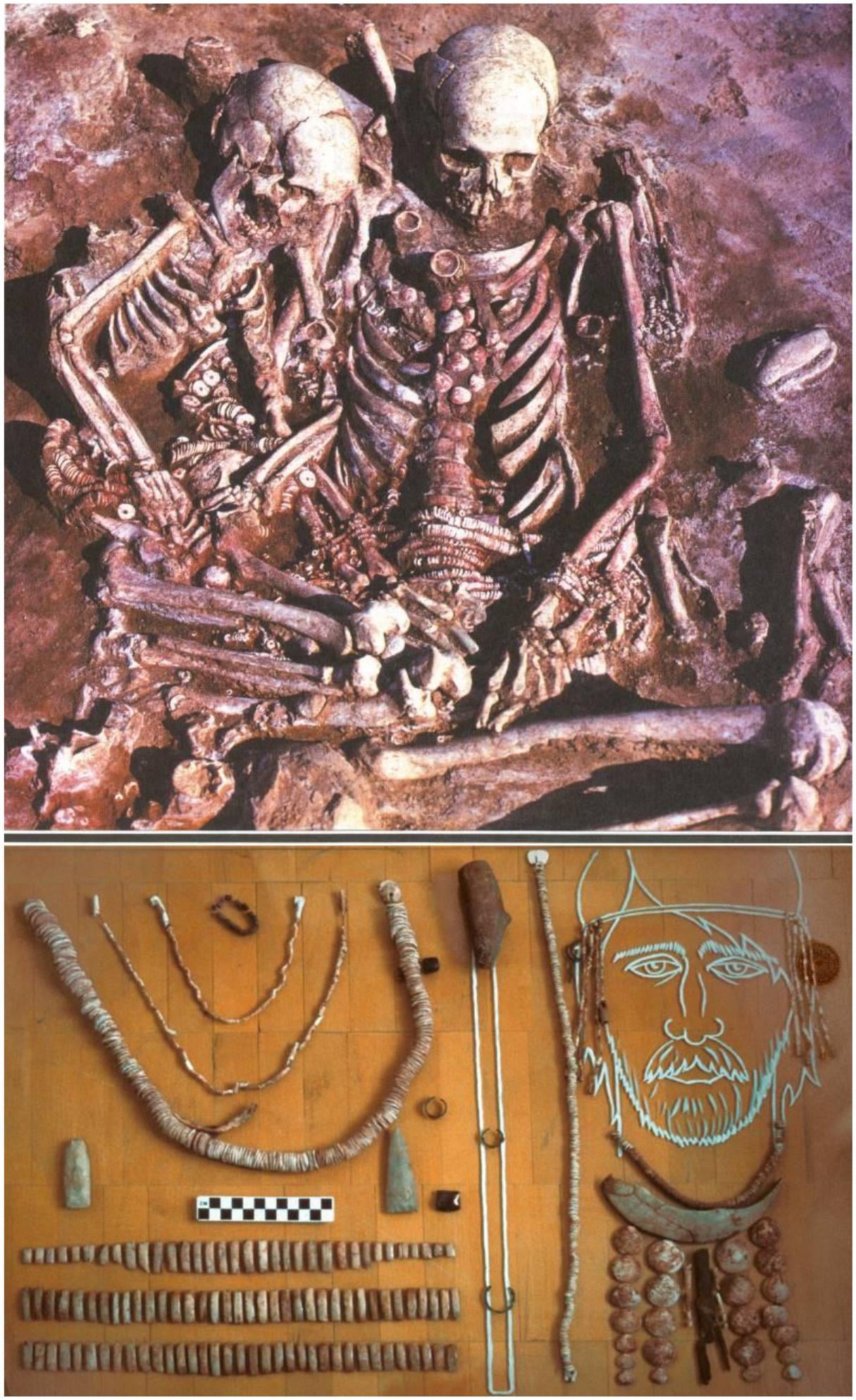
Mace chief grave, Khvalynsk II, Russia: Grave 25 (left, sister aged 8–9) & 24 (right, brother aged 20–25). The siblings were buried with a vast array of grave goods and the partial remains of 3 other individuals at their feet: a male 16–19 years old, and 2 infants. 4500–4300 BCE [1215×1986]
by Fuckoff555
1 Comment
> The male aged 20–25 (II:24) was buried with a female aged 8–9 (II: 25), his sister, with the partial remains of three other individuals at their feet: a male 16–19 years old (a 3rd-degree relative), and two infants (not analyzed for aDNA). Whole genome analysis revealed that 24 & 25 were brother and sister, although born at least 10 years apart. She wore many decorative belts of riverine Unio shell beads. Copper rings and beads were found only on the male, and beside him was an ‘eared’ mace like the broken one in Grave 108, and 14 bones from a sheep and a goat (Bogatkina 2010: 400). He was buried wearing multiple mid-body belts of Unio shell beads, multiple mid-body belts made of 194 beaver incisors (or a shirt covered with beaver incisors?); a boar’s tusk chest pendant; fossil Glycemeris shell pendants (a marine shell also used at Varna for ornaments); a tubular bird bone; and 14 copper ornaments consisting of beads, rings, a spiral ornament or coil of wire (Figure 8:5), and bands that might have been wrapped around wooden shafts (Figure 9). He also had two lumps of melted copper, perhaps signs of metal craft working, or perhaps copper trade ingots. The male’s Y-chromosome haplogroup was Q1a1b, a Siberian, northern haplogroup; for example, almost all the males at Murzikha, a contemporary cemetery in the forest zone, were Q1a (Figure 2). His and his sister’s MtDNA haplogroup was U2e1b, also found in Mesolithic individuals in Latvia and Siberia, so again a northern lineage. His paternal ancestry contrasted with the paternal ancestry of most of the males at Khvalynsk II.
[https://pmc.ncbi.nlm.nih.gov/articles/PMC11699484/](https://pmc.ncbi.nlm.nih.gov/articles/PMC11699484/)