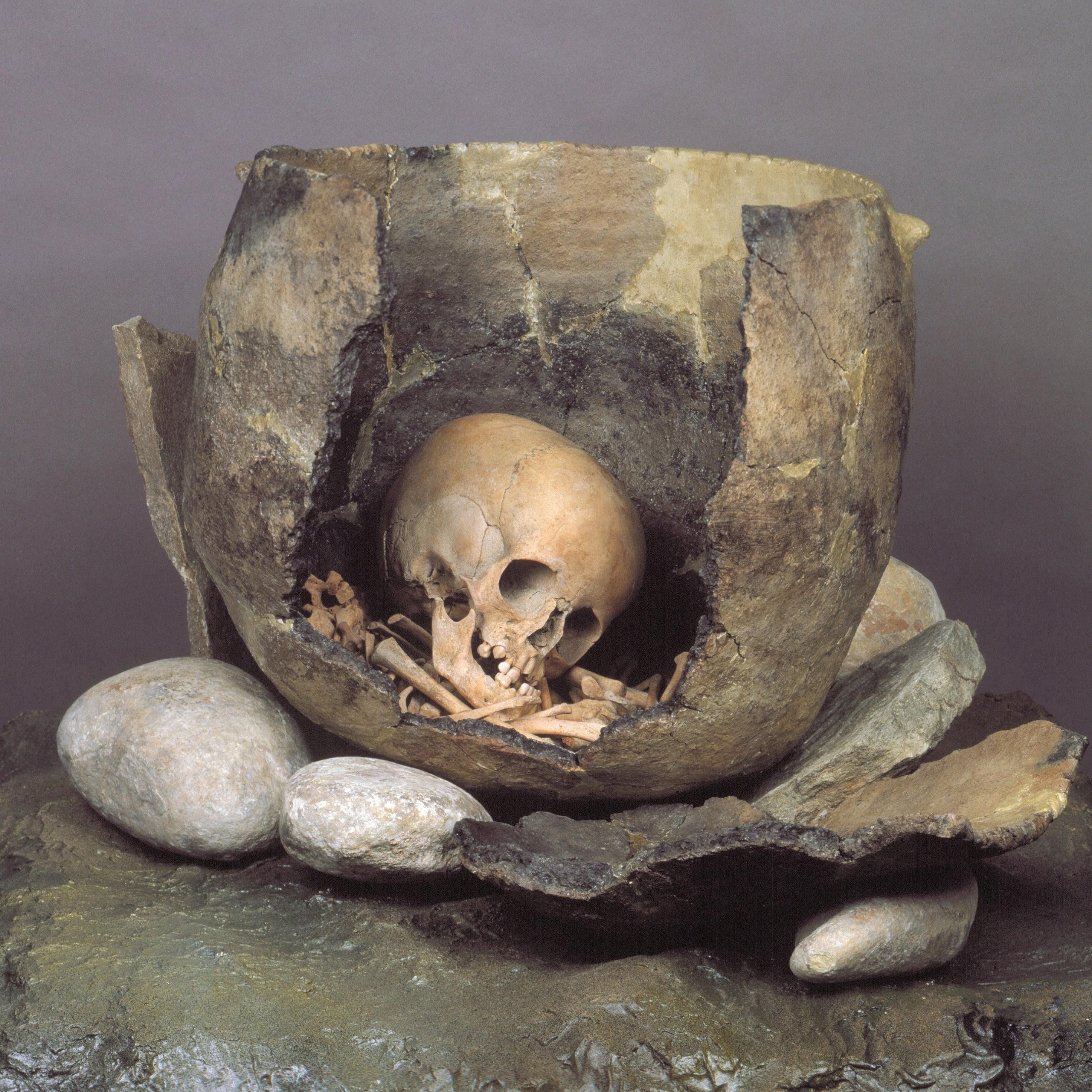
Funeral urn with remains of a child. Granada, Spain, Argaric culture, 1900-1600 BC [2900×2900]
by MunakataSennin

Funeral urn with remains of a child. Granada, Spain, Argaric culture, 1900-1600 BC [2900×2900]
by MunakataSennin
2 Comments
[Museum](https://artsandculture.google.com/asset/funerary-urn/bgEVemjv2_4lrQ)
Cremation and burial of the cremated remains in a jar or urn was a Bronze Age legacy of European cultures descending from the Proto Indo-European migrations 6000-5000 years ago. The Neolithic cultures that sparsely populated Europe were Hunter-Gatherers and Semi-Nomadic herders who’s ways of life and genetic make up were radically altered by the arrival over centuries of migrants and settlers from the Caspian Steppe. The various, broadly unrelated, Neolithic Peoples of Europe largely buried their dead with notable individuals and families receiving large stone megalithic tombs. You’ll find stone-built dolmens and burial edifices all over continental Europe that predate the arrival of the Proto Indo-Europeans on the scene. The arrival of the PIE Peoples in Europe resulted in a dramatic shift in cultural norms and burial practices across the Bronze Age, including the adoption of cremation burials en masse.
When I say “A People” or “A Culture” I don’t mean a singular, unified group of individuals identifying themselves and everyone else as belonging to one group or one identity. The Proto Indo-European Peoples who migrated from central Eurasia to Europe did so in small groups, and perhaps large ones, in spurts and fits over centuries and the groups from which they emerged or moved-away from were never just One People or One Culture either but rather a patchwork of genetically, culturally, and linguistically related groups. Those groups brought their cultures, their beliefs, and their languages with them in hundreds and thousands of derivations and permutations that spread across Europe– but We identify them as broadly belonging to a single cultural-origin and we categorize them, for our convenience, into identifiable Cultures. One of the most identifiable cultural attributes of any People are their burial customs because the evidence those practices are what we can often find in the ground.
In Europe one of the late Bronze Age’s biggest, most wide-spread cultures was the PIE-descended Urnfield Cultures, marked by their cemeteries of cremated individuals placed carefully into jars and urns and buried with artifacts those people valued in life or would require in the next one. We see that across thousands of years that People’s descending from the PIEs maintained their cremation burial practices in one-way-or-another. The Greeks, the Aryan/Iranians, the Vedics, the Scandiavians, the Romans, the Germans, the Celts, etc. All of these Peoples descend from waves of PIE migrants thousands of years ago and their burial practices, among the most conservatively protected part of any culture, were maintained for a very long time.
This Argaric Culture, which flourished in the Iberian Penninsula, existed between 2250 BCE and 1250BCE and predated the more northerly Urnfield Cultures that would peak in the early Iron Age. We see the genetic markers of the PIE in these people and we can see that they created and buried their dead in urns meaning that they were carrying on the traditions of their ancestors from the steppes thousands of years removed in time.
Cremation in Europe would only cease to be the primary and most-sacred way of burying the dead with the advent of Christianity, a semitic religious cult arising from the Levant– a place where the Proto Indo-Europeans didn’t settle or migrate to, and therefore their culture and beliefs had little to no effect in shaping the region and its Cultures. Christians, like Jews, believe that the body is the literal creation of their God and that upon a person’s death they should return to the Earth from which their body was formed (dust to dust, ash to ash). Christians, in particular, held that the body must be buried whole so that on the day of Resurrection they might be born anew and rise from their grave. The body and the soul are inseparable in their belief system so a cremated body is one who’s soul has been destroyed and there is no hope for Resurrection (and therefore Eternal Salvation). While the Romans were a PIE-descended People with elements of PIE culture still present in their culture, religion, and language the spread of Christianity within their Empire put a rather quick end to mass crematory practices. Cremation, which had been the primary method the PIE people and their descendants had practiced for almost 5000 years was almost entirely gone as a cultural practice by the 5th century CE.