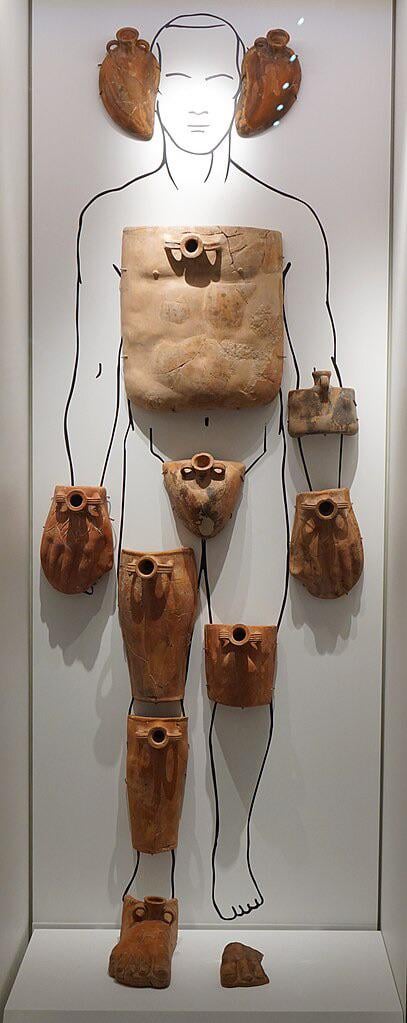
Terracotta vessels used for medicinal heat therapy. Roman period (1st cent. BC – 1st cent. AD). Archaeological Museum in Nicosia, Cyprus [407×1024]
by Remote_Finish_9429

Terracotta vessels used for medicinal heat therapy. Roman period (1st cent. BC – 1st cent. AD). Archaeological Museum in Nicosia, Cyprus [407×1024]
by Remote_Finish_9429
3 Comments
These terracotta vessels in the form of life-size human body parts, have been interpreted as hot water bottles. Their undersides are molded to fit tightly on the corresponding body parts. The bottles are filled from their neck with hot water or oil and then applied to the aching body. They were probably used as warm compresses for causing hyperaemia and relieving pains. We know of the use of emplastra and thermasmata (warm plasters) for the treatment of rheumatic conditions from the ancient texts of Hippocrates and Galen.
The vessels were found in Paphos in a building, which may have functioned as an Asklepeion (healing temple) or a doctor’s establishment. Nea Pafhos and Kition (modern Larnaka) were the most important medical centres in Cyprus during the Hellenistic and Roman periods.
Did they move museums? I’ve seen them in the archaeological museum in Paphos, but that was 3 years ago
Fascinating! Thank you for sharing this.