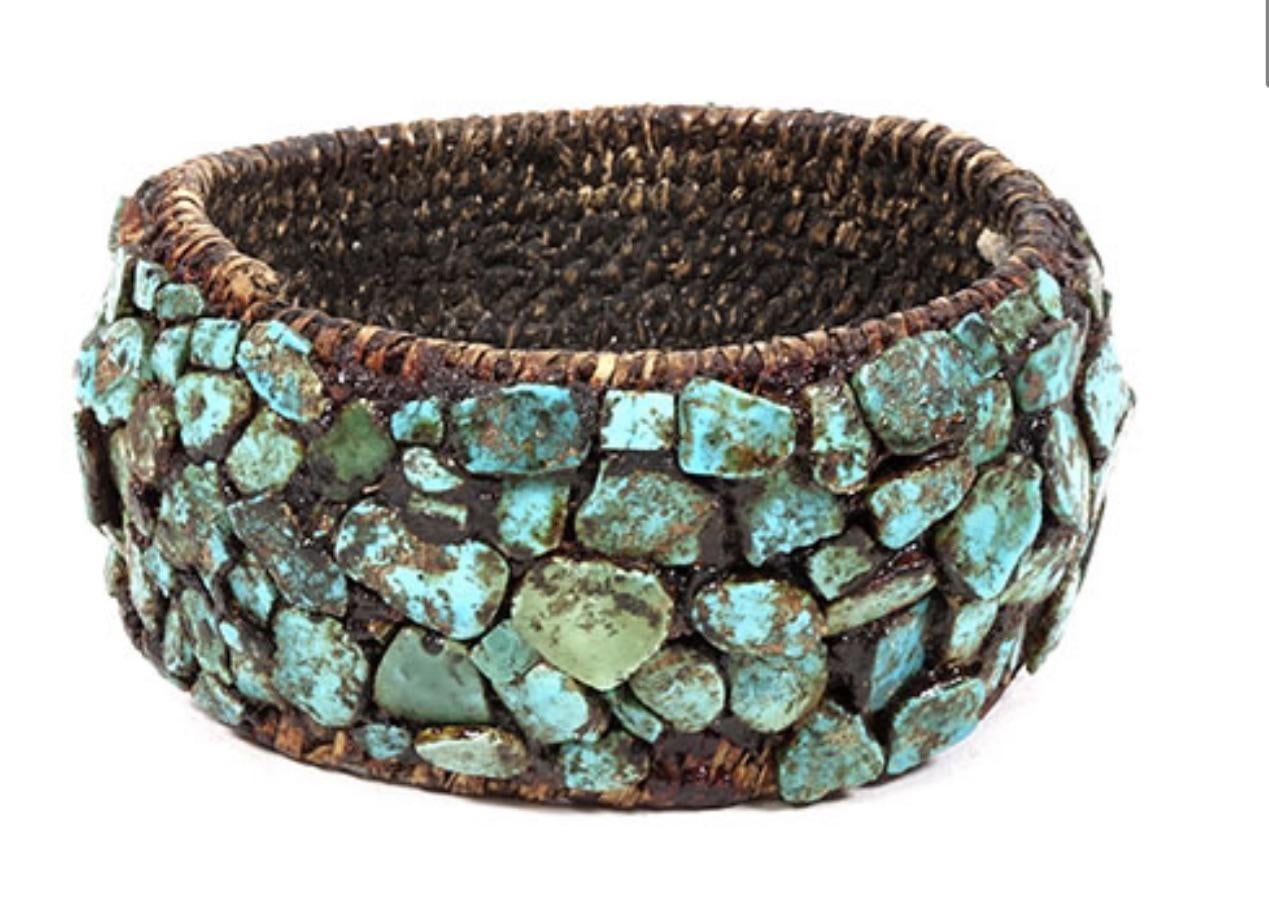
Turquoise armband, 700–1450 CE placed in a cave in the Hueco Mountains near El Paso Courtesy Texas Archeological Research Lab, The University of Texas at Austin.[1284×878]
by CryptographerKey2847

Turquoise armband, 700–1450 CE placed in a cave in the Hueco Mountains near El Paso Courtesy Texas Archeological Research Lab, The University of Texas at Austin.[1284×878]
by CryptographerKey2847
1 Comment
Very cool. It looks like the stones are bonded to a woven fiber backing with pitch. I’ve often wondered about the style origins of native American turquoise jewelry, since prior to Spanish contact, Southwestern North American peoples didn’t have smelted metals, and I’m not even sure if there’s any evidence of native copper articles, like those made by Midwestern and Pacific NW peoples. Yet, very shortly after the introduction of European metal working methods, you see these big, turquoise studded cuff bracelets, often with large, irregular nuggets of stone, being made by Southwestern peoples. It’s a style that is not at all like Spanish or other European jewelry, but seems like a well-developed style because it’s so distinctive. So, this makes me wonder if they had a long tradition of making these sorts of fiber and pitch based turquoise cuffs, but very few survived just due to the nature of the woven backing materials, and once silversmithing was introduced, they just transferred the same concept and style to the more durable fabrication methods.