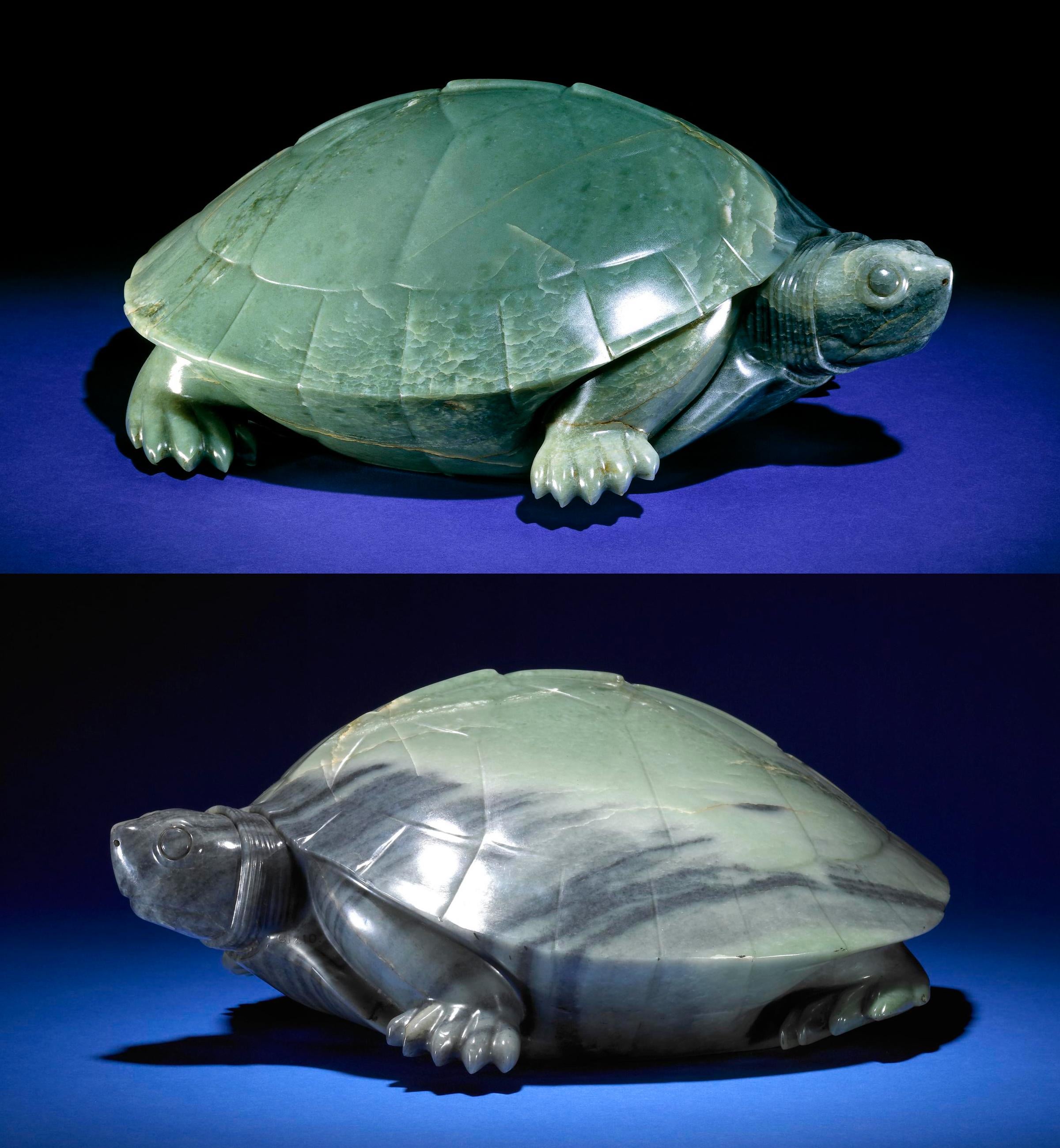
Jade carving of a terrapin. Allahabad, India, Mughal Empire, around 1600 [2400×2600]
by MunakataSennin

Jade carving of a terrapin. Allahabad, India, Mughal Empire, around 1600 [2400×2600]
by MunakataSennin
2 Comments
[Museum](https://www.britishmuseum.org/collection/object/A_1830-0612-1). 48.5 cm long.
This stone carving of a terrapin was found during engineering work in 1803 at the Mughal fort at Allahabad, northern India. Previously the sacred Hindu city of Prag, Allahabad was fortified and so renamed by Akbar (r. 1556–1605), who then built a palace there as well. The Fort was occupied by his son, Prince Shah Selim, later the emperor Jahangir (r. 1605–1627). Jahangir, a patron of jade carving and a keen naturalist, may have commissioned the piece to decorate his palace gardens within the fort.
The detailed carving work allows the species to be identified, i.e., a female ‘Kachuga dhongoka’ and native to the River Jumna which joins the Ganges at Allahabad. Spectroscopy testing confirms the stone to be nephrite, one of two main varieties of true jade. The size and appearance suggests the raw material originated from an unusual source, namely Xinjiang, then an independent central Asian kingdom. During a hazardous journey, the raw jade would have been carried around the Taklamakan Desert to Kashgar and then over the Karakorum Mountains to Kashmir and northern India.
600-year-old jade terrapins that still look like they could outlive your houseplants. Mughal Empire didn’t just do architecture—they carved turtles like legends.