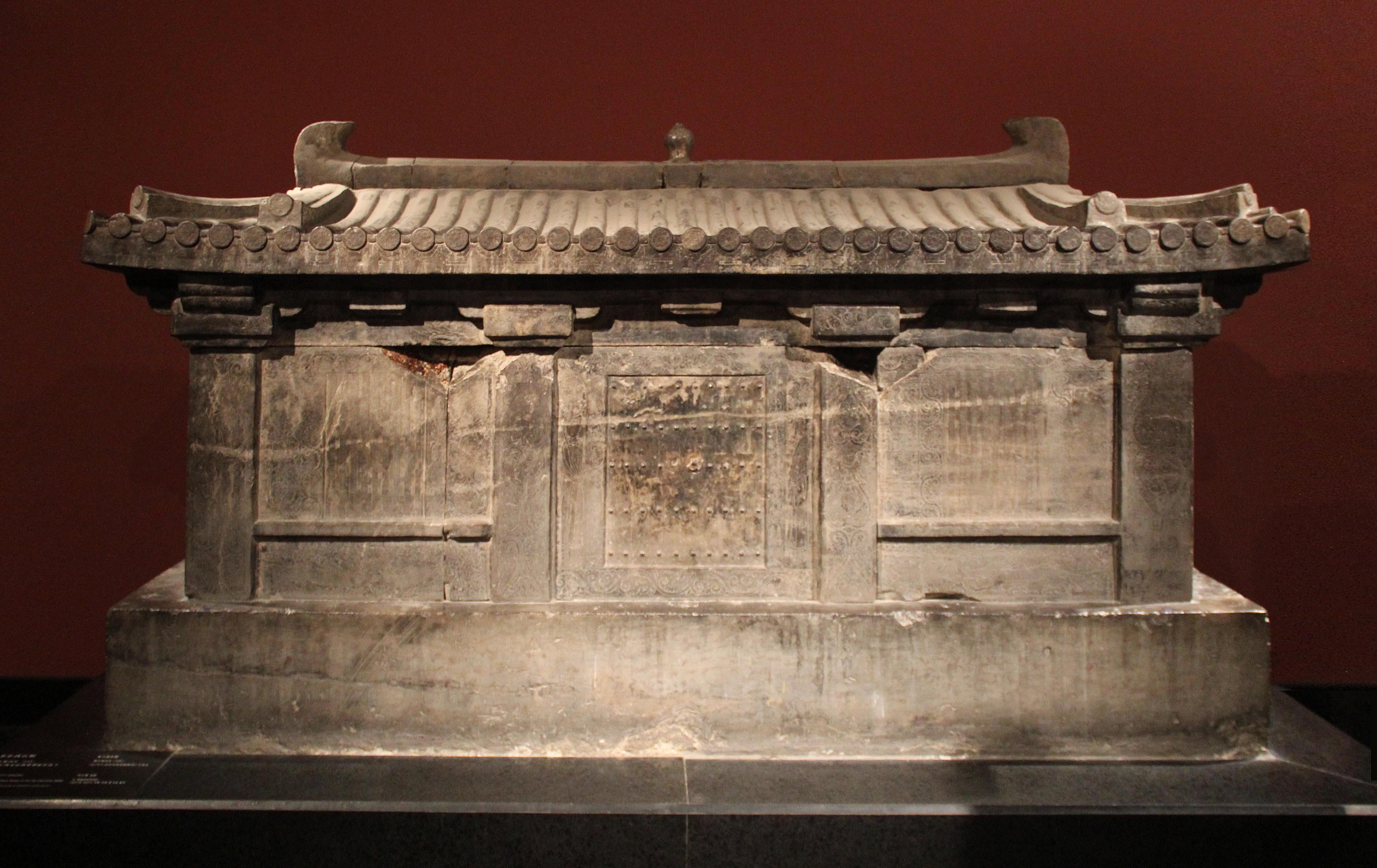
Stone sarcophagus of the 9 year old princess Li Jingxun created in 608 AD, Xi’an, Sui dynasty [800×504]
by Tall_Process_3138

Stone sarcophagus of the 9 year old princess Li Jingxun created in 608 AD, Xi’an, Sui dynasty [800×504]
by Tall_Process_3138
1 Comment
The stone sarcophagus is in the shape of a Sui dynasty house. It is a rare design, but a carved stone coffin is also known from the tomb of another princess, Princess Yongtai (684-701). Stone outer coffins were also known among non-dynastic people, such as the Sogdian officials Wirkak and Yu Hong. The sarcophagus of Li Jingxun was decorated with two engraved male and female attendants, and with painting on the inside walls of the sarcophagus, which have disappeared due to moisture.
An inscription on a tile of the sculpted gabled roof of the sarcophagus reads: “Open this sarcophagus, and you will die immediately”
The epitaph reads:
“Epitaph of the 4th daughter of sir Li, Glorious Grand Master of the Left, and Prefect of Qizhou, with a prologue.
Her first name was Lingxun, also called “Little Girl” (小孩), she was from Zhenji in Longxi. She was the granddaughter of Li Zhuang, Pillar of the State and Governor of Youzhou, and the fourth daughter of Li Min, the Glorious Grand Master of the Left. Her clan, registered in Lixiang, is remarkable and immortal. Her family shines over the region, covered in the light of the sun and the moon. In addition, she was virtuous, wise and naturally intelligent, straight as an orchid, had had a great reputation since childhood, and her fragrance brought joy. She was raised by her maternal grandmother, the Empress of the Zhou, followed the rules of Everlasting Happiness, and enjoyed her warm compassion. She was educated in the depth of the Palace, and learned the virtues of pliability and obedience. Then, she focused on the Eight Liberations [of Buddhism], and converted to the Six Perfections [of Buddhism]. Her rings and earrings shined in unisson, she had the scent of flowers. But then a great frost fell on the day, the beautiful flower fell in springtime. Without ever conceiving a child, the orchid tragically died early. She became ill on the 1st of June of the 4th year of Daye (608 CE), and died in the Palace of Fenyuan. She was nine years old….
*(the epitaph finishes with the account of the mourning of her death, and a formal eulogy in four-character poetic form)”*
— Epitaph of Li Jingxun, 608 CE
[https://en.wikipedia.org/wiki/Li_Jingxun](https://en.wikipedia.org/wiki/Li_Jingxun)