
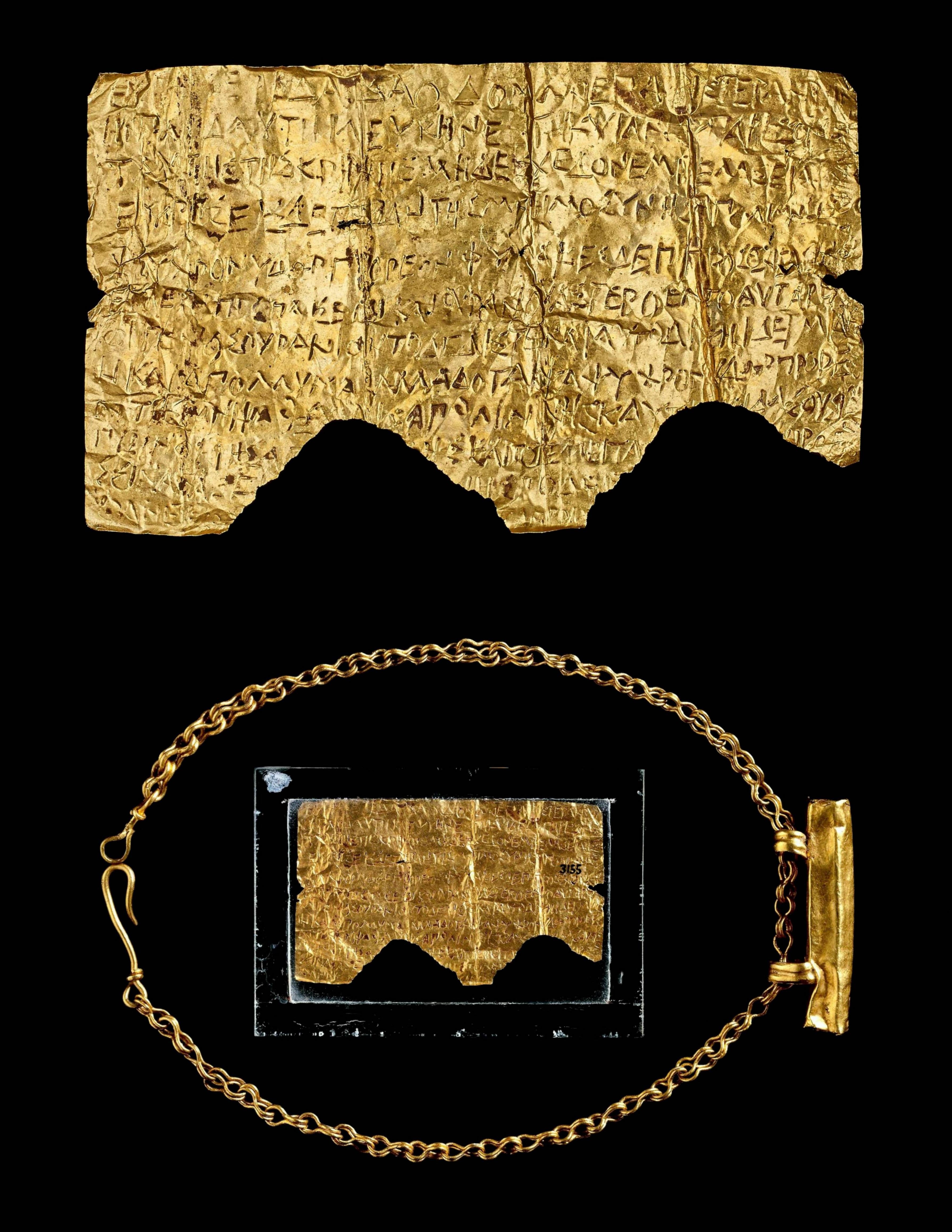
The Petelia Tablet from Ancient Greece, c.300-150 BCE: this “passport for the dead” provides instructions on where to go and what to say after crossing into the Greek Underworld, and it was supposed to allow a dead person to obtain special privileges in the afterlife [3580×4631]
by SixteenSeveredHands
1 Comment
This little tablet was crafted from a sheet of gold foil, and it measures just 4.5cm long. It was found in a small pendant case in Petelia, Italy; the tablet itself dates back to about 300-150 BCE, but the pendant case and chain were likely made about 400 years later, during the Roman era.
Experts believe that the tablet was originally buried with a human body, and that an unknown individual later removed it from the burial site and stuffed it into the pendant case. Unfortunately, they simply rolled it up and snipped off the tip of the tablet in order to make it fit, and the final lines of the inscription were destroyed in the process.
This type of textual amulet is often described as a *totenpass* or “passport for the dead.” *Totenpässe* were supposed to be used as roadmaps to help guide the spirits of the dead as they journeyed through the Underworld, and they were also meant to serve as indicators of the elite or even “divine” status of certain individuals, providing special privileges and allowing them to obtain an elevated position in the afterlife.
This particular *totenpass* is incised with a Greek inscription that reads:
> You will find a spring on your left in Hades’ halls, and by it the cypress with its luminous sheen.
> Do not go near this spring or drink its water. You will find another, cold water flowing from Memory’s lake; its guardians stand before it.
> Say: “I am a child of Earth and starry Heaven, but descended from Heaven; you yourselves know this. I am parched with thirst and dying: quickly, give me the cool water flowing from Memory’s lake.”
> And they will give you water from the sacred spring, and then you will join the heroes at their rites.
> This is [the … of memory]: [on the point of death] … write this … the darkness folding [you] within it.
The final section was damaged when the tablet was shoved into the pendant case. Sadly, that part of the inscription does not appear on any of the other tablets that are known to exist, so the meaning of those lines remains a mystery (no pun intended).
Tablets with this motif are also known as “Orphic lamellae” or simply “Orphic tablets,” because they were traditionally attributed to an Orphic-Bacchic mystery cult.
Only about 40 orphic tablets are known to exist, and they are all made from sheets of gold. The inscriptions vary, but they generally include references to a cypress tree, a spring that must be avoided, another spring known as the “Lake of Memory,” the sensation of thirst, and a conversation with a guardian (or another entity that is associated with the Underworld, like the goddess Persephone) in which the dead must present themselves as initiates or divine individuals before they are permitted to drink from the Lake of Memory, which would allow them to obtain privileges reserved only for the elite.
The details of that reward are unclear. Orphic tablets may have been viewed as a way to gain access to the Elysian Fields, to participate in certain sacred rites, or to break free from the eternal cycle of reincarnation. Regardless of the specific details, the overall objective was likely the same: to obtain a special status and acquire privileges that were inaccessible to most of the souls in the Underworld.