
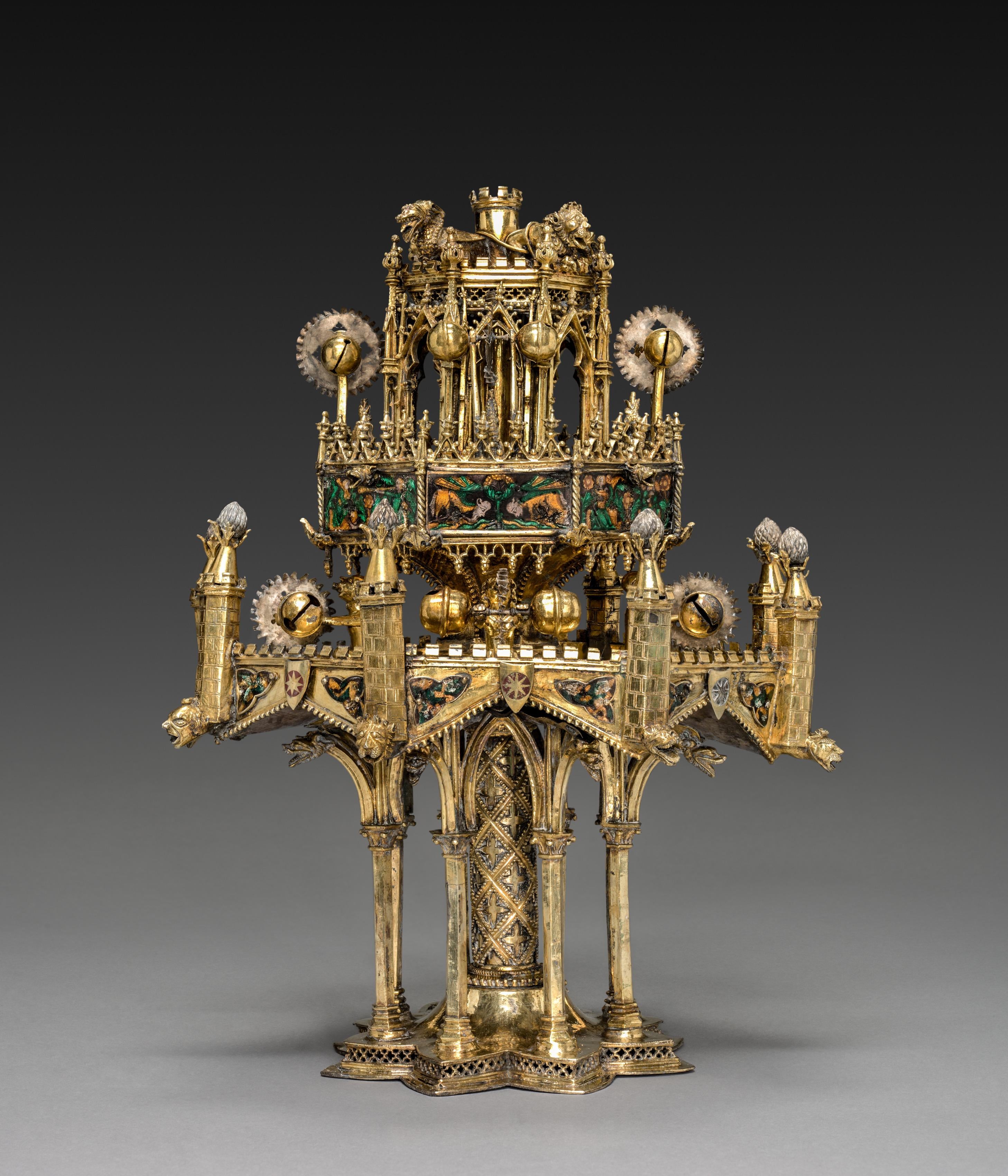
This is the heavily-decorated structure of a small or "table" fountain, which originally would have been attached to a matching basin, now missing. Rather than placed on a table, as the name would suggest, it might have stood on a small pillar or the floor in a reception or banquet hall. Through a system of pipes connected to a reservoir, it would have spouted water or perfume, which would have made it almost like an air freshener. To the wheels are attached bells, which would have chimed as the cascading water turned them around. While the wheels on the upper level are kept in place by unadorned pieces of metal, the ones on the lower level are held by nude figurines. Its decoration makes use of elements found in architecture, as well as statues and enamels depicting mythological creatures. Automated decorations such as these were popular fads among the richest of the rich, and were not limited to fountains, but could also include moving statues, powered by wind, hydraulics, or clockwork.
Unfortunately the exact origins of this unique piece (literally, as it is the only of its kind to survive) are unclear, though we can make an educated guess. The quality and amount of decoration indicates its original owner was of wealthy, probably noble origin. It has eight sides, and each is decorated with a shield bearing an eight-pointed star, the personal emblem of king Jean/John II, and may therefore have belonged to him or someone from his entourage. As such, it is very likely that the piece was produced in Paris, then an international hub for luxury trades like goldsmithing and clockmaking, and where it was acquired by the Cleveland Museum of Art in 1924 shortly after its discovery. Another explanation for the eight-sided shape is as a symbol of renewal, creating a link between this fountain, and the Fountain of Youth.
by FieteHermans
4 Comments
Thanks for sharing your knowledge and its uniqueness
These kinds of fountains were so impressive that Möngke Khan had French artists build him one to serve his court at his capital Karakorum. It was described by the French missionary William of Rubruck during his missionary trip across the Mongol Empire. There’s a good article summarizing what he saw:
[The Khan’s Drinking Fountain](https://publicdomainreview.org/essay/the-khans-drinking-fountain/)
>Now the words “drinking fountain” might evoke high school hallways and awkwardly hunching over to bring your face to the faucet, but this was something else entirely. Crowned by a trumpet-wielding, angelic automaton, the main structure formed a magnificent silver tree, wrapped in silver serpents and complete with branches, leaves, and fruit. At its roots sat “four lions of silver, each with a conduit through it, and all belching forth white milk of mares.” Up in the branches, four pipes emerged to splash a different alcoholic beverage down to silver basins waiting below. There was grape wine, fermented mare’s milk, rice wine, and honey mead, all to be ready when the khan so desired. This so-called “drinking fountain” was, for all intents and purposes, a most convoluted and extravagant bar.
>
When the call came, the man would blow, and the angel would raise the trumpet to its lips. The sound produced was loud enough to bring servants scurrying from the cavern outside the palace where drinks were stored. They would pour liquids into the tree’s roots that would quickly siphon up and pour out from above and into the basins. From there the drink would be collected by cup-bearers and delivered, in great style, to the khan and his guests.
Thanks very much for this post. Very interesting!
Great write up, thanks for sharing!