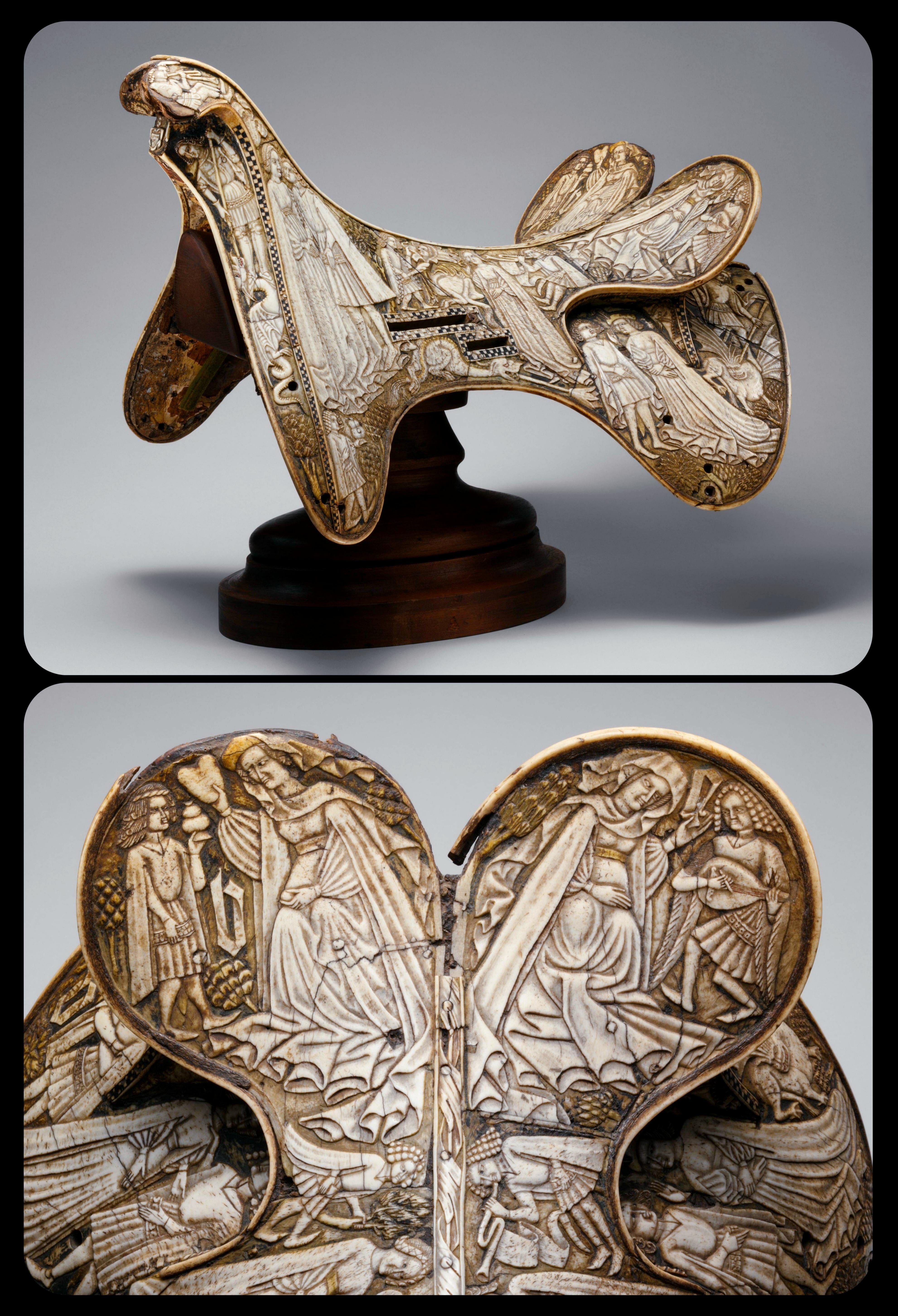
Bone Saddle from Bohemia, c.1400-1420 CE: this medieval saddle is decorated with bone plaques that depict scenes of romance and courtship, along with references to sex, pleasure, and chivalry [3964×5808]
by SixteenSeveredHands

Bone Saddle from Bohemia, c.1400-1420 CE: this medieval saddle is decorated with bone plaques that depict scenes of romance and courtship, along with references to sex, pleasure, and chivalry [3964×5808]
by SixteenSeveredHands
1 Comment
This saddle was crafted from staghorn, bone, birch bark, rawhide, metal, and limewood. Bone pins and glue were used to fix each plaque to the limewood core of the saddle, and the panels were originally adorned with green, blue, and red pigments.
The bone plaques are decorated with intricately carved scenes of romance; some of these scenes show women being serenaded by suitors and troubadours, lovers caressing one another, couples exchanging tokens of their affection, and men offering luxury containers in exchange for their lovers’ hearts. Squeezed beneath the left flank of the saddle is a scene that depicts two lovers holding hands and gazing at one another, while another scene on the right flank shows a man and woman standing cheek-to-cheek as the woman wraps her arms around the man’s back and pulls him to her breast.
Knights, dragons, and monstrous figures are also depicted on several panels.
As the [Metropolitan Museum of Art](https://www.metmuseum.org/art/collection/search/467691) describes:
> Romantic and erotic imagery adorned not only the pages of late medieval manuscripts and the vessels of a lady’s private dressing table; these themes were equally suited to the public self-fashioning of European nobles.
> Illicit touch and unmediated sight are just two of the carnal senses evoked by this saddle. Tucked between larger figures, troubadours and instrument-bearing grotesques evoke the auditory pleasures of the court, while floral and arboreal motifs conjure the alluring sights, smells, and tastes of a pleasure garden.
> This saddle stages touch not only as skin-to-skin contact, but also as penetration. On the right tip of the saddle’s pommel, a man pokes his hand into a conical hat as a cheeky reference to the amorous intentions of the embracing couple below. Three other vignettes show male protagonists stabbing monstrous adversaries. As oblique references to the physicality of sex, wounding touch also symbolizes the social domination and submission that resulted from medieval coupling as well as, perhaps, an encoded warning about the pain of love lost.
> Even the shape of the saddle is suggestive. The accentuated curvature of the pommel and the double-lobed cantle (a common feature of Eastern European saddles) emphasize the saddle’s phallic form.
> For those viewers bold enough to inspect the saddle’s hidden surfaces, grotesques under the pommel and at the center back of the cantle offer comic relief while also warning against the bestial side of desire.
> The morals of late medieval Christianity are primarily embodied on this saddle by Saint George, shown as a knight spearing a dragon on the right side of the pommel. According to hagiographic precedent, the dragon’s defeat secured the safety of a captive maiden, an ideal of feminine purity threatened by the corruption of evil.
> Saint George and the dragon and scenes of courtly love dominate the roughly twenty bone saddles that survive from late medieval Europe.
> Attached to a limewood core with bone pins and glue, the carved panels probably derive from the pelvic bones of cows or other large animals. The underside of the saddle is lined with hide and birch bark. Although these fragile materials are ill suited for the battlefield or daily use, bone’s off-white color and receptiveness to carving served as the ideal ground for eye-catching carvings and paintings.
> Viewers today should remember that the saddle was originally brightly colored with blue, green, and red paint. The saddle was also just one part of a larger ensemble of a horse’s parade armor.
This particular saddle is associated with the court of Wenceslaus IV.
#Sources & More Info:
– Metropolitan Museum of Art: [Bone Saddle](https://www.metmuseum.org/art/collection/search/467691)
– Museum Publication: [Prague: the Crown of Bohemia](https://books.google.com/books?id=AbZ-rhlSlxsC&lpg=PA215&pg=PA236#v=onepage&q&f=false)
– American Journal of Archaeology: [Mediaeval Sculptured Saddle](https://archive.org/details/sim_american-journal-of-archaeology_1942_46_supplement/page/142/mode/1up?q=%22Mediaeval+Sculptured+Saddle%22)
– The Gothic Ivories Project at the Courtauld Institute of Art: [Trivulzio Saddle](http://www.gothicivories.courtauld.ac.uk/images/ivory/9554ADDE_7bcef3cf.html)
– Central European University: [The Art of Love in Late Medieval Bone Saddles](https://www.etd.ceu.edu/2017/somogyvari_virag.pdf) (PDF)