
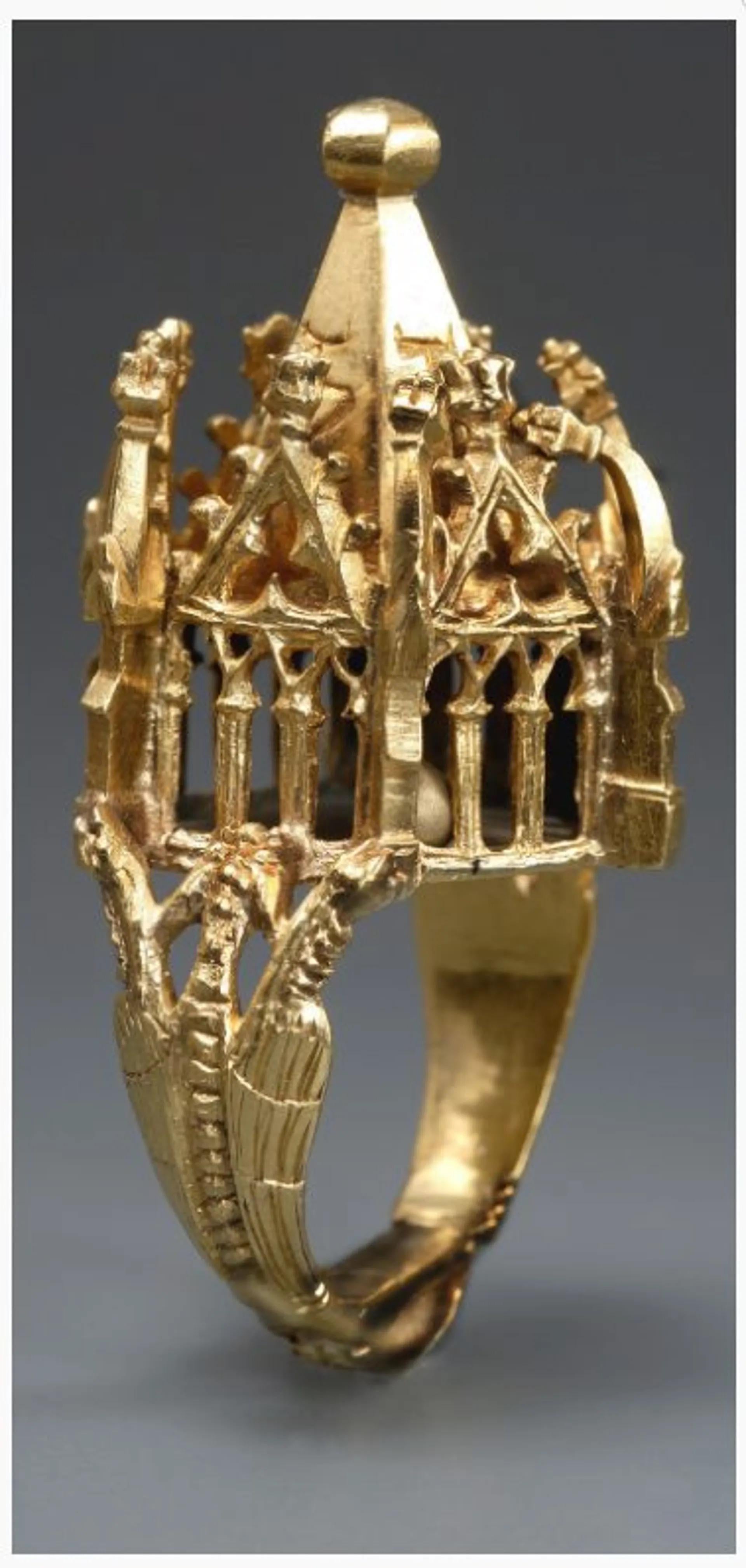
Jewish wedding ring, Germany, first half of the 14th century. The ring takes the form of a miniature building, symbolizing the lost Temple of Jerusalem and has a band in the form of the clasped hands of the betrothed couple. [1920 x 4038]
by Persephone_wanders
4 Comments
This ring is a treasure from the long-lost Jewish communities of Europe, this exquisite and rare gold ring, one of three, was used in Jewish weddings. It takes the form of a miniature building, symbolizing the lost Temple of Jerusalem and has a band in the form of the clasped hands of the betrothed couple. Since Jewish law stipulates that wedding rings be smooth and unadorned, such opulent rings were likely used solely for the ceremony, in which remembrance of the Temple played a vital role. The ring is at [The MET](https://www.metmuseum.org/art/collection/search/688007).
The Jewish Wedding Ring was found in Erfurt/ Germany and is considered to be the most impressive and detailed of the three medieval wedding rings that still exist today. The masterpiece of medieval Jewish wedding rings represents the outstanding Jewish craftsmanship of the 14th century.
The ring was buried under a cellar staircase near the Old Synagogue in 1349 together with over 3,141 silver coins, 14 silver bars and 700 goldsmith objects. This unique ensemble of Jewish artefacts was rediscovered during construction work in 1998 and is known as the Erfurt Treasure.
The ring is made of pure gold without gems. The ceremonial ring was owned by the entire Jewish community and was only used during the wedding ceremony.
The upper side of the ring impresses with its finely crafted Gothic temple architecture symbolizes the destroyed Temple in Jerusalem. Inside the temple there is a small golden ball that creates a special sound when the ring is moved.
On the underside are two fine ornamented and intertwined hands, a symbol of marital fidelity. On either side of the circlet, winged dragons support the miniature Gothic temple. The Hebrew letters מזלטוב are engraved with amazing precision on the roof of the miniature temple.
Oh wow, that’s great craftsmanship. Amazing it survived so long in such good condition!
So they would give each other opulent rings they didn’t own in a public setting?
I’m sensing this may have had a part in propagating that one stereotype I don’t even need to name.
Cool ring though, looks like it even has a little bell or something.
I dont know much about Middle Eastern architecture but this has a definitively European gothic look to it, resembling Catholic cathedrals not a temple of Salomon. Given how many goldsmiths and jewelers existed in this region at the time what attributes this ring to a particular craftsman?
Could it be just any locally sourced ring as part of a wealth hoard?
I am not questioning where it was found but surely jewelry comes from all over not from the very address where it was buried? Could it not be bought in another town or ordered from a non-jewish artisan?
And if the law is explicit in stating no adornments how do we know how it was used? Is it just a conjecture or do we have sone period literature describing weddings breaking the prescribed laws? The communal ownership is particularly interesting, are there any books to read on it?
Finally what makes the rattling of the ball special? Whats is its significance?