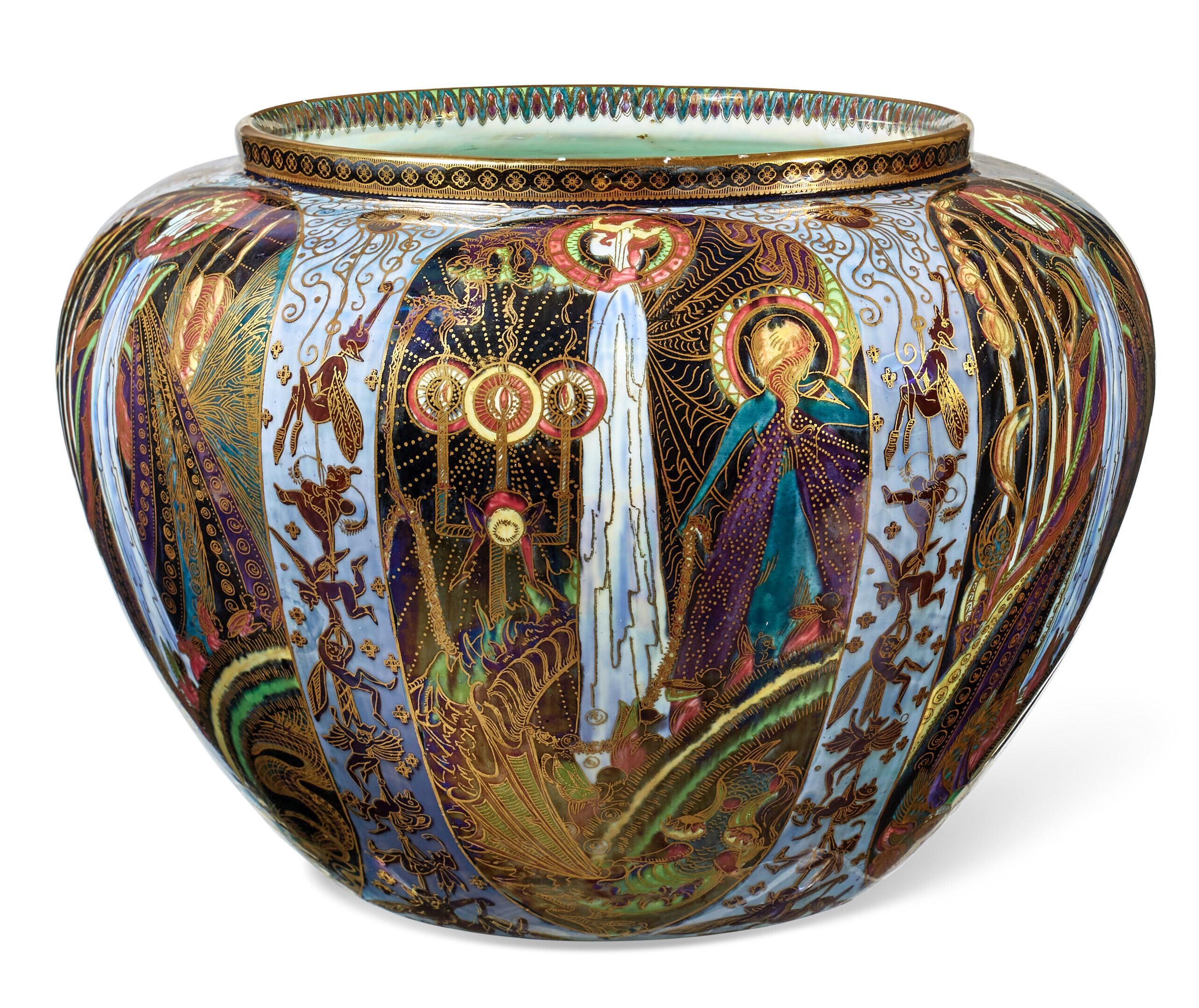
A Wedgwood Fairyland Lustre Porcelain Black Vase, Designed by Daisy Makeig-Jones, Circa 1920-1930 [2561 x 2153]
by Mysterious_Sorcery

A Wedgwood Fairyland Lustre Porcelain Black Vase, Designed by Daisy Makeig-Jones, Circa 1920-1930 [2561 x 2153]
by Mysterious_Sorcery
1 Comment
Information about the vase: “The sides enriched in the ‘Candlemas’ pattern with six vignettes of haloed candle-bearers footed by swirling dragons, the vignettes spaced by blue lustre bands decorated with imps climbing church bell-ropes, the short raised rim with a gilt flowerhead band and the interior rim embellished with the ‘Pan-Fei’ gilt border, the interior foot slightly domed and enriched with a roundel of gilt grasses, flowers and feathers on a dappled purple ground.” From [Christie’s](https://www.christies.com/en/lot/lot-6426775).
Information about the [artist](https://nmwa.org/exhibitions/ceramics-daisy-makeig-jones/): “Daisy Makeig-Jones was among the best-known ceramic designers in the early 20th century, a period when Wedgwood and other companies employed many women as designers and artisans. Makeig-Jones was born in Yorkshire, England, to a middle-class family that supported her artistic ambitions. Through family connections, Makeig-Jones introduced herself to Cecil Wedgwood, a partner in the Wedgwood firm, and she began an apprenticeship at the company in 1909. Beginning in 1914, Makeig-Jones worked as a lead designer with Wedgwood and began experimenting in both production and design.
With motifs inspired by contemporary illustrated fairy-tale books, Makeig-Jones’s Fairyland Lusterware became highly popular in the 1920s among fashionable collectors. Influenced by the Arts and Crafts movement and Art Nouveau style, Makeig-Jones’s ornamental wares stood apart from more streamlined works produced by Wedgwood and other firms during the same period.”