
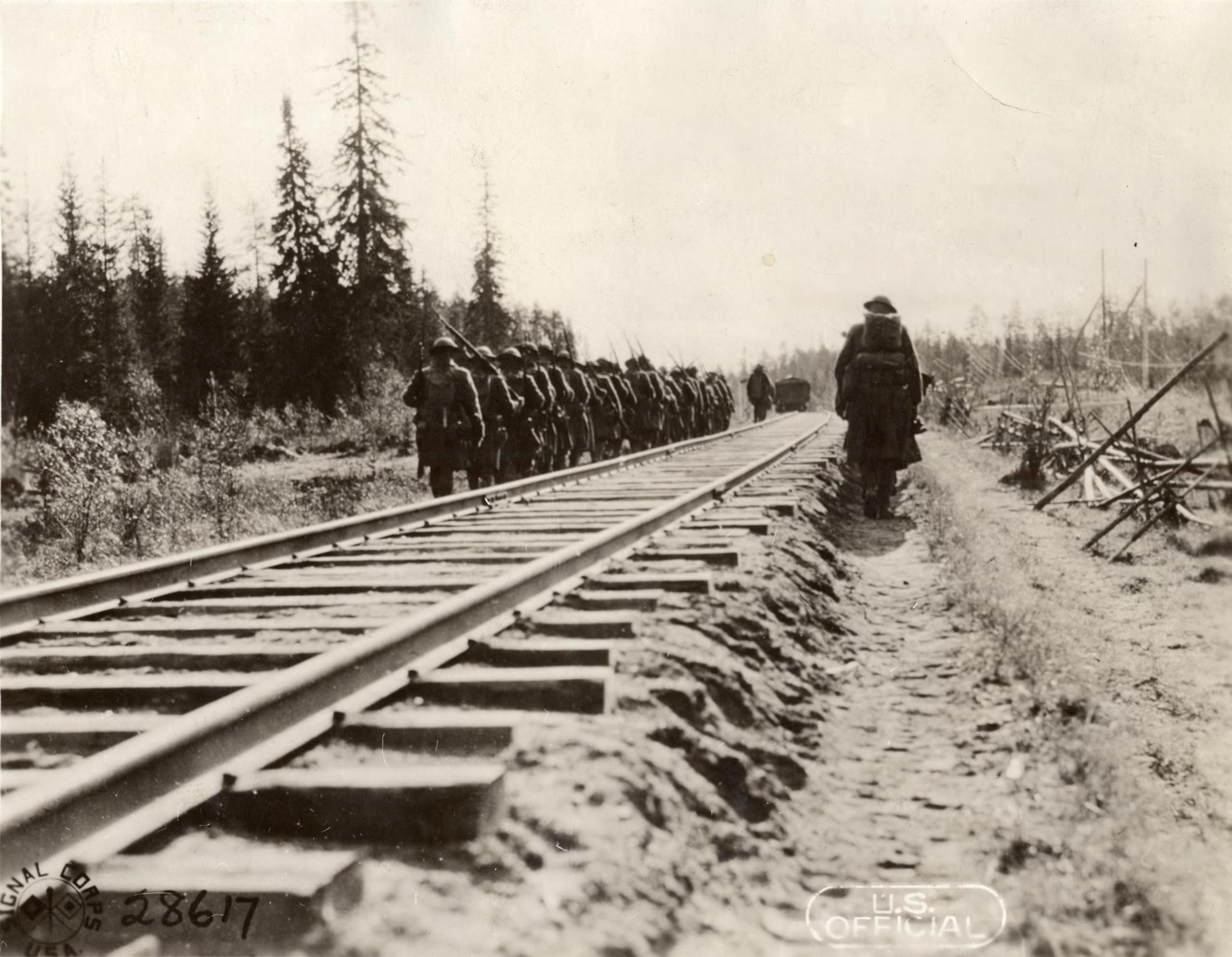
After the October Revolution of 1917, Vladimir Lenin came to power in Russia, and the country plunged into a civil war between the communists ("Reds") and nationalists ("Whites"). For the Allied Powers, Moscow’s withdrawal was a potentially fatal blow: the Central Powers no longer had to worry about the Russian front and could converge their effort on an offensive towards Paris. Desperate, in the summer of 1918, the U.K., France, and other Allies sent troops into northern Russia and Siberia to influence the outcome of the Russian civil war and recreate the Eastern Front.
The 339th Regiment was given orders to go to England and from there to France. It was only on July 17, 1918, when the regiment was embarking a transatlantic convoy in New York, that President Woodrow Wilson reluctantly ("sweating blood," as he wrote to his closest advisor) yielded to French and British pressure and officially decided to intervene in Russia. "The Allies had tried to convince Wilson to intervene against the Bolsheviks for months," says Carl Richard, professor of history at the University of Louisiana at Lafayette. "When the German shells started falling on Paris, he finally agreed." When the troops arrived in England, they were issued heavy winter clothes and finally discovered they were going to Russia.
The famous explorer Ernest Shackleton was assigned to training the 339th, who would eventually become known as the "Polar Bears". Shackleton also designed special boots which later became infamous among the soldiers. "The Shackleton boots worked very well in the compact snow of Antarctica, but performed very poorly in the Northern Russia quagmires", explains Mike Grobbel, president of the Polar Bear Memorial Association, a Polar Bear decorated with the Distinguished Service Cross and the French Croix de Guerre. "Many soldiers ended up throwing them away and buying local footwear."
On September 5, 1918, the Bears landed on Russian soil at the White Sea port of Arkhangelsk after a cruise plagued by the Spanish flu that killed dozens on board. At the same time, around 8,000 more U.S. troops were sent to support the Whites in Siberia. Arkhangelsk was in British hands at the time, and the 339th Regiment was put under orders of the occupying force to start an offensive against the Bolsheviks, driving the Reds some 200 miles south of the city.
The Allied front reached its maximum extension near the village of Ust Padenga, 450 miles from Moscow on January 1919. Three weeks before, the parish priest had been captured by the Red Army and killed by locals loyal to the Soviets. According to a newspaper of the time, the priest was beheaded, disemboweled, and his body stuffed with straw and frozen.
[…]
On January 19, with temperatures around -49 F (-45 C), the Red Army attacked with 1,300 men. (according to wikipeida, it was 800) "At 05.30 am I was awakened by artillery fire," writes Lieutenant Harry Mead. "I ran out to see what was up and was greeted by a burst of shrapnel right over my headquarters." Of the 47 "doughboys" defending the outpost, 25 died, and 15 were wounded.
The life condition of the Allied troops must have looked desirable to the Russians observing from the church's bell tower on the other side of the front. In his memoir, Red Army soldier Alexander Bykov lists the luxuries of his American counterparts. "The Americans (…) erected strong dugouts, blockhouses, and trench communications. It was considered an impregnable fortress for the Red Army soldiers and their commanders, writes Bykov sarcastically. "They were dressed in overcoats (…) fur mittens with ribbons up to the elbows; each soldier had five woolen blankets (…) chocolate bars in the pockets of their khaki jackets, and smugly smoked fragrant cigarettes."
When it finally became clear that trying to influence the destiny of the Russian civil war was futile, American troops withdrew from Arkhangelsk on June 15, 1919. A decade later, a recovery mission by the Veterans of Foreign Wars collected the remains of 86 U.S. troops left behind on Russian soil; 27 Polar Bears remain unaccounted for to this day.
( source : https://www.nationalgeographic.com/premium/article/us-russia-polar-bear-wwi-bolshevik-arkhangelsk )
by LookIntoTheHorizon