
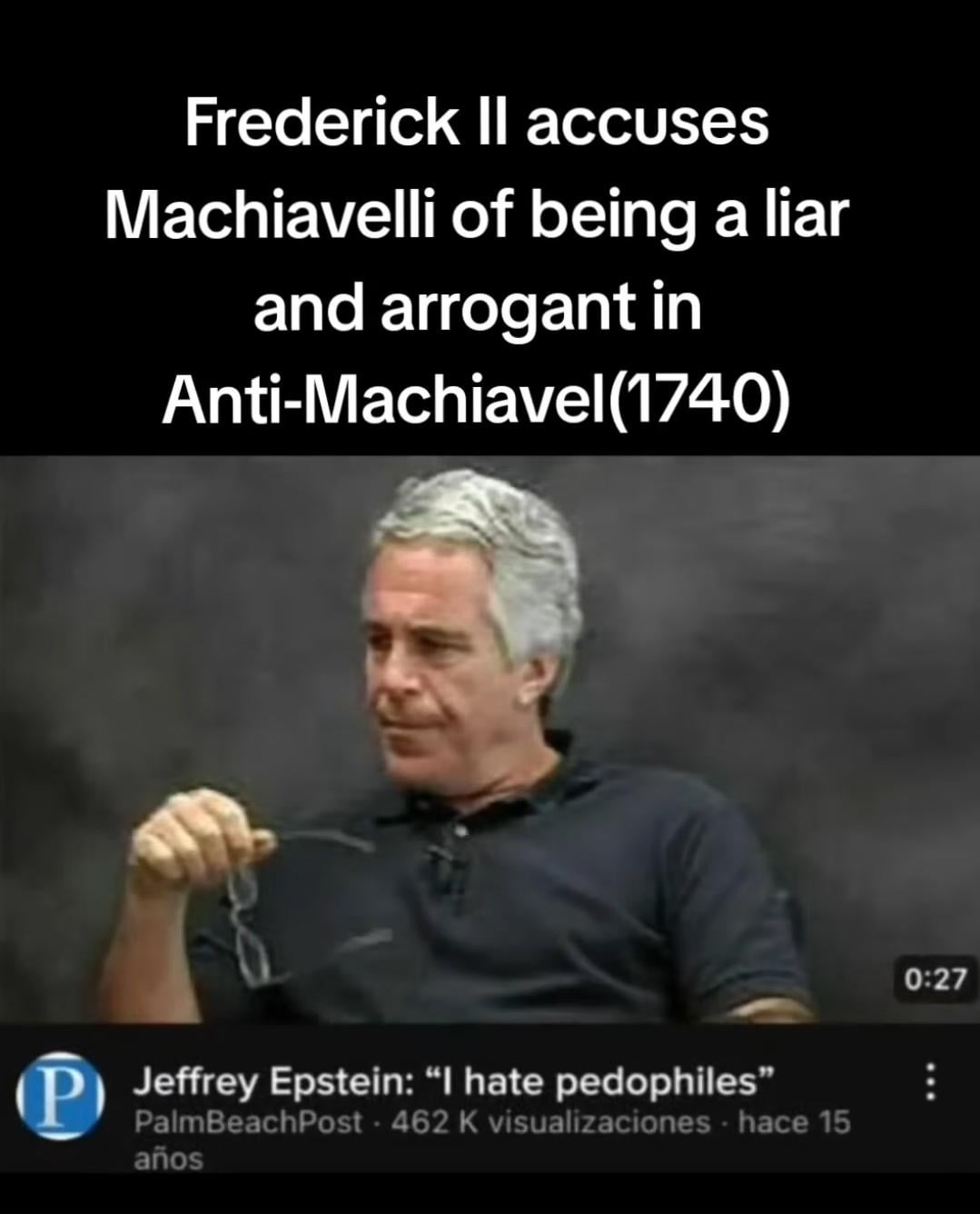
Context::
Frederick II of Prussia wrote Anti-Machiavel in 1739–1740 before becoming king, criticizing Niccolò Machiavelli for promoting deceit and rule through fear. With help from Voltaire, Frederick argued that rulers should govern with justice, honesty, and morality.
But after becoming King of Prussia in 1740, he invaded Silesia the same year, using weak legal claims to expand his power. Over time, he relied more on secret diplomacy, shifting alliances, and political calculation.
In his early writings, Frederick supported enlightened and moral rule, but by his Second Political Testament in 1768, he admitted that politics often required secrecy and pragmatism. In the end, the king who rejected Machiavelli slowly became the kind of ruler Machiavelli described.
And the image is of… Well if you don't know him, you are unaware of elite meme knowledge
by My_Test_Acc_1
5 Comments
Frederick II had a massive conflict on the way to rule with his father Frederick William I when he was young.
But then, as time passed, he became more and more accepting of his father’s way of ruling. In some way, the Soldier King ruled a rather peaceful era, while his peace-loving son led a bloody era that marked his name down in history as Frederick the Great, a great military ruler.
Wait was he one of those pedophile losers who insists on being called an “ephebophile”
This nga’s last words were “I’m tired of ruling over slaves” btw 😭😭✌️
Very interesting dichotomy between how you feel before being a ruler and after becoming one. Very easy (and understandable) to be anti despot when your abusive father the king makes your life hell, much harder to be anti despot when all the things you want require despotism.
He just doesn’t like the competition