
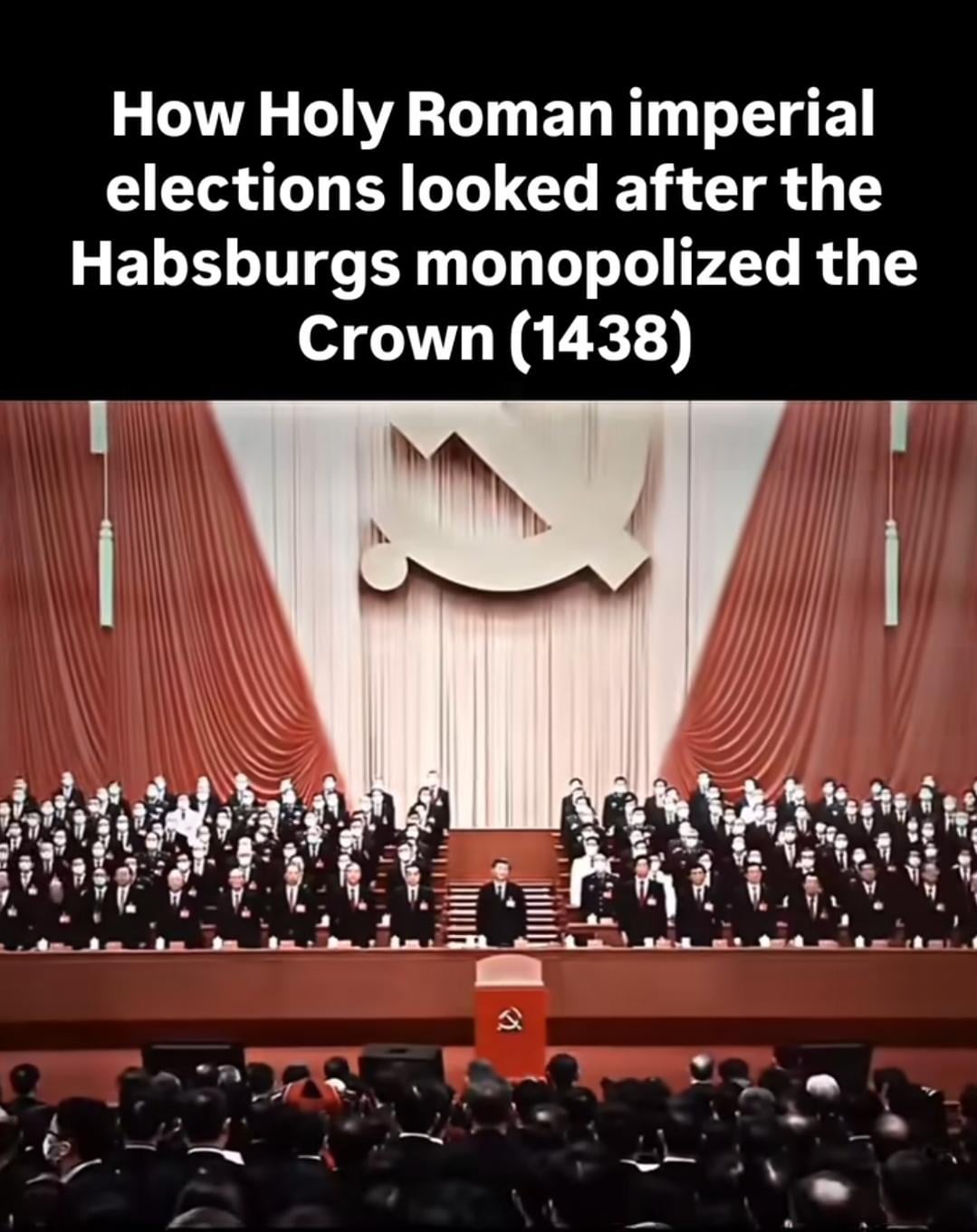
For centuries, the Holy Roman Empire claimed to be an elective monarchy, where powerful prince electors gathered to choose the next Emperor. Yet after 1438, the outcome of these elections became increasingly predictable as the Habsburg dynasty secured an almost continuous hold over the imperial crown. What was once presented as a competition between the Empire's greatest houses gradually turned into a ritual confirming Habsburg supremacy.
The imperial elections still preserved their elaborate ceremonies, negotiations, and political theater in Frankfurt, but behind the spectacle, most European rulers understood that the Habsburgs had become nearly impossible to displace. By the sixteenth and seventeenth centuries, the imperial title had effectively become a hereditary possession in all but name, symbolizing the overwhelming influence of the Austrian dynasty within the Empire.
by My_Test_Acc_1
6 Comments
From a certain point of view, yes.
From another point of view, Habsburg centralization helped streamline an otherwise very inefficient system.
you implied a soviet election is not democratic, im sorry for the upcoming inevitable arguments.
The Habsburgs had to provide copious amounts of bribes just to get elected. And face rebellions still.
On the other hand just one Congress election where Stalin got more negative votes than Kirov started the Great Purge.
It was kinda like that With the Hohenstuafen and Luxembourg dynasties as well
Tbf, Fredrick of the Palatine tried to upset the system by becoming king of Bohemia and throwing the election to him.
It kicked off the Thirty Years War and none of the Protestant princess wanted to go along with it.
And before that the Elector of Cologne got booted when he converted to Protestantism in part because it would’ve shifted the electors to a protestant majority
But it does show that it was more than just a formality.
But then that one Wittlesback snuck in and stole it in the 1700s.