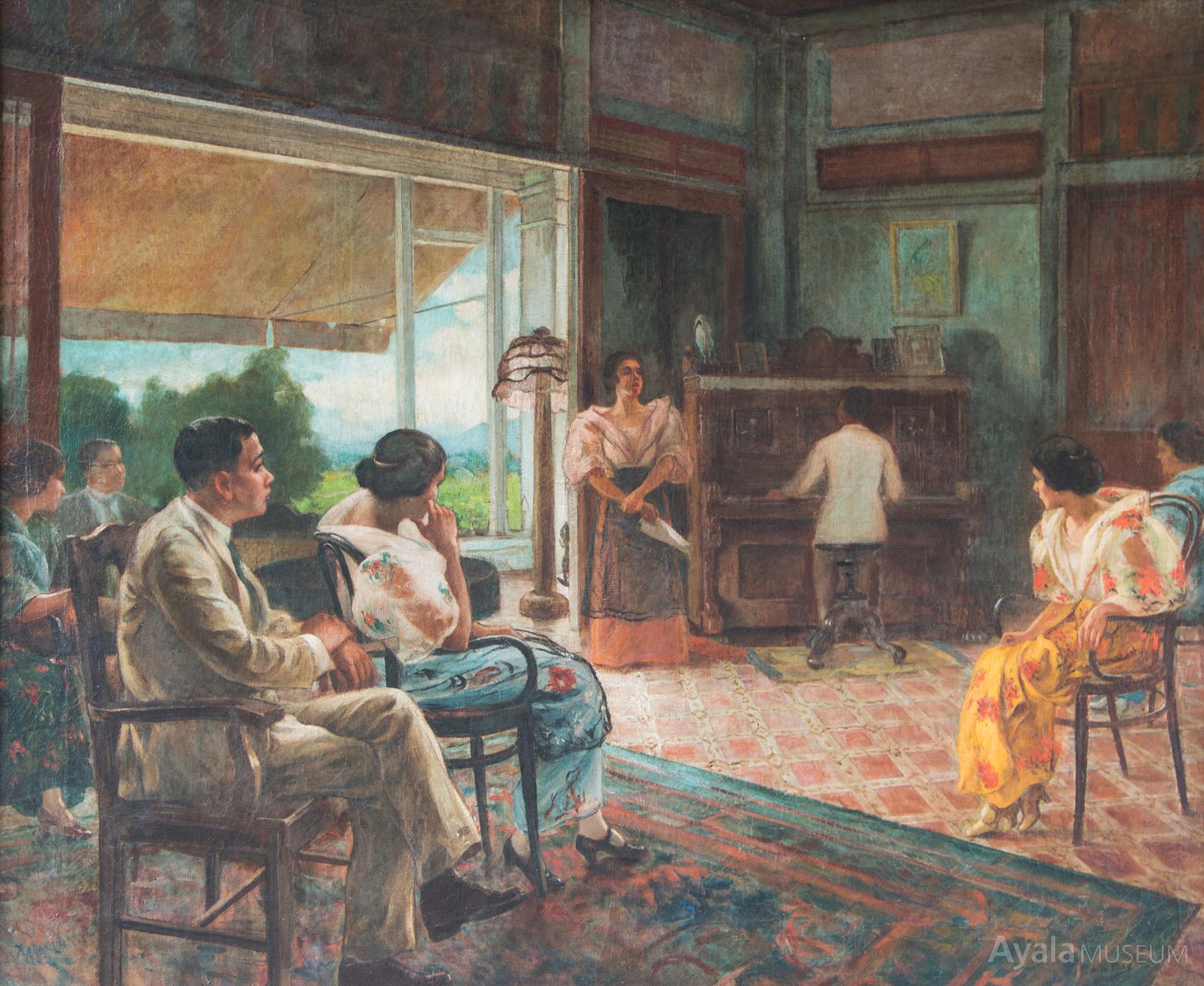
“El Kundiman”. Painting by Fabián de la Rosa. Philippines, Insular Government, 1932. [2000×1638]
by No_Stay_6006

“El Kundiman”. Painting by Fabián de la Rosa. Philippines, Insular Government, 1932. [2000×1638]
by No_Stay_6006
2 Comments
Currently part of the Paulino and Hetty Que Collection.
A framed reproduction hangs in its original location at the Dr. Luis Santos Ancestral House in Kamestisuhan District,^1 Malolos, Bulacan, reportedly as a compromise trade in exchange for the restoration of the main hall ceiling painted by Fernando Amorsolo.^2
General information about the artefact from the [Cultural Center of the Philippines Encyclopedia of Philippine Art](https://epa.culturalcenter.gov.ph/3/82/2216/).
In addition, the audience consists of the prominent ophthalmologist Dr. Luis U. Santos^3 in the left foreground and his younger sisters garbed in late 1920’s *terno* (still in vogue at the time of painting).
Most of the additional information regarding this artefact is from heritage advocate Leo D. Cloma’s [2010 blog entry of the Dr. Luis Santos Ancestral House](https://akyat-bahay-gangster.blogspot.com/2016/05/cix-good-doctors-home-1933-luis-u.html).
The watermark on the bottom right is due to the artefact being loaned for an exhibit at the Ayala Museum in 2022. Here is a [picture](https://commons.wikimedia.org/wiki/File:Kundiman_-_Fabián_de_la_Rosa_(framed).jpg) of the artefact with its original frame and label.
——-
Notes:
1 – Aptly named due to the number of *mestizo* (half-blood caste) families that had historically inhabited the area: mainly comprising *mestizo español* (Spanish-Filipino) & *mestizo sangley* (Filipino-Chinese). The district features many heritage houses in different architectural genres and in almost pristine condition.
2 – Fabián de la Rosa is Fernando Amorsolo’s maternal first cousin once removed; in general the relationship is simply called uncle-nephew due to lack of specific native terms for consanguinity. In the aftermath of Amorsolo’s father’s death when he was 11, the bereaved family temporarily lived with de la Rosa. Later on Amorsolo apprenticed under his “uncle”‘s wing who guided his eventual painting style.
3 – Dr. Santos’s renown is such that the mentioned artists were also his former patients, and their rendered artworks are basically gratitude art.
Tamil speakers will love this one