
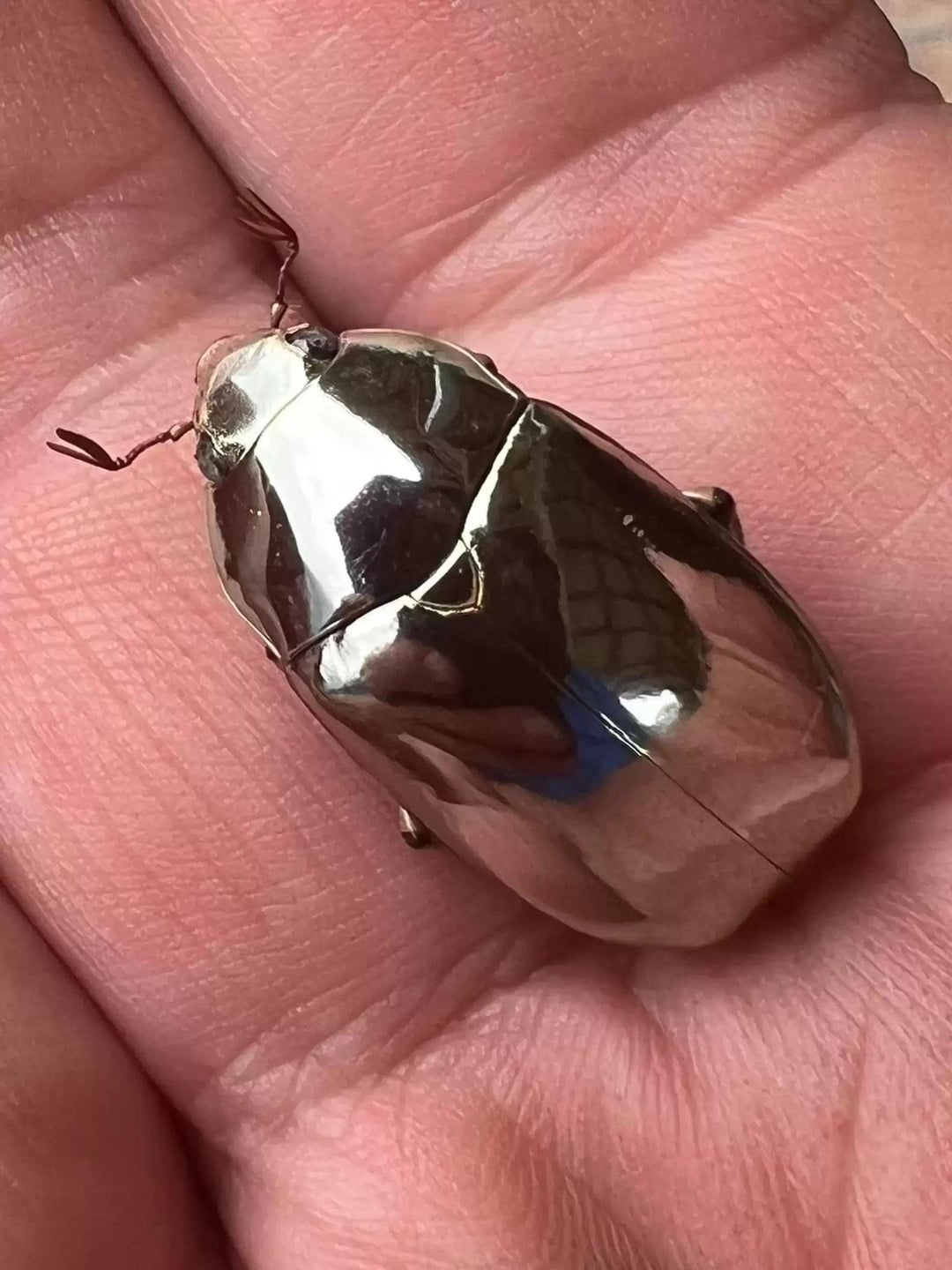
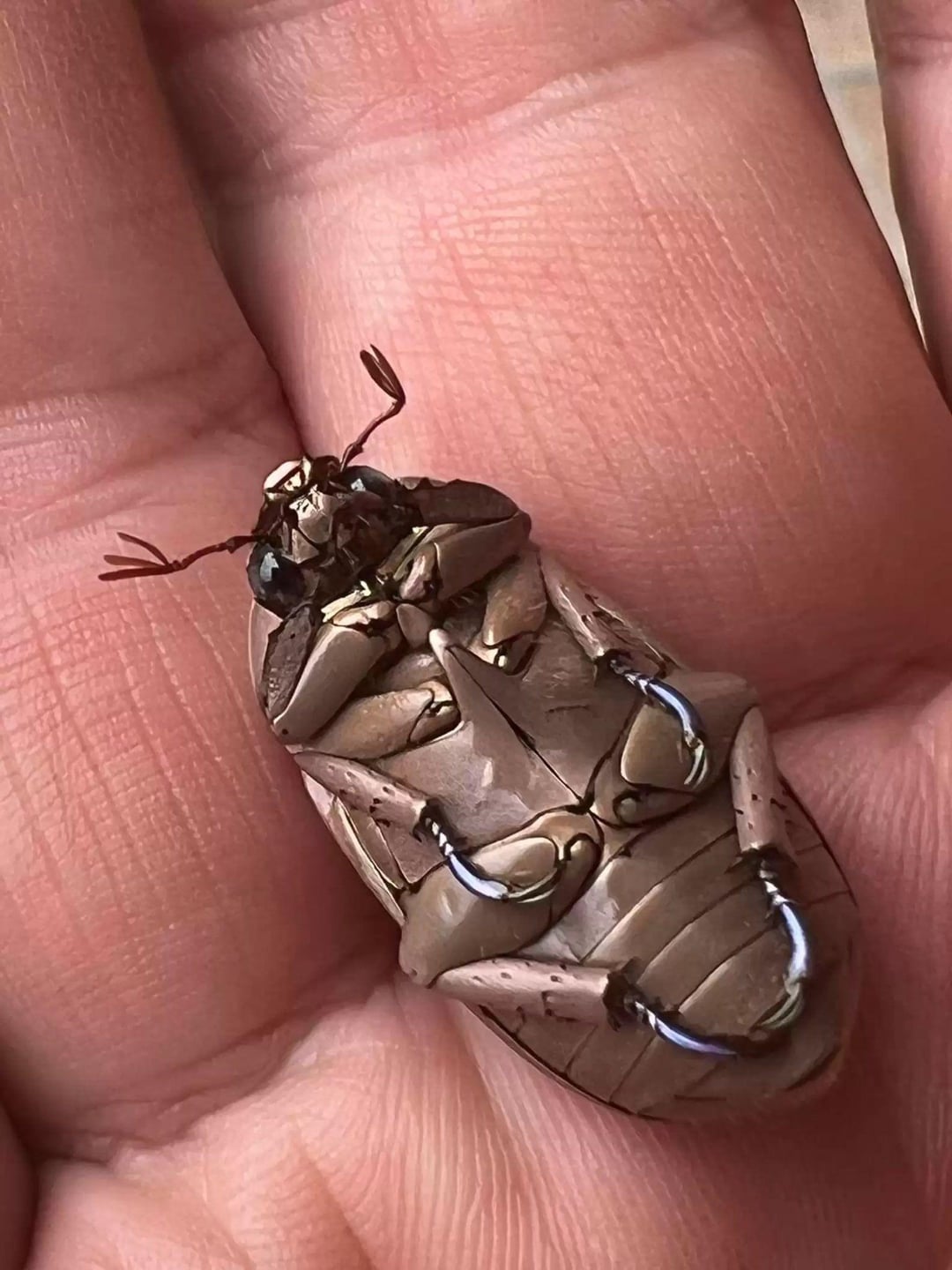
Man discovers an incredible beetle that looks almost too stunning to be real ,It’s a rare species of scarab beetle called Chrysina limbata, known for its metallic appearance. It’s found only in mid-altitude forests in Costa Rica and western Panama.
by Darshan_brahmbhatt
26 Comments
not sure if he discovered it as it was already known to exist
Shiny pokemon are real
The Mummy, get ready, Imhotep is coming !!!
Elden Ring you’d get some extra discovery bonus on this bad boy.
No punchbacks
Looks like it dropped a very rare skin
The Saharan Silver Ants are badass too.
Terminator’s little bro.
Okay ill play spelunky 2 again
Only in Panama and Costa Rica because they have trouble getting through customs.
Space beetle
Beetle be like:

Aww. The little guy wants a belly rub.
Fucking tourists… I’ve lived my whole 40 years of life in Costa Rica and I’ve never seen one of these.
Looks like it should be dangling from a necklace.
Shiny and chrome. On to Valhalla!
> **Man** discovers…
Just like Robert Paulson, the man in OP’s image has a name, and it’s Michael Farmer. But he found one. He didn’t discover this species.
[Chrysina limbata](https://en.wikipedia.org/wiki/Chrysina_limbata) was described in 1894 by zoologists Walter Rothschild and Karl Jordan.
The [source](https://www.thedodo.com/daily-dodo/man-finds-an-incredible-beetle-whos-almost-too-stunning-to-be-real) of OP’s pictures provides the following context:
> By Stephen Messenger
>Published on July 7, 2022 at 5:41 PM
> One day, while strolling the grounds of his property in Costa Rica, Michael Farmer spotted something he couldn’t quite believe.
> There, on the leaves of a guava tree, was what looked to be a small metal object — glinting in the sun like a piece of polished chrome. But then it began crawling.
> It was, in fact, a living thing.
> Turns out, Farmer had just stumbled upon one of the world’s most unique beetles, Chrysina limbata, a species known for their silvery, reflective shells.
> Seeing it firsthand, Farmer was stunned.
> When Farmer picked up the beetle, she stopped crawling and played dead, allowing him to get a better look.
> “I was amazed by how beautiful it was,” Farmer told The Dodo. “[I’ve] never seen anything like it.”
> “[It] was like a mirror. Utterly flawless reflection in the beetle,” he said. “Truly one of the most beautiful things I’ve ever seen.”
> Farmer later came to learn that these beetles are actually quite rare. Though once more commonly found in the region, the species has been hard hit by habitat loss — and from being caught and sold to collectors.
> The beetle Farmer found that day was spared that sad fate.
> “I don’t believe in selling living creatures like that,” Farmer said. “I put it back on the tree, and it rapidly flew away.”
> The memory, however, has stayed with him.
**As for what gives it it’s shiny metallic appearance:**
> They have a reflective silver metallic appearance which is achieved through thin film interference within layers of chitin. These layers of the chitin coating are chirped (in layers of differing thicknesses), forming a complex multilayer as each layer decreases in depth; as the thickness changes, so too does the optical path-length. Each chirped layer is tuned to a different wavelength of light. The multilayer found on C. limbata reflects close to 97% of light across the visible wavelength range.
> Physicist William E. Vargas believes that the metallic appearance may act like water, appearing only as a bright spot to predators. The rain forest of Costa Rica where C. limbata lives has water suspended from leaves at ground level. Light is refracted in different directions, and it allows metallic beetles to fool predators.

BugFX
BEETLE BORG!
https://preview.redd.it/km62v9kb6k2h1.jpeg?width=1300&format=pjpg&auto=webp&s=cabaf866f96e1578d36eaead34ab249ab8c87fe2
That “man” was Walter Rothschild and Karl Jordan in 1894.
The Gold Bug
Edgar Allen Poe
Found my guy Gregory Samsa
I know a shiny Pokemon when I see one
Not a VW but I know a luxury beetle when I see one.