Do they belong to a particular ethnic group in Korea or am I tripping because of the colorization?
Ye_average_edgelord on
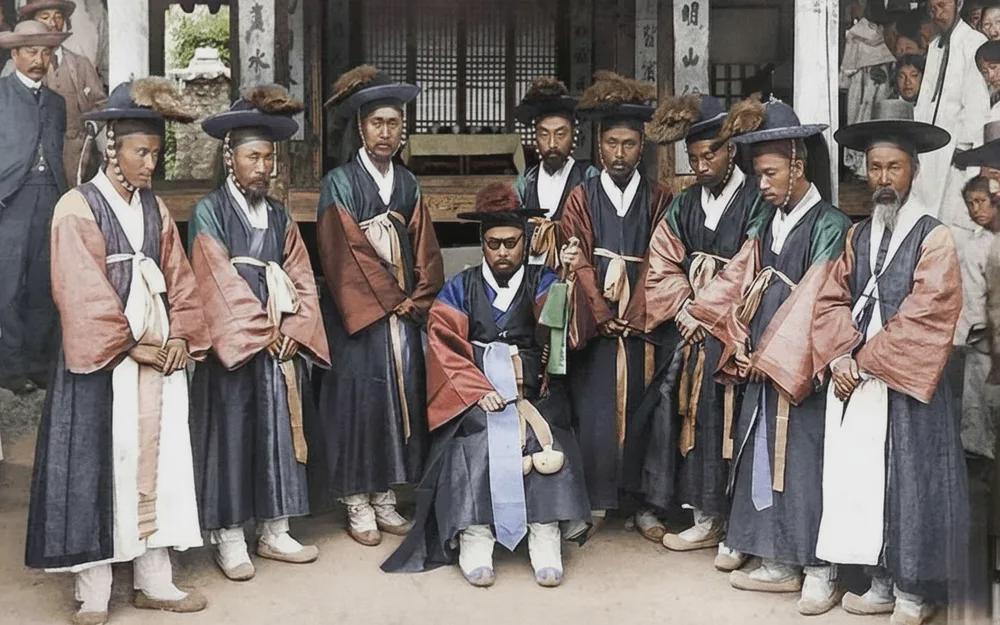
Additional Context: if you look closely, you might see the officers donning small white sacks hanging from their waists.
The guy in the middle(with the immacualte glasses) seems to have two, hanging on his left, near his knee.
Those sacks contain Byeongbus(병부).
Historically, these were wooden plates split in half, with one piece kept in the King’s palace(yes, the one with Gyeongbokgung), and the other kept by the commissioned officer.
They were symbols of authority, granted by the King. It was supposed to represent the authority of the officer being an extension(or a granted fragment thereof) of the King’s.
The King’s military uniform, consequently, had no such thing as a Byeongbu sack, because he WAS the authority.

2 Comments
Do they belong to a particular ethnic group in Korea or am I tripping because of the colorization?
Additional Context: if you look closely, you might see the officers donning small white sacks hanging from their waists.
The guy in the middle(with the immacualte glasses) seems to have two, hanging on his left, near his knee.
Those sacks contain Byeongbus(병부).
Historically, these were wooden plates split in half, with one piece kept in the King’s palace(yes, the one with Gyeongbokgung), and the other kept by the commissioned officer.
They were symbols of authority, granted by the King. It was supposed to represent the authority of the officer being an extension(or a granted fragment thereof) of the King’s.
The King’s military uniform, consequently, had no such thing as a Byeongbu sack, because he WAS the authority.
Edit: additional info