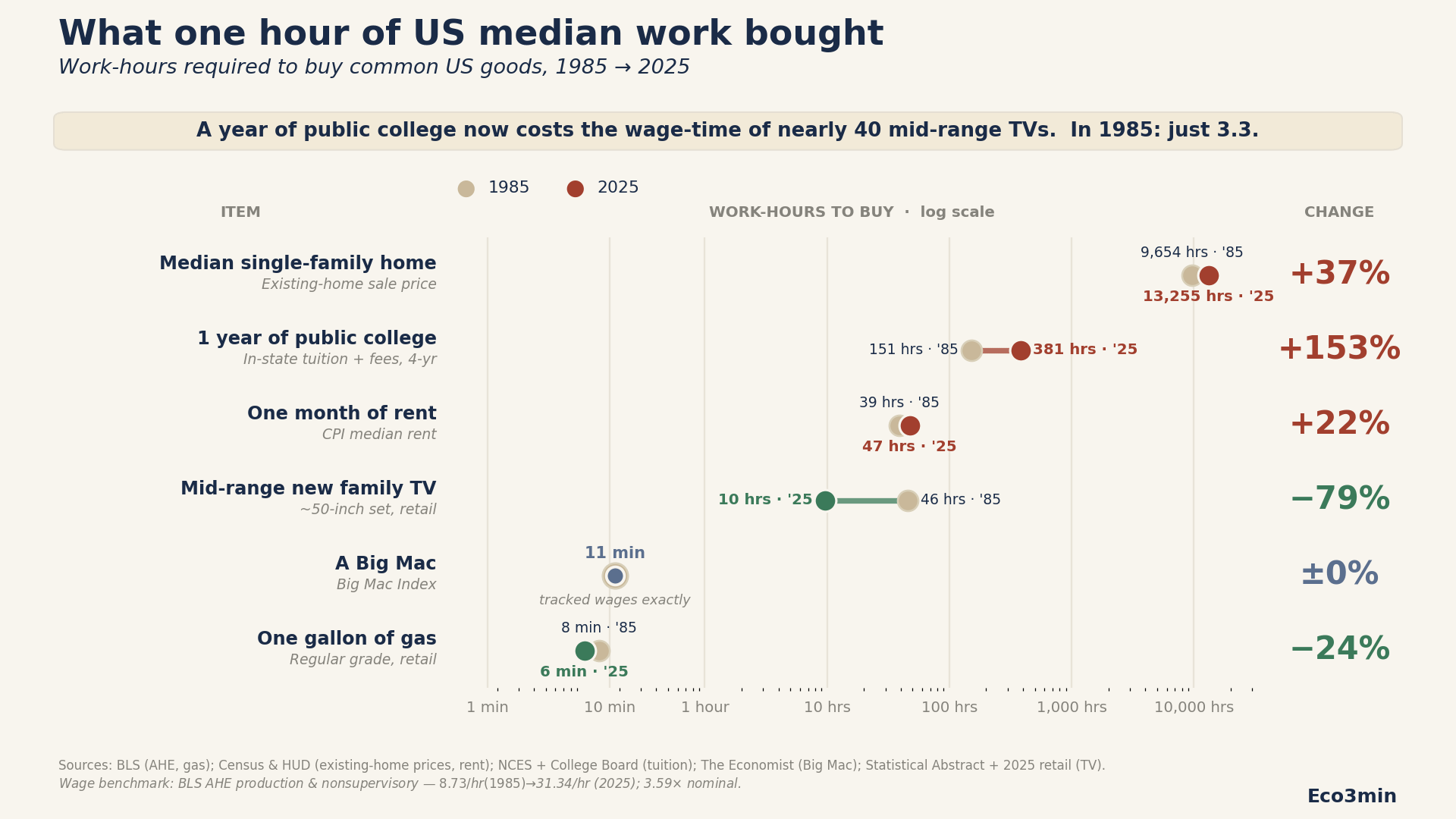
[OC] A Big Mac required 11 minutes of US median work in 1986. It still does in 2025. The same is not true for six other items.
by Low_Ability4450

[OC] A Big Mac required 11 minutes of US median work in 1986. It still does in 2025. The same is not true for six other items.
by Low_Ability4450
23 Comments
Methodology :
A year of public college tuition now costs the wage-time of nearly 40 mid-range TVs. In 1985, it was just 3.3 TVs.
Methodology highlights:
– Wage benchmark: BLS production & nonsupervisory hourly earnings, FRED series AHETPI ($8.73/hr in 1985 → $31.34/hr in 2025)
– Homes: FRED median existing-home prices
– Tuition: NCES + College Board
– Rent: Census + BLS CPI rent series
– Big Mac: The Economist Big Mac Index
– Gas: BLS regular gasoline
– TVs: retail survey / major retailer comparisons
Points that can be noted :
– TV quality improved massively over the period
– 2025 rent uses latest available ACS data (2024)
– Big Mac uses 1986 because that’s when the index begins
Full dataset + CSV + verifier code:
[https://eco3min.fr/en/us-purchasing-power-1985-vs-2025/](https://eco3min.fr/en/us-purchasing-power-1985-vs-2025/)
Tools: Python (pandas, matplotlib). Reproducible verifier code published with the dataset (42 checks, all pass).
Happy to answer questions.
So uhh what’s before and after I can’t tell on this legend.
11 minutes to make my Big Mac?! TOO LONG.
Why do a big Mac when you could do groceries?
Are we sure the log scale is the right way to show the impact?
Isn’t this just inflation with more steps?
The top three had demand subsidized. The bottom three had supply expanded.
Three of these things are heavily government subsidized
OK but are homes and college really that important?
Looks about right. Price the wage slaves out of shelter and education, but give them bread and circuses.
I think a problem with this is the TV.
You shouldn’t compare buying a new mid-range TV, but owning one for a year.
The key difference is that in the 80s we had a tv that was many years old. Kids at school were routinely discussing shows they had seen on TVs that were older than they were.
There was a dedicated shop in my neighborhood specialized on repairing television sets.
My point is that on average in the 80s you bought your TV once a decade.
Nowadays TVs can be incredibly cheap, but even the more pricy ones don’t last as long.
You pay more per year because you need to buy more often thanks to planned obsolescence.
Also watching TV was free. The signal came unencrypted over the air and you didn’t need any subscriptions until cable television and Satellite TV and digital TV and streaming came along.
TVs are so weird because they are basically the only product that has gotten both much better and cheaper (when not adjusting for inflation) over time.
’50” TV’ – 1985 was $2000 or so, or more like 200 hours.
Average set was more like 25″, running $500 or so, so it’s mostly just the size that’s wrong.
A big mac is 4.99 and 11 minutes is 1/5.45 or (~18%) of an hour so the media work hour is roughly $27 an hour or 54-55k a year? That’s looks high, looking here, its more like in 2026, the **national median** is closer to at $22/hour (43-44k), meaning a Big mac is more like (0.37 per minute) so more like 13.5 minutes or +20%
[Average wages, median wages, and wage dispersion](https://www.ssa.gov/OACT/COLA/central.html)
EDIT: added link and some quick math, still could be wrong.
Why bigmac scale is so powerful. Curious if the single family home numbers change much if they’re price per sqft
The reality is that because we have such higher standards of living today, people assume that these higher standards of living are the historic norm and don’t account for how much better the life of the typical person actually is…
It may feel more expensive when have many more ways to spend your money than were available to people who lived 70 years ago, but it doesn’t mean it is actually more expensive.
People in the past didn’t have the option to pay for:
– iPhones
– Streaming services
– Fresh fruit year round
– Air conditioning
– Microwaves
– Overnight shipping
Even things like buying new clothes with the changes of the seasons or being able to afford air travel on occasion was unheard of for the majority of people.
The reality is that we live at a substantially higher level than the past and say that it it tough to afford all of the luxuries that were not common for even the ultra wealthy to have.
TV should not be used. Technology has become cheaper in the most cases.
Yeah, where is this median rent of $1,472 lmao.
The Economist has been using Big Mac prices around the world as a gauge for currency valuation for the last 40 years. It has been surprisingly accurate.
https://www.economist.com/interactive/big-mac-index
I’d like to see how the marginal cost changed for these items over the 40 years.
high education is the biggest scam no one is talking about.
Homes and apartments have generally trended towards being bigger and better equipped over that time period — is median for each really the right way to look at it when the “product” isn’t the same?
Same for looking at a mid-range TV — what are we comparing? A 32″ CRT to a 60″ OLED? granted, because of tech advances the costs still went down, but those decreases undersell things once you consider what you are actually getting.
Isn’t the big Mac a classic example of shrinkflation?