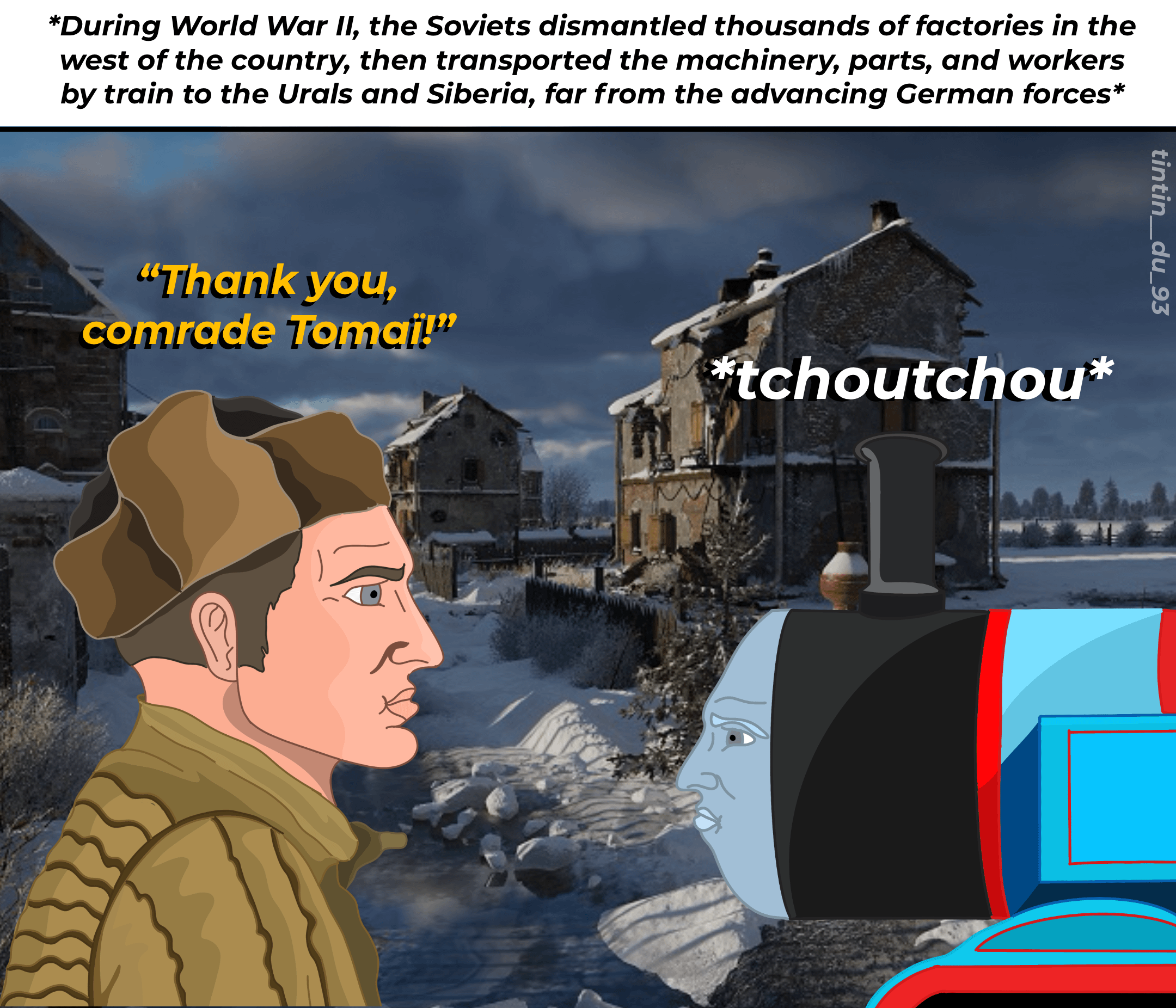
During World War II, the Soviet Union relocated its industry eastward — ***into the Urals, Siberia, and Central Asia*** — to keep it out of reach of the advancing German forces. This evacuation began in the **summer and fall of 1941**, at the time of the Nazi invasion.
They dismantled the machines and equipment, then loaded them onto trains along with some of the workers, engineers, and sometimes their families. The convoys headed toward safer regions, where the equipment was reinstalled in existing buildings or in ***hastily built workshops***.
The operation was **extremely chaotic**: time was short, resources were limited, and the logistical challenges were immense — on top of the fact that they waited until the last possible moment to move, in order to maximize output for as long as possible.
The industrial evacuation played a **decisive role** in the war. The USSR was able to restart arms production — ***at the expense of agriculture*** — and workers had to labor with barely anything to eat.
In 1945, a film was released directed by Leonid Trauberg and Grigori Kozintsev: ***Simple People***.
The story follows workers from the Tchkalov aircraft factory — elderly people, women, and teenagers — forced to evacuate to Uzbekistan as the Wehrmacht advances on Leningrad. It is the **only Soviet film** to directly address this episode of factory displacement.
Yet upon its release, the film was **censored and banned** from screening by the Central Committee of the Communist Party in 1946 — because it highlighted the workers and factory staff ***more than the Party members***.

3 Comments
During World War II, the Soviet Union relocated its industry eastward — ***into the Urals, Siberia, and Central Asia*** — to keep it out of reach of the advancing German forces. This evacuation began in the **summer and fall of 1941**, at the time of the Nazi invasion.
They dismantled the machines and equipment, then loaded them onto trains along with some of the workers, engineers, and sometimes their families. The convoys headed toward safer regions, where the equipment was reinstalled in existing buildings or in ***hastily built workshops***.
The operation was **extremely chaotic**: time was short, resources were limited, and the logistical challenges were immense — on top of the fact that they waited until the last possible moment to move, in order to maximize output for as long as possible.
The industrial evacuation played a **decisive role** in the war. The USSR was able to restart arms production — ***at the expense of agriculture*** — and workers had to labor with barely anything to eat.
In 1945, a film was released directed by Leonid Trauberg and Grigori Kozintsev: ***Simple People***.
The story follows workers from the Tchkalov aircraft factory — elderly people, women, and teenagers — forced to evacuate to Uzbekistan as the Wehrmacht advances on Leningrad. It is the **only Soviet film** to directly address this episode of factory displacement.
Yet upon its release, the film was **censored and banned** from screening by the Central Committee of the Communist Party in 1946 — because it highlighted the workers and factory staff ***more than the Party members***.
Source :
[arte : Stalin’s factories versus Hitler’s armies](https://www.arte.tv/fr/videos/112223-000-A/les-usines-de-staline-face-aux-armees-d-hitler/)
Basically robbed Ukraine and Belarus for half of their industrial capabilities and specialists, moved them in russia and never returned anything back
Thomas the Gulag Tankengine