
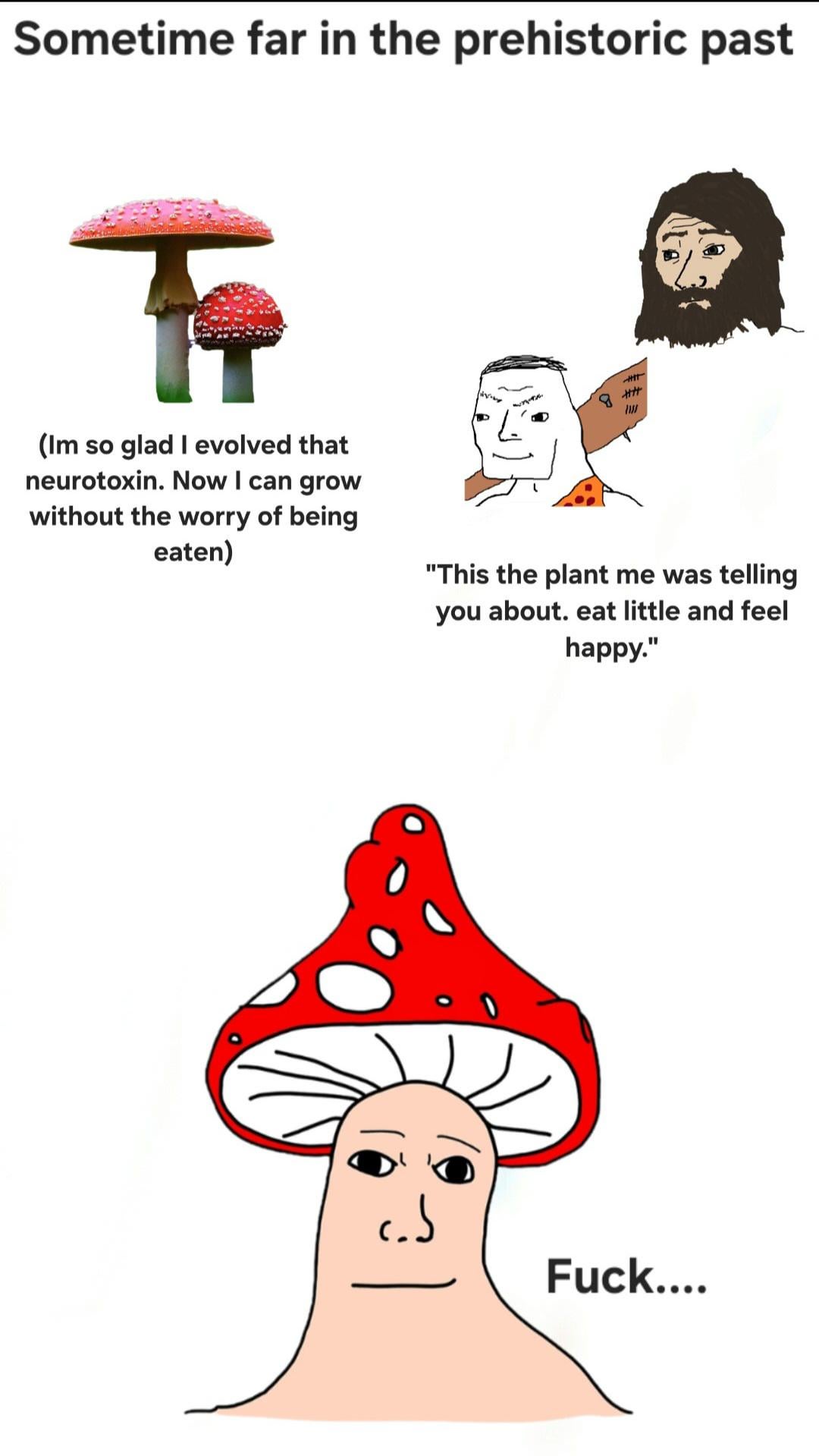
Context: nthropological research has suggested that humans "may have evolved to counter-exploit plant neurotoxins". The ability to use botanical chemicals to serve the function of endogenous neurotransmitters may have improved survival rates, conferring an evolutionary advantage. A typically restrictive prehistoric diet may have emphasized the apparent benefit of consuming psychoactive drugs, which had themselves evolved to imitate neurotransmitters.\34]) Chemical–ecological adaptations and the genetics of hepatic enzymes, particularly cytochrome P450, have led researchers to propose that "humans have shared a co-evolutionary relationship with psychotropic plant substances that is millions of years old."\35])
by Salty_Strain3313
5 Comments
[deleted]
Yeah the fact that some mushrooms share chemical structures that resemble the shape of seretonin pathways in the human brain has a lot more to do with the simplicity of mushrooms as a lifeform and a lot less to do with any complicated co-evolutionary path. It’s true humans can survive these tiny particles infiltrating our nervous systems. Evolution might have afforded us that. A lot of coincidence happens nonetheless. I’m sure some mushrooms do function as neurotoxins that helps them survive. There’s that one that makes ants get eaten by bigger animals. Ah. Fuck this.
From the mushroom’s perspective, the fact that humans would go on to cultivate them is evolutionarily advantageous
Fun fact: you can get high on one amanita more than once. The first time you eat it, the second, you drink it….
We have the stoned ape hypothesis at home.
The stoned ape hypothesis at home: