
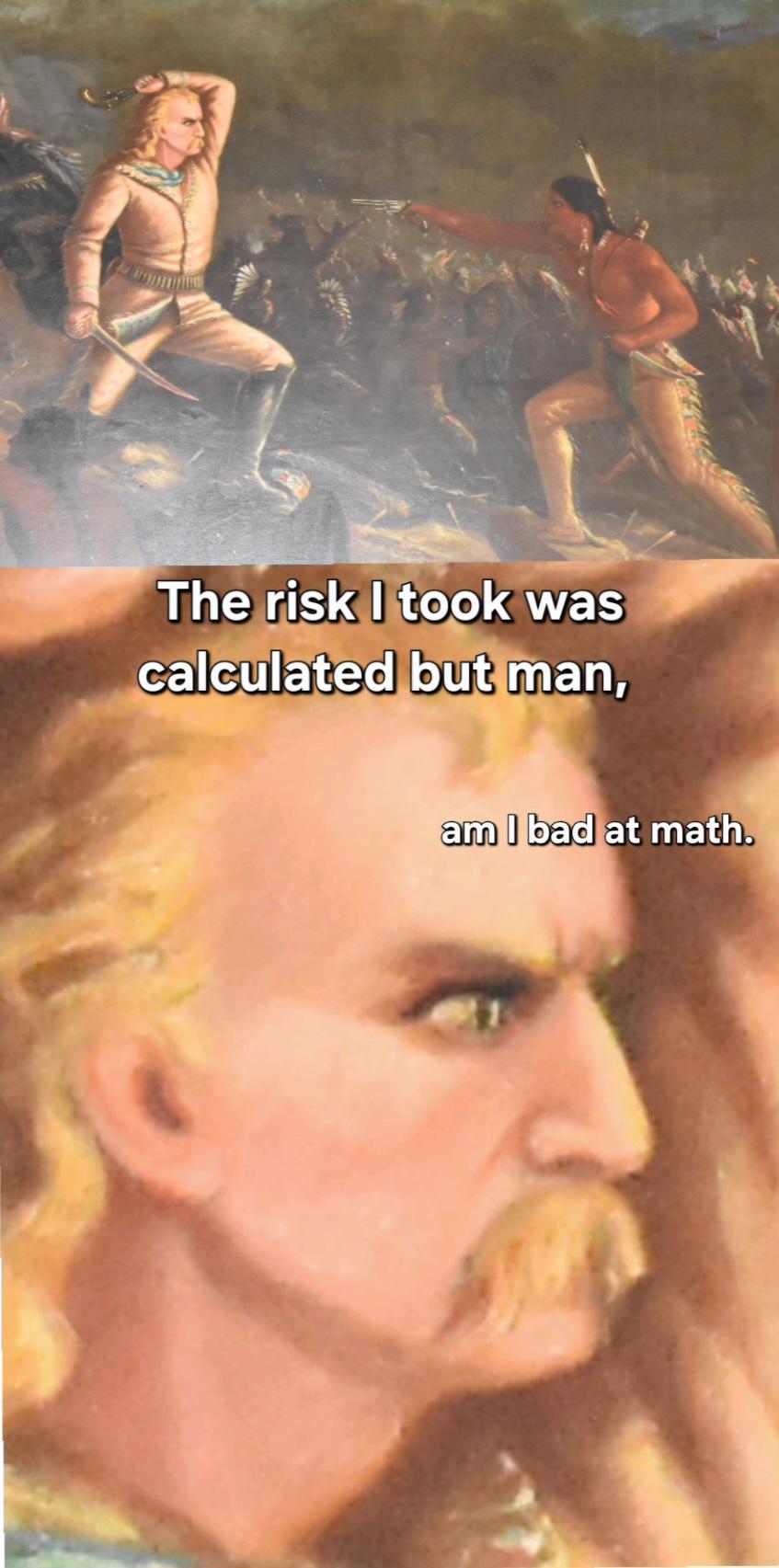
Context: Battle of the Little Bighorn, (June 25, 1876), battle at the Little Bighorn River in Montana Territory, U.S., between federal troops led by Lieut. Col. George A. Custer and Northern Plains Indians (Lakota [Teton or Western Sioux] and Northern Cheyenne) led by Sitting Bull. Custer and all the men under his immediate command were slain. There were about 50 known deaths among Sitting Bull’s followers.
That spring, under the orders of Lieut. Gen. Philip Sheridan, three army columns converged on Lakota country in an attempt to corral the rebellious bands. Moving east, from Fort Ellis (near Bozeman, Montana), was a column led by Col. John Gibbon. From the south and Fort Fetterman in Wyoming Territory came a column under the command of Gen. George Cook. On May 17 Brig. Gen. Alfred H. Terry headed west from Fort Abraham Lincoln in charge of the Dakota Column, the bulk of which constituted Custer’s 7th Cavalry. On June 22 Terry sent Custer and the 7th Cavalry in pursuit of Sitting Bull’s trail, which led into the Little Bighorn Valley. Terry’s plan was for Custer to attack the Lakota and Cheyenne from the south, forcing them toward a smaller force that he intended to deploy farther upstream on the Little Bighorn River. By the morning of June 25, Custer’s scouts had discovered the location of Sitting Bull’s village. Custer intended to move the 7th Cavalry to a position that would allow his force to attack the village at dawn the next day. When some stray Indian warriors sighted a few 7th Cavalrymen, Custer assumed that they would rush to warn their village, causing the residents to scatter.
Custer chose to attack immediately. At noon on June 25, in an attempt to prevent Sitting Bull’s followers from escaping, he split his regiment into three battalions. He sent three companies under the command of Maj. Marcus A. Reno to charge straight into the village, dispatched three companies under Capt. Frederick W. Benteen to the south to cut off the flight of any Indians in that direction, and took five companies under his personal command to attack the village from the north. That tactic proved to be disastrous. In fragmenting his regiment, Custer had left its three main components unable to provide each other support.
As the Battle of the Little Bighorn unfolded, Custer and the 7th Cavalry fell victim to a series of surprises, not the least of which was the number of warriors that they encountered. Army intelligence had estimated Sitting Bull’s force at 800 fighting men; in fact, some 2,000 Sioux and Cheyenne warriors took part in the battle. Many of them were armed with superior repeating rifles, and all of them were quick to defend their families. Native American accounts of the battle are especially laudatory of the courageous actions of Crazy Horse, leader of the Oglala band of Lakota. Other Indian leaders displayed equal courage and tactical skillCut off by the Indians, all 210 of the soldiers who had followed Custer toward the northern reaches of the village were killed in a desperate fight that may have lasted nearly two hours and culminated in the defense of high ground beyond the village that became known as “Custer’s Last Stand.” The details of the movements of the components of Custer’s contingent have been much hypothesized. Reconstructions of their actions have been formulated using both the accounts of Native American eyewitnesses and sophisticated analysis of archaeological evidence (cartridge cases, bullets, arrowheads, gun fragments, buttons, human bones, etc.), Ultimately, however, much of the understanding of this most famous portion of the battle is the product of conjecture, and the popular perception of it remains shrouded in myth.
https://www.britannica.com/event/Battle-of-the-Little-Bighorn
by Salty_Strain3313
5 Comments
His last words before he engaged with the natives were, “Custer’s luck! The biggest Indian Village on the Continent!”
The face of a man before deodorants were invented, having smelled his armpit for the first time
Oops, arrow in your dick
(Fun?) fact, it is known the U.S. combatants shot their horses to use them as cover
And it happened 9 days before the U.S.’s 100th birthday