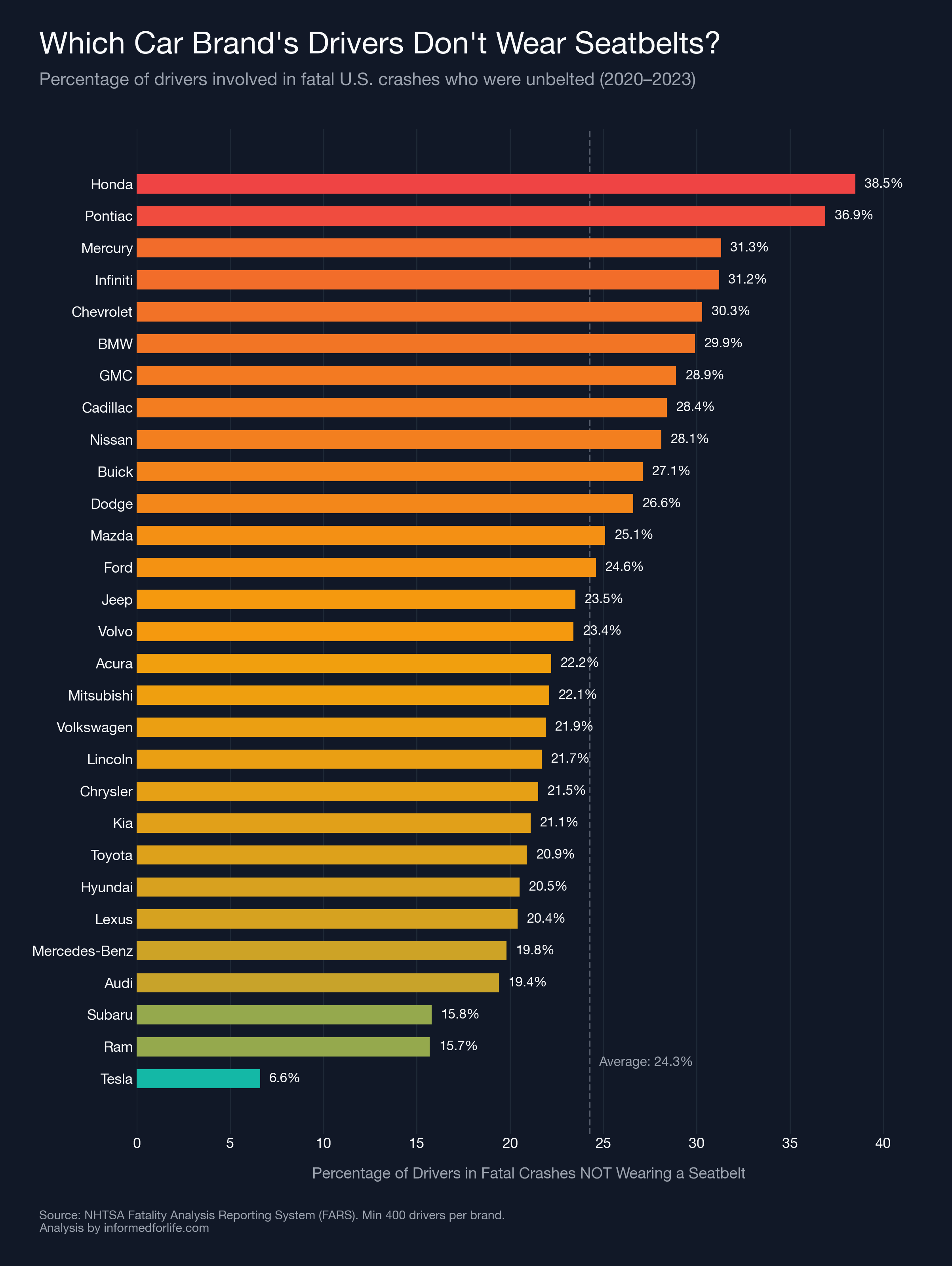
[OC] In Fatal Crashes, Which Car Brand’s Drivers Weren’t Wearing a Seatbelt? (NHTSA FARS, 2020–2023)
by informed-for-life

[OC] In Fatal Crashes, Which Car Brand’s Drivers Weren’t Wearing a Seatbelt? (NHTSA FARS, 2020–2023)
by informed-for-life
39 Comments
I analyzed 153k fatal vehicle crashes in the United States from 2020–2023 inclusive using NHTSA’s [Fatality Analysis Reporting System (FARS)](https://www.nhtsa.gov/research-data/fatality-analysis-reporting-system-fars), which records every fatal crash in the USA.
**What this shows:** For each car brand, the percentage of *drivers involved in fatal crashes* who were not wearing a seatbelt. This is NOT general seatbelt usage — it’s seatbelt usage specifically among drivers in crashes where someone died.
**Why it matters:** Not wearing a seatbelt dramatically increases the odds that a crash becomes fatal. So this chart is really showing us two things:
1. **Which brands’ drivers were most likely to die** ***because*** **they weren’t belted** — seatbelt non-use is a major contributing factor to fatality
2. **A proxy for driver risk profile** — seatbelt non-use correlates strongly with other risky behaviors (speeding, alcohol, etc.)
**Key findings:**
* **Honda: 38.5%** — Honda has the largest used-car market in the US. Older, cheaper Civics and Accords are disproportionately driven by younger and lower-income demographics, who statistically have lower belt use. Honda has an average fatality rate overall, but this rate would likely go down if the driver used their seatbelts.
* **Tesla: 6.6%** — By far the lowest. Likely reflects Tesla’s aggressive seatbelt warning system (won’t let you ignore it easily), higher-income demographic, and newer vehicle fleet (avg age 2 years in FARS vs 12 years for Honda). Tesla also has a lower than average fatality rate per registered vehicles, but it also appears to attract very safe/cautious drivers.
* **Luxury brands cluster low** (Mercedes 19.8%, Audi 19.4%) while **domestic trucks/SUVs cluster mid-range** (Ford 24.6%, Chevy 30.3%)
**Methodology:**
* Data: NHTSA FARS National CSV files, 2020–2023 final releases
* Vehicle identification: VPICMAKENAME field
* Seatbelt: REST_USE field, “Not Used” or “None Used” classifications
* Only drivers (PER_TYP = driver), excludes motorcycles and commercial trucks
* Min 400 drivers per brand
**Tool:** Python (pandas) + matplotlib
**Full interactive version with more charts:** [informedforlife.com/fars-data](https://www.informedforlife.com/fars-data.html)
Honda odd one out for sure
Ram I find very hard to believe (possibly seatbeltless crashes aren’t fatal)
The most surprising part to me is ram drivers wearing seatbelts
I’m suprised BMW drivers know what seatbelts are
The title and color pallet selection here seems backwards? Honda in red is actually the safest, while Tesla in teal is the most dangerous.
If you died in a Tesla there was a 93.4% chance that you had a seatbelt on. So wearing a seatbelt in a Tesla barely makes a difference in the outcome of a crash. While in a Honda you were far more likely to die if you didn’t have your seatbelt on than if you did.
Teslas are very aggressive about seatbelt warnings, I can hardly reposition my car in the driveway without a seatbelt on, it keeps trying to put it into park on me.
Could a case be made that in very safely-built cars (e.g.Volvo) a crash would have to be very bad to kill the driver, and in that case seat belts wouldn’t matter much?
No way, in this day and age?!
Hmm… I’m not sure about this. I could be misunderstanding the data, but it doesn’t seem to me that it’s saying Tesla drivers are cautious as much as if you have a crash while wearing your seatbelt, you’re more likely to die in a Tesla than a Honda.
I’m not sure what this is really explaining. If the vehicle was involved in a fatal crash, how often was the driver not wearing a seatbelt. It’s interesting, but it doesn’t indicate anything particularly about the safety of the vehicle. Tesla is an outlier – does that mean that it’s unsafe even with a seatbelt on? Are the Hondas so safe that you need to not be wearing a seatbelt for the crash to be fatal?
This is for fatal car accidents, not for daily drivers.
Would a factor in this be the probability of dying while in an unbelted crash being different for each car brand? For example, unbelted Audi drivers have a different chance of survival than unbelted Ram drivers?
I have no idea if the difference would be statistically significant but just throwing it out there.
Wait, this isn’t showing overall seatbelt usage, but seatbelt usage *among crashes that were fatal*, per make? I don’t think the title is accurate at all.
So this doesn’t say that Honda drivers don’t use their seatbelt as much as Tesla drivers, but more suggests that the only way you’ll die in a Honda is by not wearing your seatbelt?
94% of people who died in a Tesla were wearing their seatbelt and died anyway. Whereas 1/3 of Honda deaths are explained by people not wearing a seatbelt.
My Subaru becomes the most annoying thing on the planet if someone is in a seat and there is no seat belt engaged. Front, passenger, and rear are all detected. It’ll be a beeping that starts light, then progresses. Music is muted. Sensory overload.
Makes sense to see it at the bottom of this list.
What this is telling me is Subaru, RAM and Tesla owners are dying whether they wear their seatbelt or not.
Your methodology seems fundamentally flawed—if a large percentage *of those killed* were wearing seatbelts, that seems to imply that the car is so unsafe that wearing a seatbelt doesn’t help.
Pontiac and Mercury? How old is this chart?
Is this normalized by frequency of crashes of each car make?
I think this is a weird way to slice the data, and misleading because you are mixing two confounding variables. Why didn’t you lead with this graph? 😉
https://preview.redd.it/0iv8qqhcwb1h1.jpeg?width=1320&format=pjpg&auto=webp&s=181cabc19cadad34446604ebf1fe622d36f84f95
Option A: Hondas are super safe (when belted) so a very large chunk of deaths happened to unbelted drivers.
Option B: Hondas are uniquely unsafe for unbelted drivers so they are disproportionately killed
As a proud honda car owner. I do Infact wear my seat belt. So I won’t be adding to this data.
Am I thinking about this wrong? I read it as Tesla fatalities are mostly drivers wearing their seatbelts. Translation: least likely to survive a crash while wearing a seatbelt?
My Honda started beeping as soon as I go above 10mph. WTF
*Looks at data.* Time to buy a honda
I’m not sure people are interpreting this data correctly. It doesn’t make any conclusions, yet people are looking at it as if Honda drivers are irresponsible maniacs or something.
In reality, it could simply mean: if you’re killed in a Honda, there’s a VERY good chance it’s because you weren’t wearing a seatbelt. Whereas in a Tesla, wearing a seatbelt is far less of a factor in whether or not you die.
It says absolutely nothing about the frequency of fatal crashes of any particular make of car, and it says nothing about the seatbelt habits of people who drive that brand.
I don’t think this shows us much of anything useful. The most common car in the road, which we can assume results in it being the most miles driven, which likely relates to the most overall fatal crashes doesn’t compare directly to that relatively uncommon Tesla.
It also says nothing about the nature of the fatal crashes themselves. What if 50% of the Accord crashes were resulting from collisions with semis on freeways but another car’s fatality crashes were predominately single car, inattentive driving resulting in fatal rollovers?
Specific makes and models may be safer in the identical situations with unbelted drivers, but this data cannot tell you that at all. Without further information the base percentages are obscured or meaningless.
Honda highest is interesting. I bet if you normalized it by degrees of excess wheel camber of the vehicle in the accident, things might level out.
I’m not saying it’s right but sometimes not wearing seatbelts is my version of hoping the asteroid would hit already cuz this world sucks
Who the fuck isn’t wearing seatbelts? Drunks?
I wonder how this compares to the make of the model and the state where these occur. Some states were/are more aggressive with policing seatbelt usage vs others, and also the popular make of the vehicle is different in each state.
Is it actually measuring something other than the make influencing seatbelt usage…
Getting flung through the windscreen because you’re not wearing a seatbelt would indeed lead to a higher fatality. Watch out for the Hondas.
Genuinely surprised that RAM is so low on the list, given how they continuously appear on the highest rates of DUI’s per mile driven list.
This is % of crashes, not the rate within a specific brand. So it doesn’t account for the varied prevalence of car brands among all cars? It also doesn’t account for higher accident risk among different vehicles or higher fatality risk in a crash between different vehicles? Am I missing something? I don’t see how any conclusions about a “car brand’s drivers” could be drawn from this data
Isn’t it mandatory by law to wear it in USA?
This is a horribly misleading representation of data.
These data mostly yield information on the type of people who drive a certain car manufacturer moreso than being an indictment on the manufacturer itself.
Who drives used Hondas? Pontiacs? Mercurys?
Also, if the make lasts longer (Hondas last 15+ years), they would likely be overrepresented on the dataset.
I’d be interested to see vehicle types: trucks, suvs, sedans, etc.
My honest question;
Why the fuck aren’t people wearing seatbelts while driving?!
There’s got to be a million different variables biasing these numbers