Eye-opening results. One would think that electricity is accessible for most in today’s world
Trang0ul on
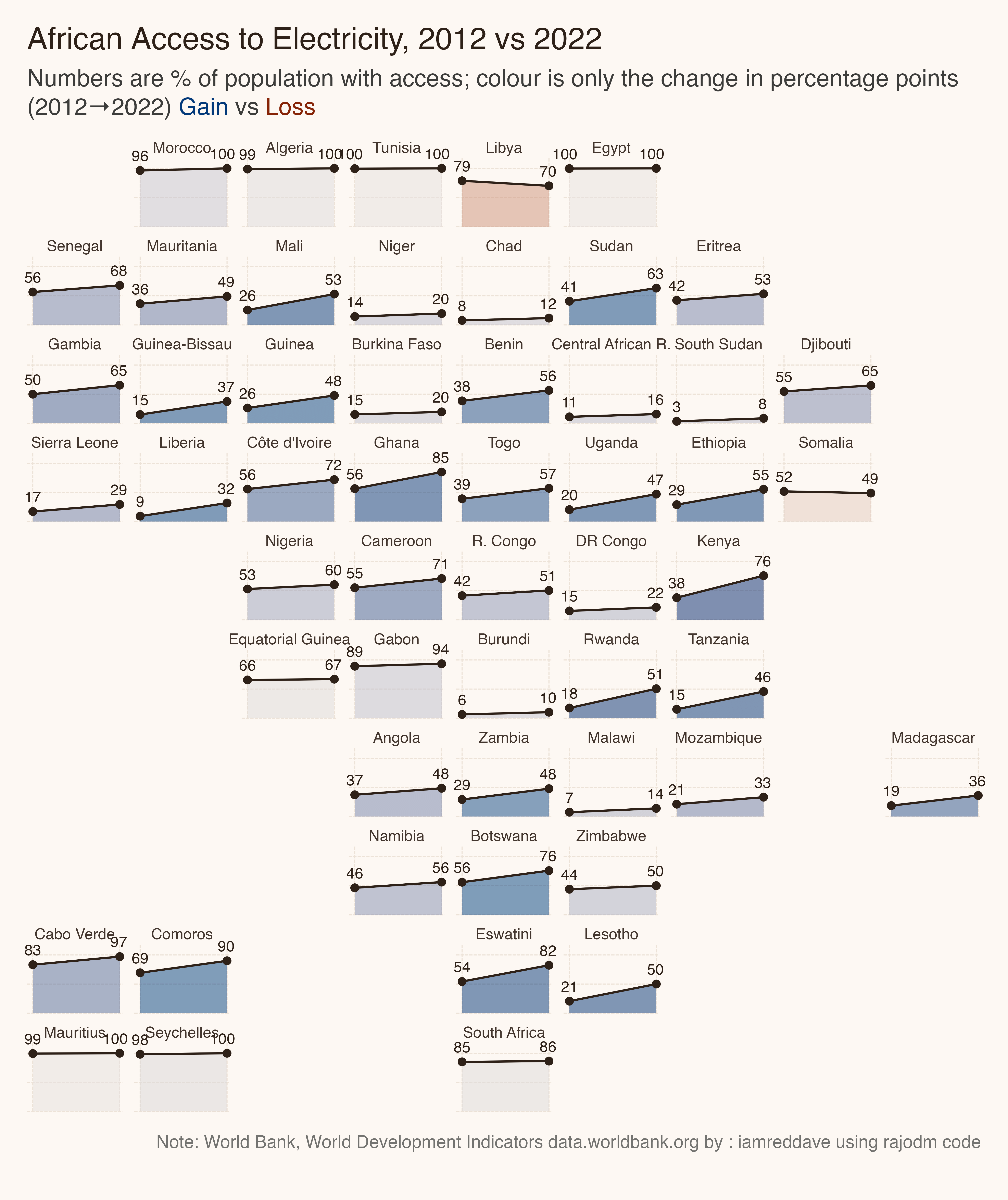
I appreciate the layout of the charts. It should be used more often. An alphabetic list of countries hides the broader picture of regions.
Trippy_BasketCase920 on
the layout in the shape of the african continent is VERY clever
Pro_ENDERGUARD on
Ngl with the amount of glaze botswana gets I was expecting a much higher score
kalle_kaktus on
Access to electricity and access to *reliable* electricity are two different things. Looking at you, Ghana.
mktolg on
Perfect Data-Is-Beautiful. So illustrative. One exception – I assumed the chart belonging to thre country name below it and go so confused. _so_ confused.
ennuithereyet on
I love this layout except I keep thinking the country names are below instead of above, because they’re closer to the ones above, especially for the ones with low numbers.
Evoluxman on
There are some really interesting things happening in Africa regarding electricity.
I read a blog post some months ago about how in some places electricity is becoming a decentralized thing, thanks to the rise of cheap solar and batteries. This helps for exemple farmers for irrigation, because they then don’t have to buy gasoline for the pumps, saving them money. It helps protect peoples health from wood or coal stoves. And it protects them from blackout because it’s not reliant on a grid. And despite what you might think its cheaper than lay thousands of kilometers of grid infrastructure in dirt poor areas. Win win win win win!
And it shows how electrification doesn’t have to follow the same rules as the developed world, and yet can be more robust (again, in regards to blackouts) and can help the countries grow without going through fossile fuel heavy phase. I’ll paste the link under when I find it back.

10 Comments
Data from [the world bank](https://data.worldbank.org/).
R package ggplot2 code is [here](https://gist.github.com/cavedave/71d0854a7faa59c82600178722200421) This is pretty much a copy of this [code by rajodm](https://github.com/rajodm/30DayChartChallenge/tree/main/2026/day_06)
*edit 92% of the world has access to electricity (at a very basic 4 hours a day level at least)
[https://ourworldindata.org/grapher/share-of-the-population-with-access-to-electricity](https://ourworldindata.org/grapher/share-of-the-population-with-access-to-electricity)
But that still leaves 750 million people without it
[https://ourworldindata.org/data-insights/the-global-number-of-people-without-electricity-has-halved-since-2000-but-it-has-increased-in-sub-saharan-africa](https://ourworldindata.org/data-insights/the-global-number-of-people-without-electricity-has-halved-since-2000-but-it-has-increased-in-sub-saharan-africa)
Eye-opening results. One would think that electricity is accessible for most in today’s world
I appreciate the layout of the charts. It should be used more often. An alphabetic list of countries hides the broader picture of regions.
the layout in the shape of the african continent is VERY clever
Ngl with the amount of glaze botswana gets I was expecting a much higher score
Access to electricity and access to *reliable* electricity are two different things. Looking at you, Ghana.
Perfect Data-Is-Beautiful. So illustrative. One exception – I assumed the chart belonging to thre country name below it and go so confused. _so_ confused.
I love this layout except I keep thinking the country names are below instead of above, because they’re closer to the ones above, especially for the ones with low numbers.
There are some really interesting things happening in Africa regarding electricity.
I read a blog post some months ago about how in some places electricity is becoming a decentralized thing, thanks to the rise of cheap solar and batteries. This helps for exemple farmers for irrigation, because they then don’t have to buy gasoline for the pumps, saving them money. It helps protect peoples health from wood or coal stoves. And it protects them from blackout because it’s not reliant on a grid. And despite what you might think its cheaper than lay thousands of kilometers of grid infrastructure in dirt poor areas. Win win win win win!
And it shows how electrification doesn’t have to follow the same rules as the developed world, and yet can be more robust (again, in regards to blackouts) and can help the countries grow without going through fossile fuel heavy phase. I’ll paste the link under when I find it back.
Rare dataisbeautiful W. Nice job OP.