
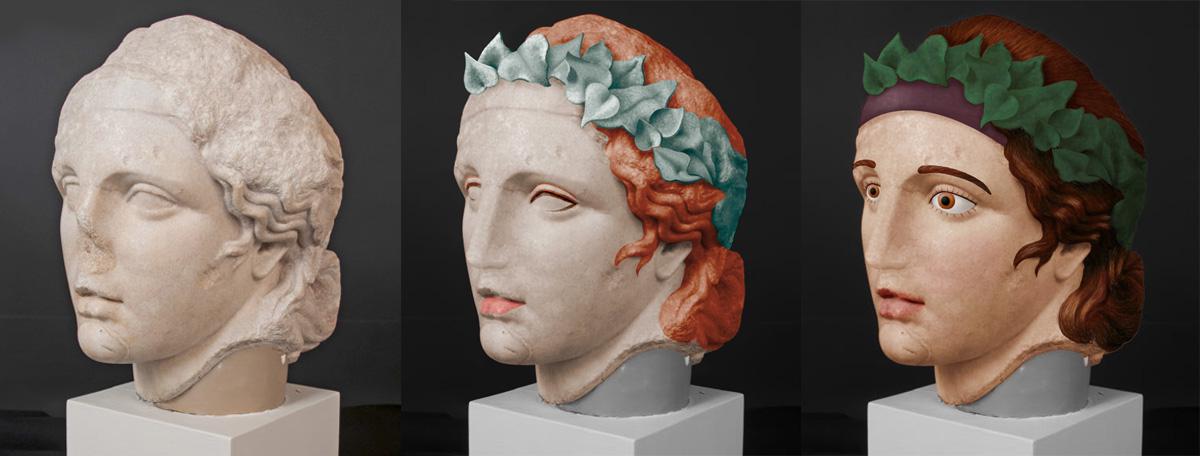
Head of Bacchus. Hadrianic Period, 117–138 AD. Kelsey Museum of Archaeology
"Left: Head of Bacchus. Marble, pigment. The image in the middle shows an application of color based on the locations of pigments found on the object’s surface during examination. The image on the right is a hypothetical reconstruction of the finished surface based on similar sculptures and wall paintings. Contributors: Catherine Person, Caroline Roberts, Elaine Gazda, Nicola Barham, and Emily Pierattini
The traces of red pigment in the hair are relatively easy to see, but we suspected there might be microscopic traces of color in other areas. To find out, we explored the surface of the head for pigment using a Dino-Lite digital microscope as well as multispectral imaging (MSI). To our surprise, we discovered a lot of color, including traces of what could be red lead or cinnabar/vermilion on the inner corner of the mouth, and black and red pigment along the inside of the eyes and in the tear ducts. The biggest surprise was revealed in the MSI imaging: luminescent areas of Egyptian blue in the garland of ivy leaves in the hair.
This physical evidence, along with curators Elaine Gazda’s and Nicola Barham’s knowledge of Roman sculpture and painting, allowed us to create this digital reconstruction of what the Bacchus head might have looked like in full color. Note: the red pigment in the hair was likely underpaint for the final color, while the blue in the leaves was likely mixed with a yellow pigment to create green"
Source of the picture and the info here
More info here
by dctroll_
2 Comments
Genuine question from someone who does not consider themselves educated in ancient Greek art: if painting or otherwise adding pigment to marble statues were common, why don’t we have more surviving examples of painted pieces in museums?
I really doubt, that the headband had the same colour as the hair. No real artist of any age would have painted it like this. The eyebrows look gross too.