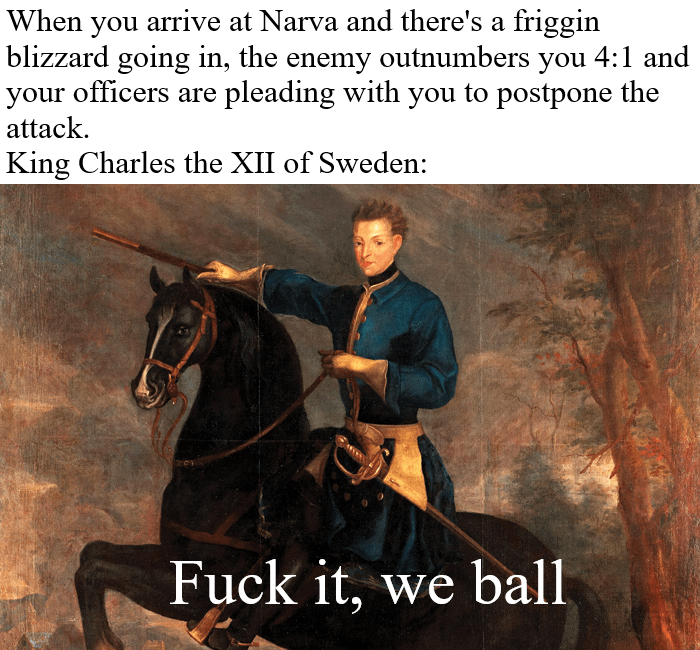
“By afternoon, the Swedes had finished their preparations and moved forward at 2 p.m. At that moment, it got colder, the wind changed, and the snowstorm blew directly into the eyes of the Russians.[^([27])](https://en.wikipedia.org/wiki/Battle_of_Narva_(1700)#cite_note-Tucker-29)^(: 686) Some Swedish officers asked to postpone the attack until the end of the storm. Still, Charles saw his opportunity and advanced on the Russian army under cover of the weather.”
…
“The Battle of Narva was a terrible defeat for the Russian army. The Swedes captured ten generals and ten colonels, and many Russian regimental officers were killed in battle. The Russian regimental rolls from January 1701 show that the total loss of personnel was about 25% (with a 57–68% loss in the two regular infantry regiments of Trubetskoy’s “division”). In Golovin’s “division” (excluding the two Guard regiments), only 250 of the 356 officers survived. Weide’s “division”, however, fared somewhat better. The Russians also suffered heavy losses in armaments, as the Swedes captured 4050 muskets and 173 artillery pieces, including 64 siege cannons. Soon thereafter, the Swedes took an additional 22 mortars from a baggage train near [*Yam*](https://en.wikipedia.org/wiki/Yam_fortress). While the Russians had mostly replenished their small arms by the spring of 1701, the former Golovin and Weide “divisions” still lacked regimental artillery. If Charles had continued the campaign against Russia (as General Vellingk had suggested attacking Novgorod and Pskov[^([56])](https://en.wikipedia.org/wiki/Battle_of_Narva_(1700)#cite_note-58)), the Russian army very likely would have suffered another defeat.[^([55])](https://en.wikipedia.org/wiki/Battle_of_Narva_(1700)#cite_note-Velikanov4-57)^(“)
jackt-up on
I’m not gay, but I think I could be gay for Charles, just for a little while
Gigantopithecus1453 on
It’s insane to me how despite completely destroying that army, the Russians were quickly able to build an even bigger one to beat the swedes at the battle of poltava. Narva wasn’t even the only major defeat they suffered in that war, yet when Sweden lost once its chances of victory were basically gone. The odds were simply stacked against them, fighting nearly all of central, northern and Eastern Europe at the same time is never gonna work out well

5 Comments
[Battle of Narva (1700) – Wikipedia](https://en.wikipedia.org/wiki/Battle_of_Narva_(1700))
“The **Battle of Narva**[^([a])](https://en.wikipedia.org/wiki/Battle_of_Narva_(1700)#cite_note-19) on 30 November 1700[^([b])](https://en.wikipedia.org/wiki/Battle_of_Narva_(1700)#cite_note-20) was an early battle in the [Great Northern War](https://en.wikipedia.org/wiki/Great_Northern_War). A [Swedish](https://en.wikipedia.org/wiki/Sweden) relief army under [Charles XII of Sweden](https://en.wikipedia.org/wiki/Charles_XII_of_Sweden) defeated a [Russian](https://en.wikipedia.org/wiki/Tsardom_of_Russia) siege force three to four times its size. Previously, Charles XII had forced [Denmark–Norway](https://en.wikipedia.org/wiki/Denmark%E2%80%93Norway) to sign the [Treaty of Travendal](https://en.wikipedia.org/wiki/Treaty_of_Travendal). Narva was not followed by further advances of the Swedish army into Russia; instead, Charles XII turned southward to expel [August the Strong](https://en.wikipedia.org/wiki/August_the_Strong) from [Livonia](https://en.wikipedia.org/wiki/Livonia) and [Poland–Lithuania](https://en.wikipedia.org/wiki/Polish%E2%80%93Lithuanian_Commonwealth). Tsar [Peter the Great](https://en.wikipedia.org/wiki/Peter_the_Great) of Russia took Narva in a [second battle](https://en.wikipedia.org/wiki/Battle_of_Narva_(1704)) in 1704.
…
“By afternoon, the Swedes had finished their preparations and moved forward at 2 p.m. At that moment, it got colder, the wind changed, and the snowstorm blew directly into the eyes of the Russians.[^([27])](https://en.wikipedia.org/wiki/Battle_of_Narva_(1700)#cite_note-Tucker-29)^(: 686) Some Swedish officers asked to postpone the attack until the end of the storm. Still, Charles saw his opportunity and advanced on the Russian army under cover of the weather.”
…
“The Battle of Narva was a terrible defeat for the Russian army. The Swedes captured ten generals and ten colonels, and many Russian regimental officers were killed in battle. The Russian regimental rolls from January 1701 show that the total loss of personnel was about 25% (with a 57–68% loss in the two regular infantry regiments of Trubetskoy’s “division”). In Golovin’s “division” (excluding the two Guard regiments), only 250 of the 356 officers survived. Weide’s “division”, however, fared somewhat better. The Russians also suffered heavy losses in armaments, as the Swedes captured 4050 muskets and 173 artillery pieces, including 64 siege cannons. Soon thereafter, the Swedes took an additional 22 mortars from a baggage train near [*Yam*](https://en.wikipedia.org/wiki/Yam_fortress). While the Russians had mostly replenished their small arms by the spring of 1701, the former Golovin and Weide “divisions” still lacked regimental artillery. If Charles had continued the campaign against Russia (as General Vellingk had suggested attacking Novgorod and Pskov[^([56])](https://en.wikipedia.org/wiki/Battle_of_Narva_(1700)#cite_note-58)), the Russian army very likely would have suffered another defeat.[^([55])](https://en.wikipedia.org/wiki/Battle_of_Narva_(1700)#cite_note-Velikanov4-57)^(“)
I’m not gay, but I think I could be gay for Charles, just for a little while
It’s insane to me how despite completely destroying that army, the Russians were quickly able to build an even bigger one to beat the swedes at the battle of poltava. Narva wasn’t even the only major defeat they suffered in that war, yet when Sweden lost once its chances of victory were basically gone. The odds were simply stacked against them, fighting nearly all of central, northern and Eastern Europe at the same time is never gonna work out well
FROM THE FROZEN NORTH THEY CAME
Nation collapsing speedrun