
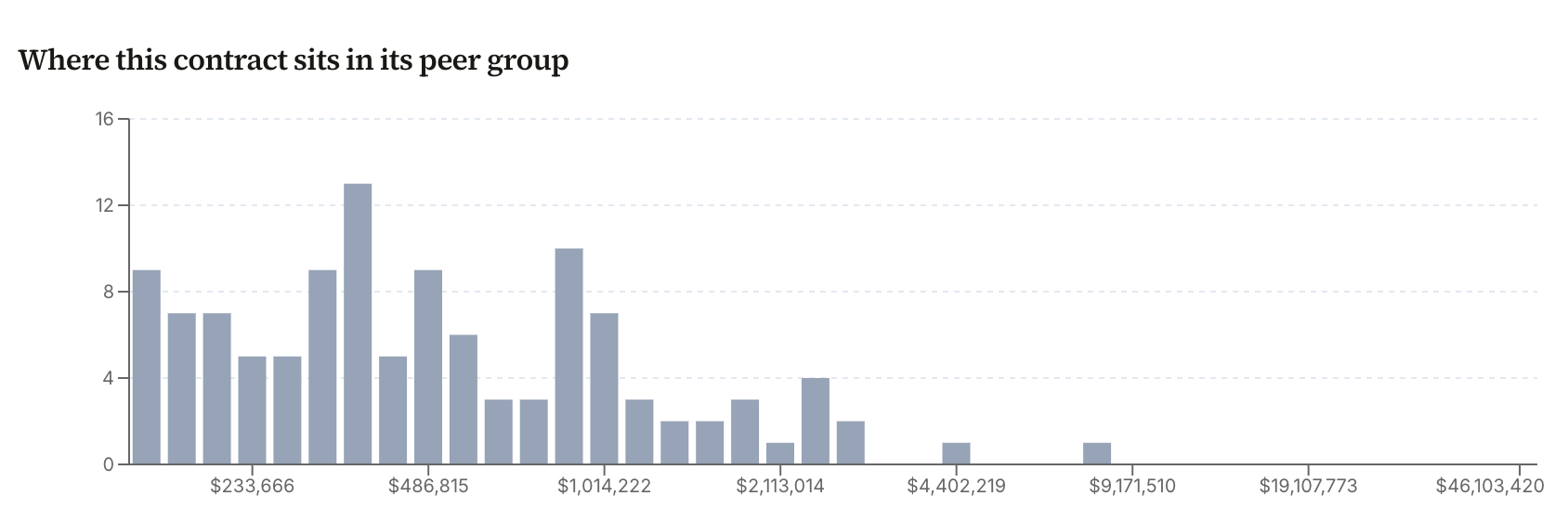
I built an automated oversight engine called Ground Truth. It pulls every federal highway and bridge construction contract from USAspending.gov and runs a specialized anomaly detection pipeline.
The Methodology:
I used Median Absolute Deviation (MAD). Each of the 10,000 contracts is matched to a peer cohort (same State, same sub-agency, same NAICS code, and same project phase). If a contract is an extreme statistical outlier within its own peer group, it gets flagged.
The Findings (Out of 9,989 tracked awards):
- The NYC Bridge Security Outlier: A $450M Army Corps contract for security on Manhattan/Brooklyn bridges pricing at a staggering 1,260x the median cost of its peer group.
- The 499x Runway: A $208M taxiway repair at NAS Oceana that lands as a 499.3x outlier against Virginia Navy paving contracts.
- The Border Wall Variance: Fisher Sand and Gravel won a $177M wall contract at 286x the median. I also found two SLSCO wall contracts awarded on the exact same day off the same parent vehicle with a 2x per-mile cost variance ($14M/mile vs $7M/mile).
- National Parks: Over $250M in extreme anomalies across the NPS and Forest Service, with some projects pricing at 44x the regional median.
Why this is different:
Every finding links to the official USAspending record and ships with a frozen set of comparable peer contracts. We explicitly list Innocent Explanations (terrain, hazmat, expedited timelines) on every page so the data acts as an objective starting point for reporters.
The Tech Stack:
- Pipeline: Python (SQLAlchemy 2.x) with bulk-SQL optimization using Postgres Temporary Tables to handle 10k+ records without timeouts.
- Storage: PostgreSQL (Neon)
- Frontend: Next.js (TypeScript) + Tailwind + TanStack Query.
- Validation: Currently in pilot with investigative watchdogs (including POGO and ProPublica) to refine statistical cost baselines.
Platform: https://ground-truth-beta.vercel.app
by Decagon25