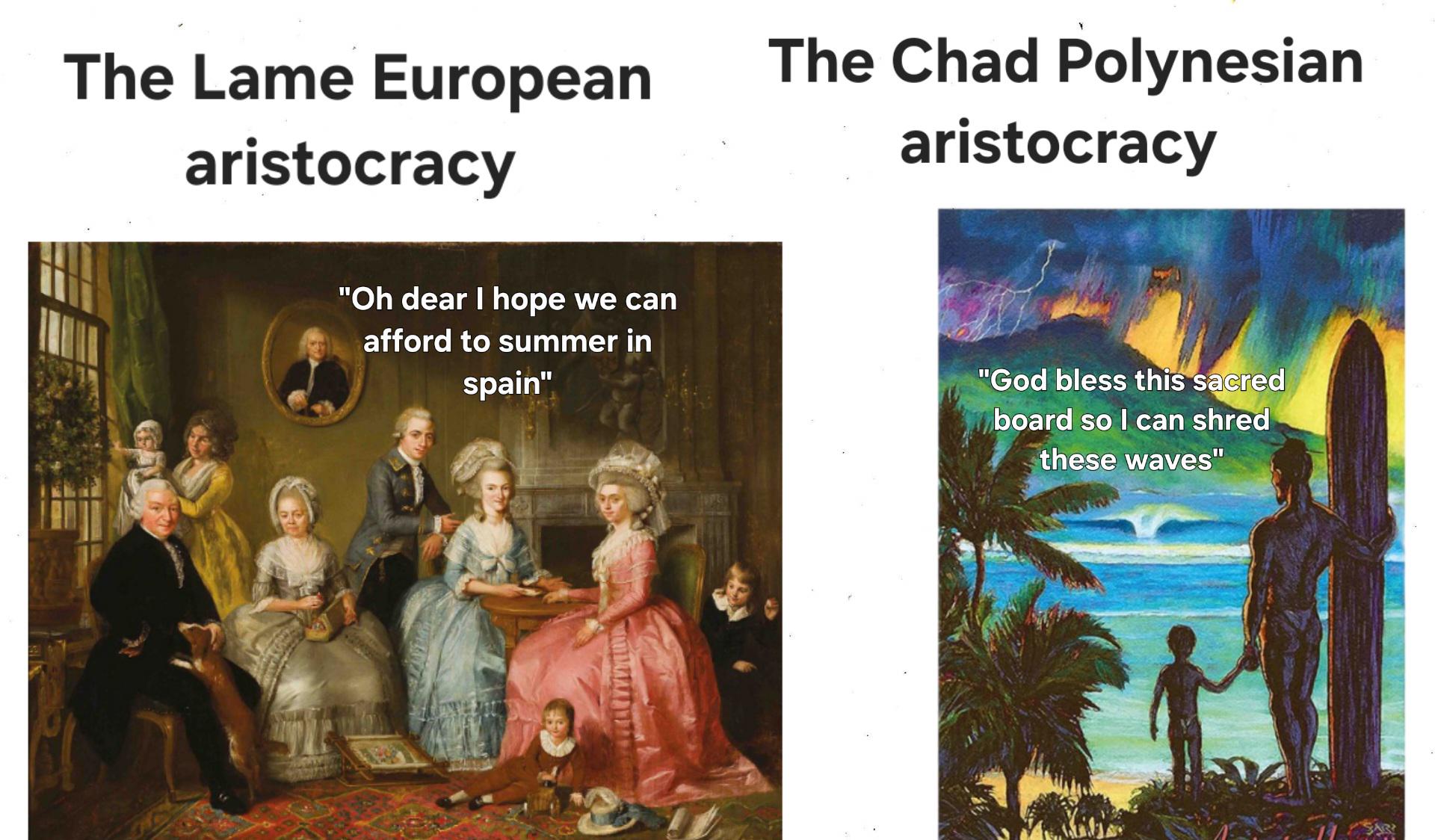
One is an aristocracy held by familial ties, a culture of patronage, but also political turbulence.
The other is OCEAN MAN.
Salty_Strain3313 on
Context: Surfing was a central part of [Polynesian culture](https://en.wikipedia.org/wiki/Polynesian_culture) predating European contact. The chief (Ali’i) was traditionally the most skilled wave rider in the community with the best board made from the best wood. The ruling class had the best beaches and the best boards, and the commoners were not allowed on the same beaches, but they could gain prestige by their ability to ride the surf on their boards.
In Tahiti and Samoa, surfing was a popular pastime that was often used as part of warriors’ training. Warriors often paddled to surf breaks and were recorded in print by early European historians as spending many hours bravely paddling head-on into large surf and riding waves. Canoes often accompanied surfing parties and the men would often swap between canoeing and paddling boards, and then catch fish after their recreational activities. In Hawai’i, surfing became ingrained into the very fabric of Hawaii’an religion and culture.
Hawaiians referred to this art as *heʻe nalu* which translates into [English](https://en.wikipedia.org/wiki/English_language) as “wave sliding.”[^([10])](https://en.wikipedia.org/wiki/History_of_surfing#cite_note-10) The art began before entering the mysterious ocean as the Hawaiians prayed to the gods for protection and strength to undertake the powerful mystifying ocean. If the ocean was tamed, frustrated surfers would call upon the [*kahuna*](https://en.wikipedia.org/wiki/Kahuna) (priest), who would aid them in a surfing prayer asking the gods to deliver great surf. Prior to entering the ocean, the priest would also aid the surfers (mainly of the upper class) in undertaking the spiritual ceremony of constructing a surfboard.
Hawaiians would carefully select one of three types of trees. The trees included the *koa* ([*Acacia koa*](https://en.wikipedia.org/wiki/Acacia_koa)), *ʻulu* ([*Artocarpus altilis*](https://en.wikipedia.org/wiki/Breadfruit)), and [*wiliwili*](https://en.wikipedia.org/wiki/Wiliwili) (*Erythrina sandwicensis*) trees. Once selected, the surfer would dig the tree out and place fish in the hole as an offering to the gods. Selected craftsmen of the community were then hired to shape, stain, and prepare the board for the surfer. There were three primary shapes: the *ʻolo*, *kikoʻo*, and the [*alaia*](https://en.wikipedia.org/wiki/Alaia). The *ʻolo* is thick in the middle and gradually gets thinner towards the edges. The *kikoʻo* ranges in length from 370 to 550 cm (12 to 18 ft) and requires great skill to maneuver. The *alaia* board is around 275 cm (9 ft) long and requires great skill to ride and master. Aside from the preparatory stages prior to entering the water, the most skilled surfers were often of the upper class including chiefs and warriors that surfed amongst the best waves on the island. These upper-class Hawaiians gained respect through their enduring ability to master the waves and this art the Hawaiians referred to as surfing.[^([11])](https://en.wikipedia.org/wiki/History_of_surfing#cite_note-11) Some ancient sites still popular today include [Kahaluʻu Bay](https://en.wikipedia.org/wiki/Kahaluu_Bay) and [Holualoa Bay](https://en.wikipedia.org/wiki/Holualoa_Bay).[^([12])](https://en.wikipedia.org/wiki/History_of_surfing#cite_note-12)
Polynesia is one of my favorite cultures, I love how they were able to thrive on tiny islands and even invent a writing system (rongorongo)! I wish we knew more about pre-colonization Polynesia! 🙂
McGillis_is_a_Char on
Presumably when the European aristocrats went to Spain they fetched their bathers, but I can’t imagine them shredding on a huge wave. Now I want a video game where you have a surfing contest with assorted historical kings and aristocrats though.
GaBeRockKing on
I think the equivalent for northern eurasians was horseback riding. Rich people just love going fast.
xellos_rj on
“ugh being the king’s master of hunt sucks” x “With my outrigger boat, I shall find and island and become king myself” easiest choice

7 Comments
One is an aristocracy held by familial ties, a culture of patronage, but also political turbulence.
The other is OCEAN MAN.
Context: Surfing was a central part of [Polynesian culture](https://en.wikipedia.org/wiki/Polynesian_culture) predating European contact. The chief (Ali’i) was traditionally the most skilled wave rider in the community with the best board made from the best wood. The ruling class had the best beaches and the best boards, and the commoners were not allowed on the same beaches, but they could gain prestige by their ability to ride the surf on their boards.
In Tahiti and Samoa, surfing was a popular pastime that was often used as part of warriors’ training. Warriors often paddled to surf breaks and were recorded in print by early European historians as spending many hours bravely paddling head-on into large surf and riding waves. Canoes often accompanied surfing parties and the men would often swap between canoeing and paddling boards, and then catch fish after their recreational activities. In Hawai’i, surfing became ingrained into the very fabric of Hawaii’an religion and culture.
Hawaiians referred to this art as *heʻe nalu* which translates into [English](https://en.wikipedia.org/wiki/English_language) as “wave sliding.”[^([10])](https://en.wikipedia.org/wiki/History_of_surfing#cite_note-10) The art began before entering the mysterious ocean as the Hawaiians prayed to the gods for protection and strength to undertake the powerful mystifying ocean. If the ocean was tamed, frustrated surfers would call upon the [*kahuna*](https://en.wikipedia.org/wiki/Kahuna) (priest), who would aid them in a surfing prayer asking the gods to deliver great surf. Prior to entering the ocean, the priest would also aid the surfers (mainly of the upper class) in undertaking the spiritual ceremony of constructing a surfboard.
Hawaiians would carefully select one of three types of trees. The trees included the *koa* ([*Acacia koa*](https://en.wikipedia.org/wiki/Acacia_koa)), *ʻulu* ([*Artocarpus altilis*](https://en.wikipedia.org/wiki/Breadfruit)), and [*wiliwili*](https://en.wikipedia.org/wiki/Wiliwili) (*Erythrina sandwicensis*) trees. Once selected, the surfer would dig the tree out and place fish in the hole as an offering to the gods. Selected craftsmen of the community were then hired to shape, stain, and prepare the board for the surfer. There were three primary shapes: the *ʻolo*, *kikoʻo*, and the [*alaia*](https://en.wikipedia.org/wiki/Alaia). The *ʻolo* is thick in the middle and gradually gets thinner towards the edges. The *kikoʻo* ranges in length from 370 to 550 cm (12 to 18 ft) and requires great skill to maneuver. The *alaia* board is around 275 cm (9 ft) long and requires great skill to ride and master. Aside from the preparatory stages prior to entering the water, the most skilled surfers were often of the upper class including chiefs and warriors that surfed amongst the best waves on the island. These upper-class Hawaiians gained respect through their enduring ability to master the waves and this art the Hawaiians referred to as surfing.[^([11])](https://en.wikipedia.org/wiki/History_of_surfing#cite_note-11) Some ancient sites still popular today include [Kahaluʻu Bay](https://en.wikipedia.org/wiki/Kahaluu_Bay) and [Holualoa Bay](https://en.wikipedia.org/wiki/Holualoa_Bay).[^([12])](https://en.wikipedia.org/wiki/History_of_surfing#cite_note-12)
[https://en.wikipedia.org/wiki/History_of_surfing](https://en.wikipedia.org/wiki/History_of_surfing)
The Polynesian aristocracy
Polynesia is one of my favorite cultures, I love how they were able to thrive on tiny islands and even invent a writing system (rongorongo)! I wish we knew more about pre-colonization Polynesia! 🙂
Presumably when the European aristocrats went to Spain they fetched their bathers, but I can’t imagine them shredding on a huge wave. Now I want a video game where you have a surfing contest with assorted historical kings and aristocrats though.
I think the equivalent for northern eurasians was horseback riding. Rich people just love going fast.
“ugh being the king’s master of hunt sucks” x “With my outrigger boat, I shall find and island and become king myself” easiest choice